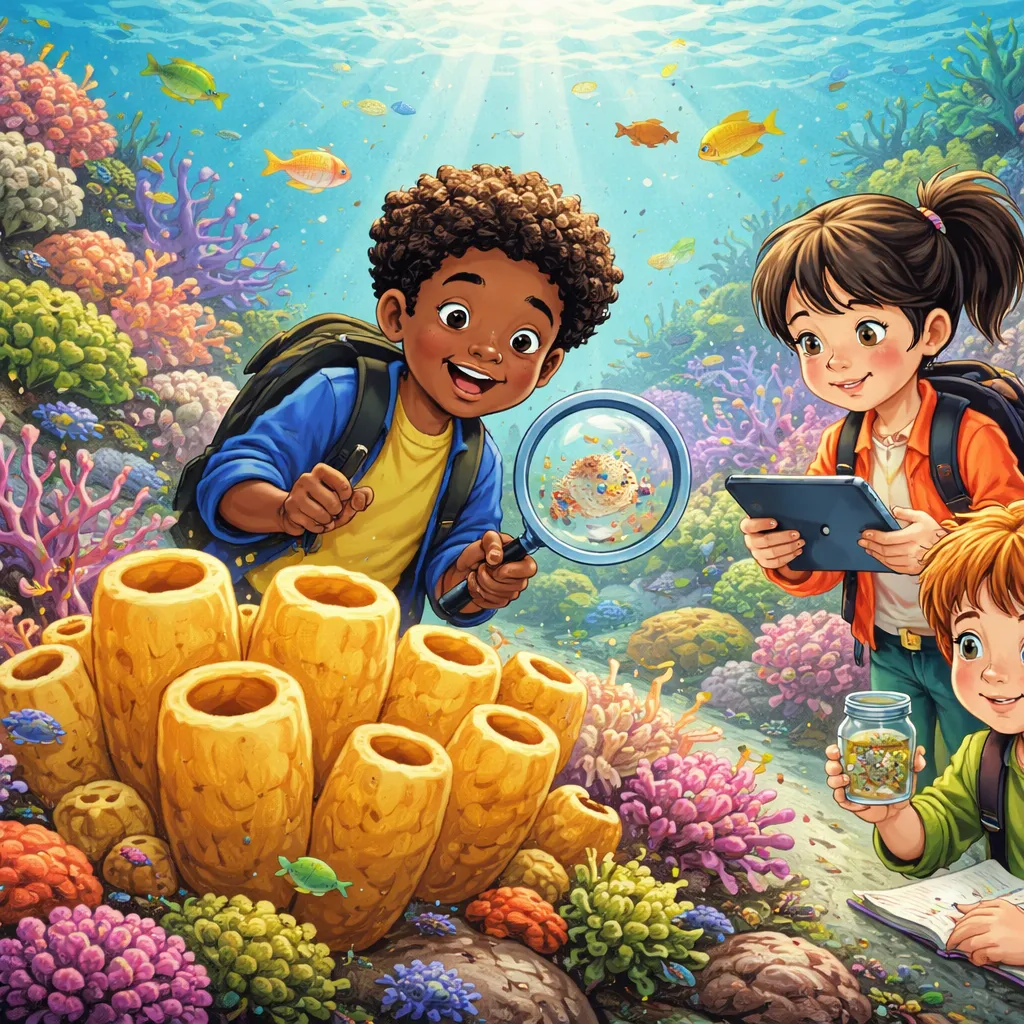

Some animals have brains. Some have muscles. The sponge has neither. It is one of the simplest animals on Earth. Yet it has survived for over 600 million years. For children, learning about Sponge opens a window to the very beginnings of animal life. Parents and children can explore this ancient creature together. No microscope is needed. Just curiosity about an animal that does not look like an animal at all.
The sponge lives attached to the ocean floor. It does not move. It does not hunt. But it is very much alive. Let us begin our discovery.
What Is This Animal? A sponge is a simple animal that lives in water. Its body is soft and full of holes. These holes are pores. Water flows in through the pores. Water flows out through a larger opening. Inside the sponge, tiny cells filter food from the water.
Sponges come in many shapes. Some look like tubes. Some look like fans. Some look like crusty layers on rocks. They can be bright colors or dull browns. They grow on reefs, rocks, and the ocean floor.
Children often find sponges puzzling. They look like plants. They feel like soft corals. But they are animals. Learning about Sponge becomes an exploration of what makes something an animal.
English Learning About This Animal Let us begin with the word “sponge.” It is pronounced /spʌndʒ/. Say it with your child: sp-uh-nj. One syllable. The “o” makes a short “u” sound. The “nge” sounds like the end of “hinge.” The word comes from ancient Greek and Latin roots meaning “sponge” itself.
When learning about Sponge in English, we meet words about filtering and simplicity. Here are a few to share.
Pore – a tiny opening in the sponge’s body.
Filter – to remove particles from water or air.
Osculum – the large opening where water exits.
Regenerate – to grow back lost parts.
Use these words in simple sentences. “Water enters the sponge through pores.” “The osculum is the exit.” These sentences help children understand the sponge’s simple design.
Here is a proverb that fits the sponge. “Still waters run deep.” Sponges do not move. They stay in one place. Yet they filter gallons of water each day. This teaches children that quiet, still beings can do important work.
Another meaningful thought comes from naturalist John Muir. He said, “When we try to pick out anything by itself, we find it hitched to everything else in the universe.” Sponges connect to the water, the reef, and the creatures that live on them. This reminds children that everything is connected.
Animal Facts and Science Knowledge Sponges belong to the phylum Porifera. The name means “pore-bearer.” Sponges are among the simplest multicellular animals. They have no tissues, no organs, no nervous system. Their bodies are made of specialized cells that work together.
There are over 8,000 species of sponges. Most live in the ocean. Some live in freshwater. They live from shallow tide pools to the deep seafloor. Sponges come in many sizes. Some are smaller than a fingernail. Some grow larger than a person.
Sponges feed by filtering water. A single sponge can filter thousands of times its own volume of water each day. Water flows in through pores. Special cells called choanocytes trap tiny food particles. These cells have flagella that create the water current. The sponge absorbs nutrients and releases clean water.
Sponges have remarkable regeneration abilities. If you cut a sponge into pieces, each piece can grow into a new sponge. Scientists use this ability to study how cells work together. This regeneration has fascinated biologists for centuries.
Many animals live on or in sponges. Tiny shrimp, worms, and crabs make their homes inside sponge cavities. Sponges provide shelter in exchange for nothing. They are living apartment buildings for other creatures.
Some sponges produce chemical defenses. These chemicals deter predators. Scientists study sponge chemicals for potential medicines. Some sponge compounds show promise in treating diseases.
How to Interact With This Animal Safely Sponges are living animals. They are fragile. If you see sponges in tide pools or while snorkeling, do not touch them. Do not pull them off rocks. Their bodies can tear easily. A torn sponge may die.
Some sponges have sharp spicules in their bodies. These are tiny glass-like structures that give the sponge shape. Touching certain sponges can cause skin irritation. Always observe without touching.
If your family collects shells or explores the shore, leave sponges where they are. Do not collect live sponges. Dead sponge skeletons sometimes wash ashore. These natural sponge skeletons are safe to handle. But always check that no living sponge remains.
In public aquariums, you may see sponges in exhibits. Observe from a distance. Do not tap the glass. Sponges are sensitive to changes in their environment.
Never use natural sponges from the ocean for cleaning without knowing their source. Some sponges are sustainably harvested. Others are taken from reefs. Teach children to choose eco-friendly products when possible.
What Can We Learn From This Animal Sponges teach us that simplicity works. They have no brain, no heart, no muscles. Yet they have survived for hundreds of millions of years. Children can learn that you do not need to be complex to thrive. Simplicity has its own strength.
Sponges also show us the power of filtering. They clean the water around them. They remove particles and return clean water. Children can learn that they can be filters too. Kindness, honesty, and helpfulness clean the spaces around them.
Another lesson is regeneration. Sponges grow back from small pieces. They do not give up. Children can learn that setbacks are not endings. You can rebuild. You can heal. You can start again.
Sponges teach us about home. They provide shelter for countless small creatures. Children can learn that creating safe spaces for others is important. A welcoming home, a listening ear, a helping hand—these are gifts.
Fun Learning Activities Turn learning about Sponge into hands-on discovery. Here are a few simple ideas.
Make a Pore Craft Cut a sponge shape from paper. Let your child poke small holes in it with a pencil. Explain that water flows through these pores. Talk about how sponges filter food.
Create a Filter Experiment Place a cup of water with a few crumbs or pepper flakes. Slowly pour it through a clean kitchen sponge into another cup. See what the sponge catches. Explain that real sponges filter tiny food from water.
Write a Still Story Ask your child to imagine being a sponge attached to a rock. You never move. But water flows through you all day. What do you feel? What do you see? Write or draw the story together. Use new words like pore, osculum, and filter.
Play the Regeneration Game Cut a paper sponge shape into several pieces. Ask your child to put the pieces together. Explain that real sponges can grow from pieces. This puzzle activity builds understanding.
Watch and Wonder Find a short video of sponges filtering water or tiny creatures living inside sponges. Watch together. Pause and ask open questions. “What do you notice about the water flow?” “Why do you think animals live inside sponges?” Let your child share observations freely.
Learning about Sponge takes us to the quiet world of the seafloor. It is a world of simple animals that filter water and provide homes. Sponges have no eyes, no ears, no brain. Yet they thrive. They clean. They shelter others. They regenerate. As parents and children explore together, they build language, knowledge, and a shared appreciation for life in its simplest form. The sponge sits on a rock, water flowing through its pores, tiny shrimp hiding inside. And in that stillness, young learners discover something beautiful—that you do not need to be complex to matter. Sometimes the simplest creatures do the most essential work of all.