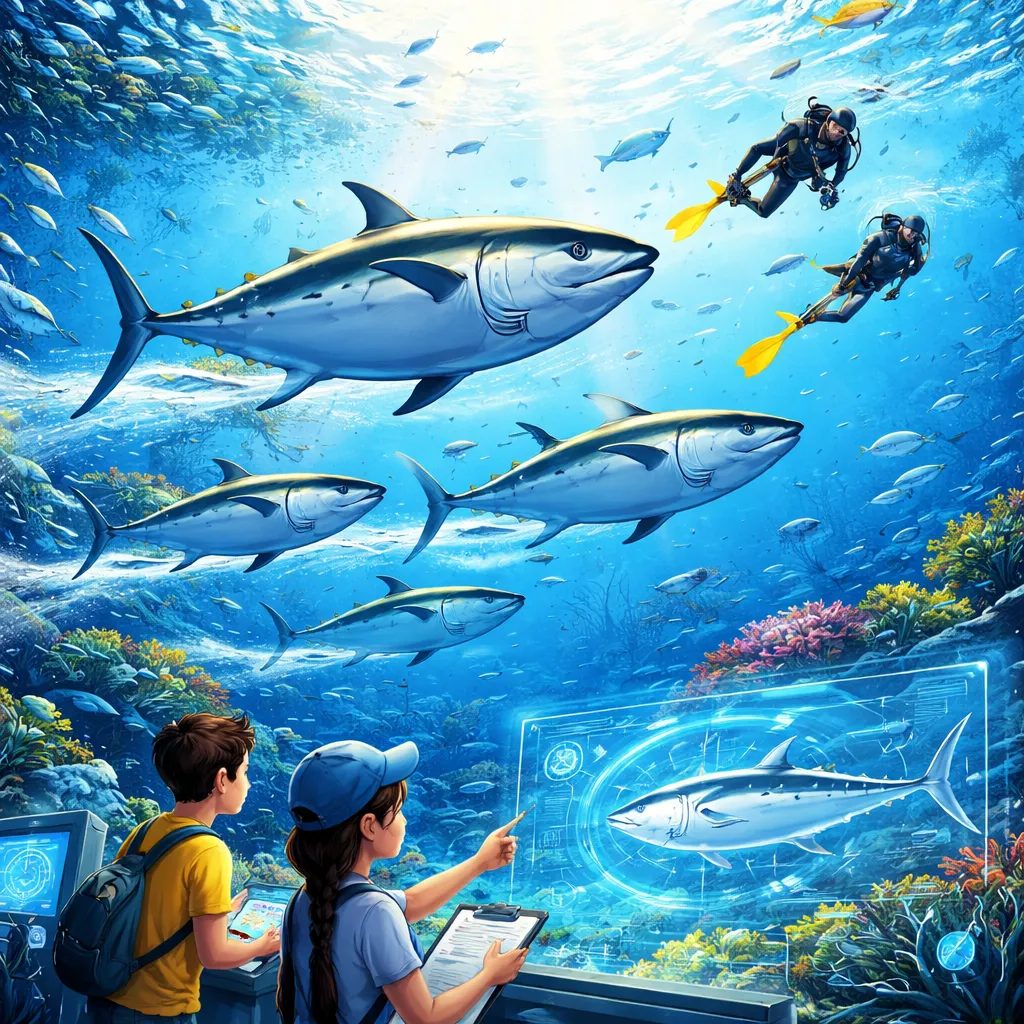

Some fish drift with the current. Others hide among rocks. The tuna does neither. It cuts through the open ocean with powerful speed. It never stops moving. For children, learning about Tuna reveals a world of constant motion, strength, and teamwork. Parents and children can explore this remarkable fish together. No diving gear is needed. Just curiosity and a sense of wonder.
The tuna is not a small fish. It grows large. It swims fast. It travels across entire oceans. Let us begin our journey into the life of this ocean athlete.
What Is This Animal?
A tuna is a large, muscular fish with a sleek body. Its shape is built for speed. The body tapers at both ends. This torpedo shape cuts through water with little resistance. Tuna have metallic blue backs and silver bellies. This coloring helps them blend in. From above, the blue blends with the deep ocean. From below, the silver matches the bright surface.
Tuna live in warm ocean waters around the world. They are constantly swimming. Unlike many fish, tuna cannot stop. They must keep moving to breathe. Water flows over their gills only when they swim. This constant motion defines their lives.
Children often find tuna fascinating because of their size and speed. Some tuna grow heavier than a grown adult. They swim faster than most fish in the sea. Learning about Tuna becomes an exploration of power and endurance.
English Learning About This Animal
Let us begin with the word “tuna.” It is pronounced /ˈtuːnə/. The first part sounds like “too.” The second part sounds like “nuh.” Say it together: too-nuh. It is a simple, two-syllable word. Children can practice by clapping once for each part.
When learning about Tuna in English, we encounter strong, active words. Here are a few to share.
Streamlined – shaped to move smoothly through water or air.
School – a large group of fish swimming together.
Predator – an animal that hunts other animals for food.
Endurance – the ability to keep going for a long time.
Use these words in short sentences. “Tuna have streamlined bodies.” “They swim in large schools.” These sentences are easy to remember. They build vocabulary naturally.
Here is a proverb that connects to the tuna. “Slow and steady wins the race.” Tuna are not slow. But they show steady endurance. They cross entire oceans without stopping. This reminds children that persistence matters. Speed alone is not enough. Consistency carries you far.
Another meaningful line comes from explorer Jacques Cousteau. He said, “The sea, once it casts its spell, holds one in its net of wonder forever.” Tuna live deep in that spell. Learning about them invites children to feel that same wonder for the vast ocean.
Animal Facts and Science Knowledge
Tuna are bony fish. They belong to the family Scombridae. Their relatives include mackerel and bonito. There are several species. The bluefin tuna is the largest. It can grow over ten feet long. It can weigh more than 1,500 pounds. The skipjack tuna is smaller and more common.
Tuna are warm-blooded. Most fish are cold-blooded. Their body temperature matches the water. Tuna can keep their bodies warmer than the surrounding water. This adaptation allows them to swim in cold depths and warm surface waters. It also gives them incredible speed. Some tuna swim up to 50 miles per hour.
Tuna are always moving. They swim day and night. They never rest completely. They need constant water flow over their gills to breathe. This makes them some of the most active fish in the ocean.
Tuna eat smaller fish, squid, and crustaceans. They hunt in schools. Swimming together helps them find food and avoid predators. Their eyes are large. They rely on sharp vision to hunt in the open ocean.
Tuna travel long distances. Some populations cross entire oceans. They follow warm water and food sources. Scientists track their migrations with tags. These journeys show how connected the world’s oceans are.
How to Interact With This Animal Safely
Tuna are wild ocean fish. Most people never see them in the wild unless on a boat. If your family goes on a fishing trip, follow the captain’s guidance. Tuna are strong fish. They fight when caught. Leave the handling to experienced adults.
If you see tuna while snorkeling or diving, keep a respectful distance. Do not chase them. Do not try to touch them. They are wild predators. They are not aggressive toward humans, but sudden movements can startle them. Watching calmly from a distance is best.
For most families, interaction with tuna happens through food. Tuna is a common fish in many meals. Talk to children about where tuna comes from. Explain that some tuna populations face challenges from overfishing. Choosing sustainably caught tuna supports healthy oceans. Look for labels like “pole and line” or “MSC certified.”
Teaching children about responsible choices builds awareness. They learn that our daily decisions affect animals far away. Even small choices, like which can of tuna to buy, matter.
What Can We Learn From This Animal
Tuna teach us about constant effort. They never stop swimming. Rest does not mean stopping. For tuna, rest is still movement. Children can learn that keeping going, even slowly, builds strength. You do not need to be the fastest. You just need to keep moving forward.
Tuna also show the power of teamwork. They swim in schools. They hunt together. This cooperation helps them survive. Children can learn that working with others makes big challenges easier. Sharing, helping, and staying together are powerful habits.
Another lesson is adaptation. Tuna have special abilities to stay warm in cold water. They adapted to thrive in a wide range of ocean depths. This teaches children that we can adapt too. New places, new situations, and new challenges become manageable when we use our strengths.
Tuna also remind us of the vastness of the ocean. They travel thousands of miles. Their world is huge. This can inspire children to think beyond their immediate surroundings. Curiosity about distant places and animals is a wonderful gift.
Fun Learning Activities
Turn learning about Tuna into active play. Here are a few simple ideas.
Make a Streamlined Fish
Draw a tuna shape on paper. Cut it out. Let your child decorate it with metallic colors. Talk about why the shape is smooth and pointed. Compare it to a toy car or a rocket. Discuss how shape affects movement.
Create a School of Fish
Cut out several fish shapes. Tape them to straws or sticks. Let your child move them together in a group. Explain that tuna swim in schools for safety and teamwork. Use words like together, strong, and protect.
Write a Travel Story
Ask your child to imagine being a tuna crossing the ocean. What does it see? What does it eat? Where does it go? Draw or write the journey together. Use new vocabulary like streamlined, school, and endurance.
Race Like a Tuna
Go outside and run a short race. Then run a longer, slower race. Talk about the difference between speed and endurance. Explain that tuna have both. They can sprint fast and swim far. Ask your child which type of movement they enjoy.
Watch and Wonder
Find a short video of tuna swimming in the open ocean. Watch together. Pause and ask open questions. “What do you notice about how they move?” “Why do you think they stay in a group?” Let your child share thoughts freely. This builds observation and language skills.
Learning about Tuna takes us into the open ocean. It is a world of constant motion, where fish never stop swimming. This powerful fish teaches children about speed, teamwork, and persistence. As parents and children explore together, they build language, knowledge, and a shared appreciation for the ocean’s athletes. The tuna glides through blue water, steady and strong. And in that endless swim, young learners find a lesson worth remembering—keep moving, keep trying, and you will go farther than you imagine.