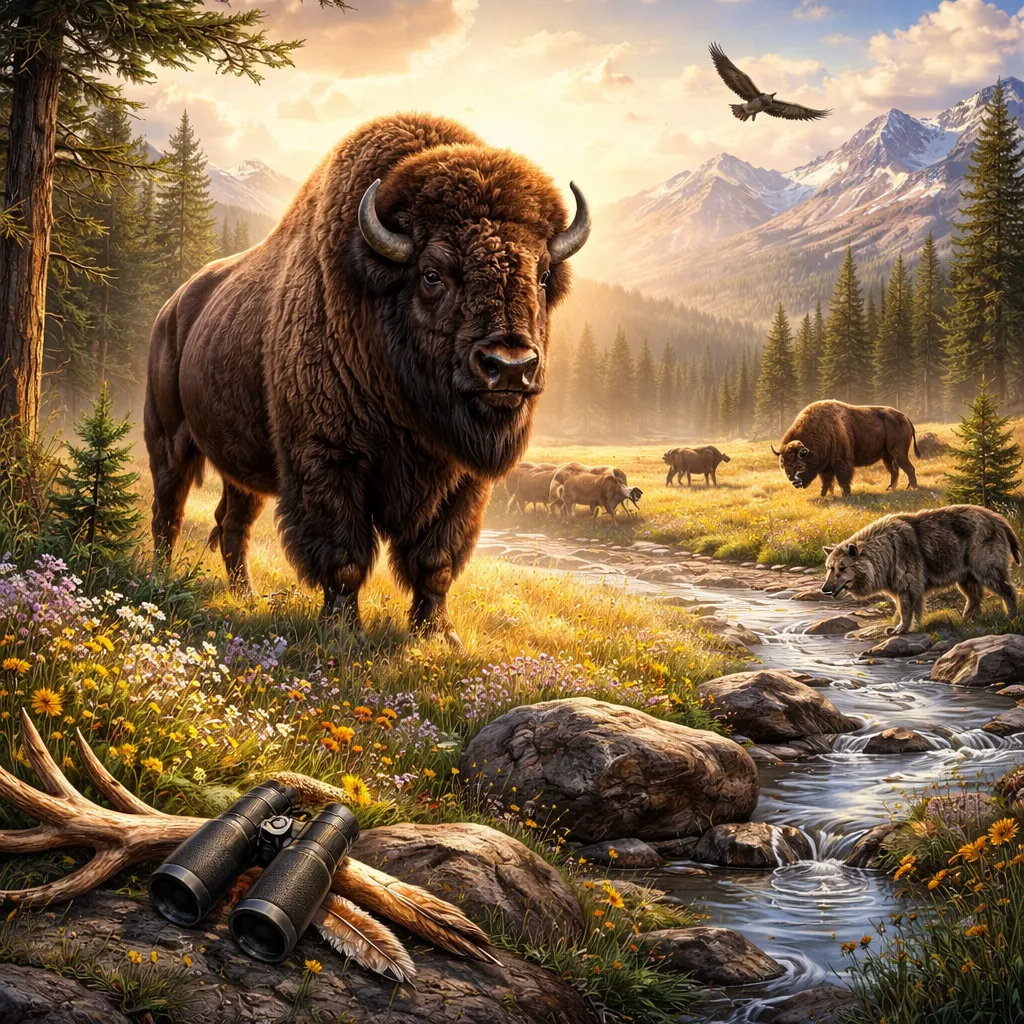

Have you ever seen a picture of a huge, shaggy bison roaming a wide, open plain? With its massive head, powerful shoulders, and curved horns, the bison is a true icon of North America. It is a story of survival, strength, and the importance of wild spaces. Learning about bison takes us on an adventure to the great grasslands and teaches us about resilience. Let’s begin our journey of learning about bison power and history.
English Language Learning
Vocabulary and Spelling Our powerful grassland friend is called a bison. The word "bison" is a noun. A noun names a person, place, or thing. So, a bison is a thing—a large, living animal. Spelling "bison" is straightforward: B-I-S-O-N. The 'B' starts the word. The 'I' and 'S' are in the middle, and it ends with 'O-N'. B-I-S-O-N spells bison. The plural of bison is also bison!
Sound and Pronunciation Let’s say the word correctly. It sounds like this: /ˈbaɪ.sən/. We can say it in two clear parts. First, say "by". It rhymes with "my" or "sky". Next, say "sən". It’s a soft, quick sound, like the end of "lesson". Now, put it together! "By" "sən". Bison! Great job! The word "bison" has two beats, or two syllables. Clap your hands twice: Bi-son. It’s a strong, solid word.
Related Words Learning about bison is more fun with new words! Here are some important ones. Body Part: The big, muscular mound on a bison’s shoulders is called a hump. The curved, sharp horns on its head are used for protection. Group: A group of bison is called a herd. They travel, eat, and protect each other. Action: Bison love to wallow in dust or mud. This helps protect their skin from bugs and keeps them cool.
A Famous Saying There is a common phrase that shows their importance: "The American bison is a national mammal." In 2016, the bison was named the national mammal of the United States. This is a great honor that reminds us how special and important this animal is to the country’s history and nature. Say the fact with me: "The American bison is a national mammal." It’s a title of respect!
Now you know the word "bison"! Are you ready to gallop into some amazing facts? Let’s run from words to wonderful knowledge!
Animal Knowledge
Who Are They? – Family and Group What kind of animal is a bison? Bison are mammals. They have hair, are warm-blooded, and mother bison feed their babies milk. They are part of the bovine family. Their close relatives are cattle, like cows. There are two species: the American Bison and the European Bison. They are the largest land animal in North America.
What Do They Look Like? – Amazing Bodies Bison are enormous! They can be as heavy as a small car. They have a large head, a big hump on their shoulders, and two short, curved horns. Their body is covered in thick, shaggy brown fur. Their most famous feature is their hump. It is a large muscle that helps them swing their massive head to clear snow in winter to find grass. Their thick, shaggy coat keeps them warm in freezing winters. Bison have special adaptations. They have excellent senses of smell and hearing. Their sharp hooves help them dig for food and run on rough ground. They are very strong and can run up to 35 miles per hour!
Where Do They Live and How? – Home and Habits Bison live in North America and parts of Europe. Their home is the grasslands, prairies, and open plains. Some also live in forests. They need wide-open spaces to roam and graze. Bison are herbivores. This means they only eat plants. They are grazers, so they eat grasses and sedges. They spend most of their day slowly moving and eating grass. Bison are very social and live in herds. Herds provide safety. The herd is often led by older females. They are most active during the day. They spend their time grazing, resting, and caring for their young.
A Bison’s Life Story – Growing Up A baby bison is called a calf. Bison are mammals, so calves are born live from their mother. A mother bison usually has one calf at a time. The mother bison is very protective. The calf can stand and walk within a few hours of birth. The mother feeds it milk and the herd helps protect the calf from wolves or other dangers. Calves are born with a reddish-brown coat. They stay close to their mothers. They grow quickly and start eating grass when they are a few weeks old. A bison becomes an adult at about three years old.
How Do They "Talk"? – Communication Bison talk with sounds and body language. They grunt, snort, and bellow. Each sound can mean something different, like a warning or a call to the herd. They use their bodies to show how they feel. A bison might shake its head or paw the ground if it is upset. They also communicate by the way they stand in the herd. Their best senses are their amazing sense of smell and hearing. They can smell water and danger from far away. Their ears are always moving to catch every sound.
Are They Okay? – Taking Care of Them Bison were once almost extinct because of overhunting and loss of land. Thanks to huge conservation efforts, they are no longer endangered, but they are still near threatened and need protected spaces. The main threats were hunting and people taking their prairie homes for farms and cities. Now, the big job is to protect and restore the grassland habitats they need. You can be a bison friend! You can learn and tell others about their amazing comeback story. You can support national parks and groups that protect prairie lands. Choosing to recycle and save paper helps protect forests and wild places for all animals.
Life Connections and Inspiration
How to Be With Them – Safety and Love Bison are wild, powerful animals. We must always admire them from a very safe and respectful distance. The most important rule is: Stay far away. In national parks, you must stay in your car or at least 75 feet away. Never try to touch, feed, or get close to a bison. They can charge very fast and are stronger than they look. We watch them with binoculars or from our car windows. We show our love by protecting the wide, open prairies that are their true home. We can be voices for wild spaces and the animals that live there.
Super Qualities We Learn from Them Bison teach us incredible lessons. One super quality is strength and resilience. Bison survived near extinction and are making a comeback. They teach us to be strong, to never give up, and to keep going even when things are very hard. Another quality is the power of the herd. Bison are safer and stronger together. They protect each other and their young. This reminds us of the importance of family, community, and working together to overcome challenges. Think about it: How can you show resilience when something is difficult? How can you be a good member of your own "herd" at home, school, or in your community?
Take Action! – Your "Bison Herd" Project Let’s do a fun and strong activity! Your project is to create a moving bison herd picture. On a long piece of paper, draw a wide prairie with grass and hills. Then, on a separate piece of paper, draw and color several bison. Cut them out. Arrange your bison cut-outs on the prairie to look like a herd on the move. Are the calves in the middle for safety? Are the adults watching the edges? You can use tape to stick them down or leave them loose to move. Tell a story about where your herd is going. What are they looking for? Fresh grass? Water? Your picture shows their journey and unity.
Closing Learning about bison strength is a powerful adventure! We learned the word "bison" and how to say its two-part name. We discovered amazing facts about their shaggy coats, their protective herds, and their amazing comeback story. We know that bison are resilient, social animals who need our help to protect their prairie homes. You can use your new words to share the history of these majestic creatures. You can use your knowledge to appreciate the importance of conservation and community. The animal world is full of strong and resilient teachers. Always remember to respect wildlife from a safe distance, be resilient in your own life, and value the strength of your community. Keep exploring with curiosity, stand strong for what you believe in, and be a protector of wild places. Your caring actions and strong spirit make you a true friend to the mighty bison.