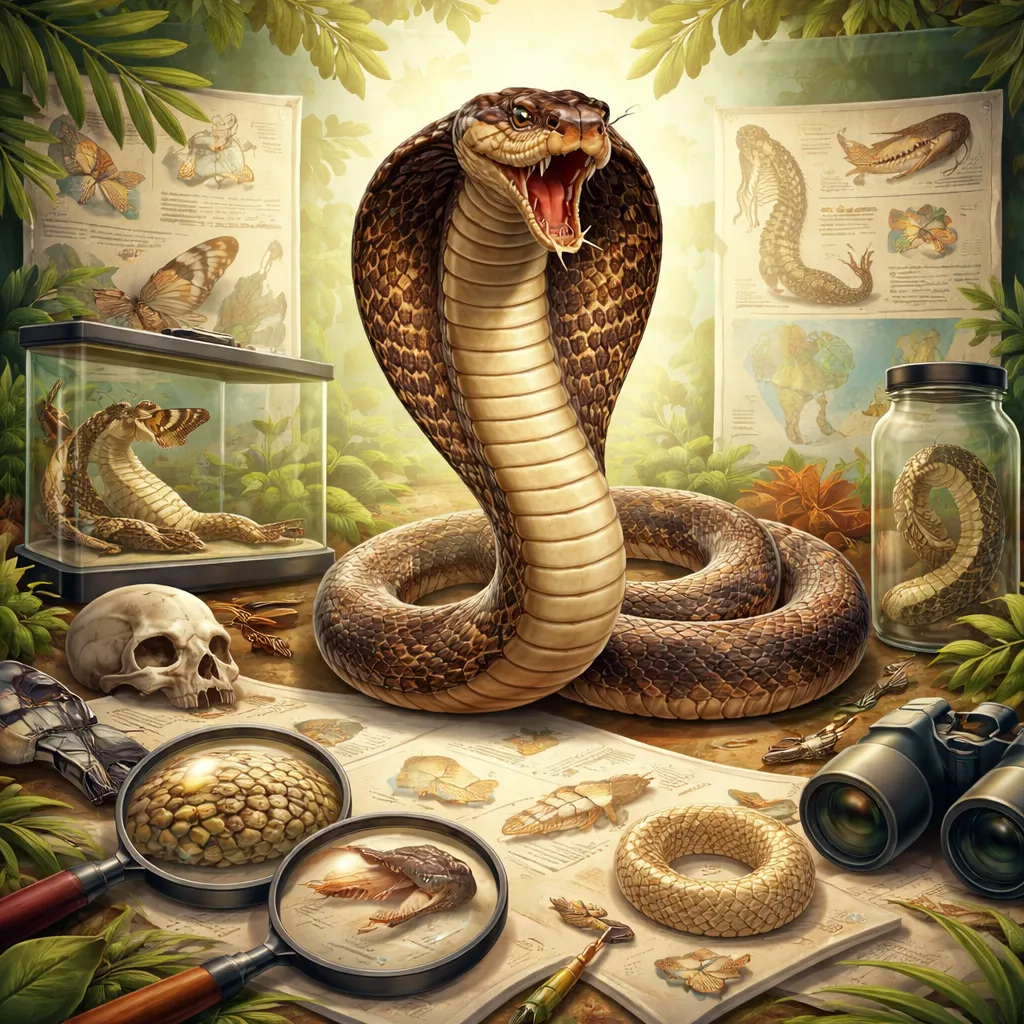

Imagine you’re watching a nature show and you see a snake rise up, spread a wide, flat hood around its neck, and stare intently. This powerful and dramatic pose is the signature of the cobra! These snakes are famous and often misunderstood. Learning about cobras is a thrilling adventure that teaches us about respect, caution, and the beauty of these remarkable reptiles. Let’s begin our journey of learning about cobra power and their place in the world.
English Language Learning
Vocabulary and Spelling Our iconic, hooded friend is called a cobra. The word "cobra" is a noun. A noun names a person, place, or thing. So, a cobra is a thing—a living, venomous snake. Spelling "cobra" is short: C-O-B-R-A. The 'C' starts the word, the 'O' and 'B' are in the middle, and it ends with 'R-A'. C-O-B-R-A spells cobra.
Sound and Pronunciation Let’s say the word correctly. It sounds like this: /ˈkoʊ.brə/. We can say it in two clear parts. First, say "co". It rhymes with "go". Next, say "bra". It sounds like the undergarment, "bra". Now, put it together! "Co" "bra". Cobra! Great! The word "cobra" has two beats, or two syllables. Clap your hands twice: Co-bra. It’s a short, striking word.
Related Words Learning about cobras is more fun with new words! Here are some important ones. Body Part: The expandable flap of skin on a cobra’s neck is its hood. A baby cobra is a hatchling or snakelet. Defense: The poison a cobra uses is called venom. Action: The way a cobra stands up is called hooding or rising.
A Famous Idea Because of its dramatic hood, people sometimes say: "Spreading its hood like a cobra." This describes someone making themselves look bigger or more impressive to show they are serious or defensive. It comes from the cobra’s warning display. It reminds us that body language is a powerful way to communicate. Say the idea with me: "Spreading its hood like a cobra." It’s about making a strong, clear statement.
Now you know the word "cobra"! Are you ready to learn about these majestic snakes? Let’s move from words to wonderful knowledge!
Animal Knowledge
Who Are They? – Family and Group What kind of animal is a cobra? Cobras are reptiles. They are a type of snake. They are cold-blooded, have scaly skin, and lay eggs. They belong to the Elapidae family. The most famous types are the Indian Cobra, the King Cobra, and the Egyptian Cobra. They are venomous snakes, which means they have poison (venom) to defend themselves and hunt.
What Do They Look Like? – Amazing Bodies Cobras are long, slender snakes. They can be brown, black, yellow, or even have spectacled marks. Their most famous feature is their expandable hood. When scared or threatened, they spread the ribs in their neck to create a wide, intimidating hood. Their body is designed for defense and hunting! Their hood makes them look bigger to scare away enemies. They have fixed, hollow fangs in the front of their mouth to deliver venom. The King Cobra is the longest venomous snake in the world. Cobras have special adaptations. They have excellent eyesight for a snake. They are also very intelligent. Their venom is a powerful tool that affects the nervous system of their prey. They are agile and can move quickly.
Where Do They Live and How? – Home and Habits Cobras live in warm parts of the Old World. Their homes are jungles, plains, forests, and near villages in Africa and Asia. Some species can even be found in deserts. Cobras are carnivores. This means they are meat-eaters. They eat rodents, birds, eggs, and other snakes (especially the King Cobra). They are skilled hunters, using their venom to quickly subdue their prey before eating it whole. Cobras are usually solitary. They are active during the day or at dusk. They spend their time hunting, basking, and hiding in termite mounds, rock piles, or old logs. A group of cobras is called a quiver.
A Cobra’s Life Story – Growing Up A baby cobra is called a hatchling or snakelet. Cobras are reptiles, so hatchlings hatch from eggs. A mother cobra lays 10 to 30 eggs in a hidden nest. The mother cobra of some species, like the King Cobra, is a dedicated parent! She builds a nest of leaves and stays nearby to guard the eggs until they hatch. This is very unusual snake behavior. Hatchlings are born fully independent, with venom and the instinct to hunt. They are as dangerous as adults from the moment they hatch. They grow by shedding their skin. It takes several years for a cobra to become an adult. They can live for about 20 years.
How Do They "Talk"? – Communication Cobras are not loud, but they are clear communicators. They can produce a low hiss. Some, like the Egyptian Cobra, are known as "asp" snakes and can hiss loudly. Their most famous "talk" is their body language. Hooding, rising up, and swaying are all powerful warnings that say, "I am here, I am dangerous, stay back!" They would rather warn and escape than fight. Their best senses are their eyesight and their sense of smell (using their forked tongue). They have good vision to track movement. Their tongue picks up scent particles to help them find prey and navigate.
Are They Okay? – Taking Care of Them Many cobra species are facing threats. Some are vulnerable or endangered. They are often killed out of fear, and their habitats are shrinking. The main threats are persecution by humans, loss of habitat, and being caught for the illegal pet trade or for use in traditional medicine. They are also sometimes killed for their beautiful skin. You can be a cobra guardian! You can learn and teach others that cobras are not evil; they are important for controlling rodent populations. Support wildlife conservation groups that protect snakes and their habitats. Never buy products made from snake skin. Always watch wildlife documentaries to learn more, safely.
Life Connections and Inspiration
How to Be With Them – Safety and Love Cobras are wild, venomous, and potentially dangerous animals. They command the utmost respect and a very wide distance. The rule is: Always admire from an extremely safe distance. If you ever see a cobra in the wild, do not approach, provoke, or try to touch it. Back away slowly and calmly. Never try to handle a cobra. In regions where they live, be careful when walking in tall grass or moving rocks. If you visit a zoo, listen carefully to the keepers and follow all safety rules. We show our love by respecting their space, protecting their natural environments, and understanding their vital role in the ecosystem from afar.
Super Qualities We Learn from Them Cobras teach us profound lessons. One super quality is clear communication and setting boundaries. A cobra doesn’t attack without warning. It hoods up and rises to say "Stop!" clearly. This teaches us the importance of communicating our boundaries firmly and respectfully to stay safe. Another quality is focused calm and respect. Despite their powerful venom, cobras are often calm and try to avoid conflict. They remind us that true strength doesn’t mean being aggressive first. It means being calm, focused, and using your power wisely, only when absolutely necessary. Think about it: How can you communicate your own boundaries clearly and safely? How can you stay calm and focused in a difficult situation, using your "power" wisely?
Take Action! – Your "Cobra Warning" Project Let’s do a clear and creative activity! Your project is to design a "warning sign" for a cobra’s habitat. On a piece of paper, draw a large warning sign shape (like a triangle or a diamond). Inside, draw a clear but simple picture of a cobra with its hood spread. Write a clear, respectful message like: "Caution: Cobra Habitat. Please respect their space." This activity helps you think about clear communication and safety for both people and animals.
Closing Learning about cobra respect is a fascinating and important adventure! We learned the word "cobra" and how to say its two-part name. We discovered amazing facts about their famous hoods, their warning behavior, and their life as intelligent hunters. We know that cobras are communicative, calm snakes that are often misunderstood and need our respect and protection. You can use your new words to share the true, respectful story of these iconic snakes. You can use your knowledge to be a safe and informed wildlife admirer and a champion for the protection of all creatures. The animal world is full of communicative and calm teachers. Always remember to respect wildlife from a very safe distance, communicate your boundaries clearly, and use your own strengths with calm focus. Keep exploring with curiosity, move through the world with respect, and be a friend to the wild. Your thoughtful actions and respectful spirit make you a true friend to the amazing cobra.