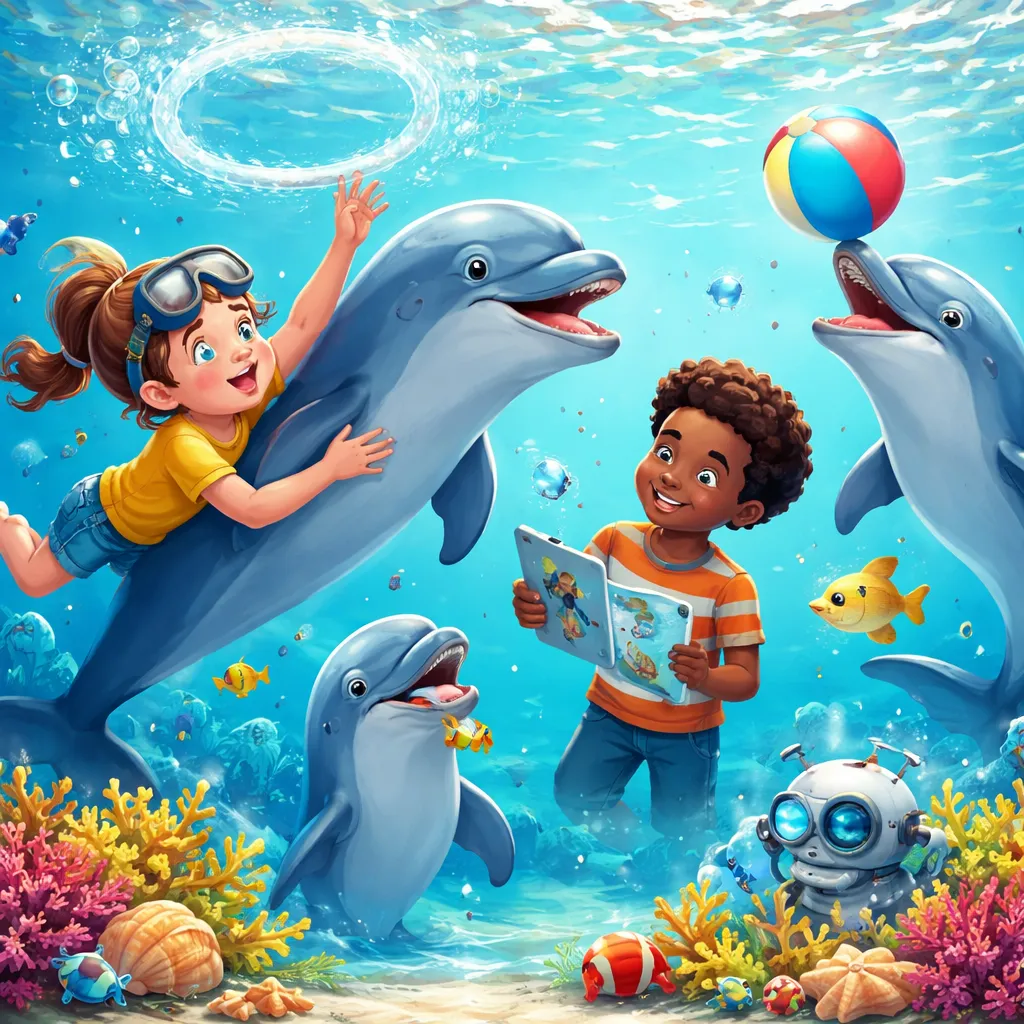

Have you ever seen a dolphin at an aquarium, in a movie, or maybe even in the ocean? With their permanent smile, playful jumps, and clever tricks, dolphins seem to be the happiest creatures in the sea. They are known for being friendly, intelligent, and great swimmers. Learning about dolphins is a splashy adventure that takes us into the world of these amazing ocean mammals. Let’s begin our journey of learning about dolphin smarts and social lives.
English Language Learning
Vocabulary and Spelling
Our clever, smiling friend is called a dolphin.
The word "dolphin" is a noun. A noun names a person, place, or thing. So, a dolphin is a thing—a very intelligent, living mammal of the sea.
Spelling "dolphin" is straightforward: D-O-L-P-H-I-N. The 'D' starts the word, the 'O' and 'L' are in the middle, and it ends with 'P-H-I-N'. D-O-L-P-H-I-N spells dolphin.
Sound and Pronunciation
Let’s say the word correctly. It sounds like this: /ˈdɑːl.fɪn/.
We can say it in two clear parts. First, say "doll". It’s just like a toy doll. Next, say "fin". It’s the same as a fish’s fin.
Now, put it together! "Doll" "fin". Dolphin! Great!
The word "dolphin" has two beats, or two syllables. Clap your hands twice: Dol-phin. It’s a friendly, smooth word.
Related Words
Learning about dolphins is more fun with new words! Here are some important ones.
Group: A family of dolphins is called a pod. A baby dolphin is a calf.
Body Part: The fin on a dolphin’s back is its dorsal fin. Its nose is called a rostrum or beak.
Sound: The clicking and whistling sounds dolphins make is echolocation or sonar.
A Famous Saying
People often say: "As playful as a dolphin."
This means someone who is very fun-loving, energetic, and full of joy. It comes from the dolphin’s known behavior of playing games, surfing waves, and interacting happily with others. It reminds us to find joy and play in our daily lives.
Say the saying with me: "As playful as a dolphin." Isn’t that a fun way to be?
Now you know the word "dolphin"! Are you ready to dive into some amazing facts? Let’s swim from words to wonderful knowledge!
Animal Knowledge
Who Are They? – Family and Group
What kind of animal is a dolphin? Dolphins are mammals. They are warm-blooded, breathe air, have a little hair, and mother dolphins feed their babies milk.
They are part of the cetacean family. Their close relatives are whales and porpoises. There are many species, like the Bottlenose Dolphin and the Spotted Dolphin. They are known as some of the smartest animals on Earth.
What Do They Look Like? – Amazing Bodies
Dolphins are sleek and streamlined, about the size of a tall person. They are usually gray with a lighter belly. Their most famous features are their long beak, curved dorsal fin, and their seemingly permanent smile.
Their body is a super swimming machine! Their smooth skin and shape help them glide quickly through the water. Their dorsal fin helps them stay stable. They have excellent eyesight both in and out of the water.
Dolphins have special adaptations. They use echolocation to "see" with sound. They make clicks that bounce off objects, helping them find food and navigate in dark or murky water. They are also very strong and can swim very fast.
Where Do They Live and How? – Home and Habits
Dolphins live in oceans and some rivers all around the world. Their homes are the open sea, coasts, and estuaries. Some species even live in big rivers like the Amazon.
Dolphins are carnivores. This means they are meat-eaters. They eat fish and squid. They often work together in their pod to herd fish into a tight group, making them easier to catch. This shows their great teamwork.
Dolphins are extremely social and live in pods that can have dozens of members. They are active during the day. They spend their time swimming, hunting, playing, and leaping out of the water. They are famous for riding the waves created by boats.
A Dolphin’s Life Story – Growing Up
A baby dolphin is called a calf. Dolphins are mammals, so calves are born live from their mother. A mother dolphin usually has one calf at a time.
The mother dolphin, with help from other females in the pod called "aunties," is a very caring parent. The calf drinks its mother’s rich milk. The calf will swim very close to its mother for protection and learning.
Calves are born with whiskers on their rostrum, which fall out soon after. They learn everything from their pod—how to hunt, communicate, and play. They stay with their mother for several years. Dolphins can live a long time, some for over 40 years.
How Do They "Talk"? – Communication
Dolphins are the chatterboxes of the sea! They talk with a complex language of clicks, whistles, and squeaks. Each dolphin has its own special whistle, like a name.
They also use body language. Leaping, tail slapping, and touching are all ways to communicate. They are very tactile and often rub against each other or swim close together.
Their best sense is their incredible hearing and their ability to use echolocation. Their hearing is so good they can hear sounds from many miles away. Echolocation is their superpower for seeing the world with sound.
Are They Okay? – Taking Care of Them
Many dolphin species are threatened by human activities. Some, like the Maui Dolphin, are critically endangered. This means they are in great danger of disappearing forever.
The main threats are getting caught accidentally in fishing nets, pollution in the ocean (plastic, chemicals, and noise), boat strikes, and loss of their habitat. It is very important to protect them.
You can be a dolphin defender! You can learn and tell others about them. You can reduce plastic use and always recycle to keep the ocean clean. You can support groups that work to protect dolphins and their homes. If you see dolphins from a boat, always stay at a safe distance.
Life Connections and Inspiration
How to Be With Them – Safety and Love
Dolphins are wild, intelligent animals. They are not pets, and we must admire them in the wild with great respect and from a safe distance.
The rule is: Admire from afar, never feed or chase. If you are swimming or on a boat, never try to touch, feed, or swim after a dolphin. This can disrupt their feeding, scare their calves, and teach them bad habits. Always let them choose if they want to interact.
We show our love by keeping their ocean home clean, healthy, and quiet. We can be good neighbors to all ocean creatures.
Super Qualities We Learn from Them
Dolphins teach us wonderful things. One super quality is intelligent teamwork and playfulness. Dolphins work together to solve problems and find food. They also make time for play, showing us that intelligence, friendship, and fun can all go together. They teach us the value of cooperation, friendship, and finding joy in what we do.
Another quality is clear communication and empathy. Dolphins have complex conversations and show care for sick or injured pod members. This reminds us of the importance of talking clearly, listening well, and showing kindness and understanding to our friends and family.
Think about it: How can you use teamwork to get a job done, like dolphins herding fish? How can you be a good communicator and a kind friend in your own "pod" or group?
Take Action! – Your "Dolphin Pod" Project
Let’s do a playful and team-based activity! Your project is to invent a simple "pod" game with your family or friends.
Stand in a circle like a pod of dolphins. The first person makes a fun sound or a gentle click. The next person repeats it and adds a new one. Keep going around the circle! See how long you can remember the sequence. This shows how dolphins communicate and work together as a team.
Closing
Learning about dolphin wonders is a joyful and fascinating adventure! We learned the word "dolphin" and how to say its two-part name. We discovered amazing facts about their echolocation, their playful pods, and their life as intelligent ocean citizens. We know that dolphins are social, clever mammals who need our help to keep their oceans safe. You can use your new words to share the wonderful story of these smiling swimmers. You can use your knowledge to make smart choices that protect marine life. The animal world is full of playful and communicative teachers. Always remember to respect wildlife from a safe distance, work and play well with others, and communicate with kindness. Keep exploring with curiosity, swim through life with a smile, and be a friend to the wild. Your caring actions and playful spirit make you a true friend to the amazing dolphin.