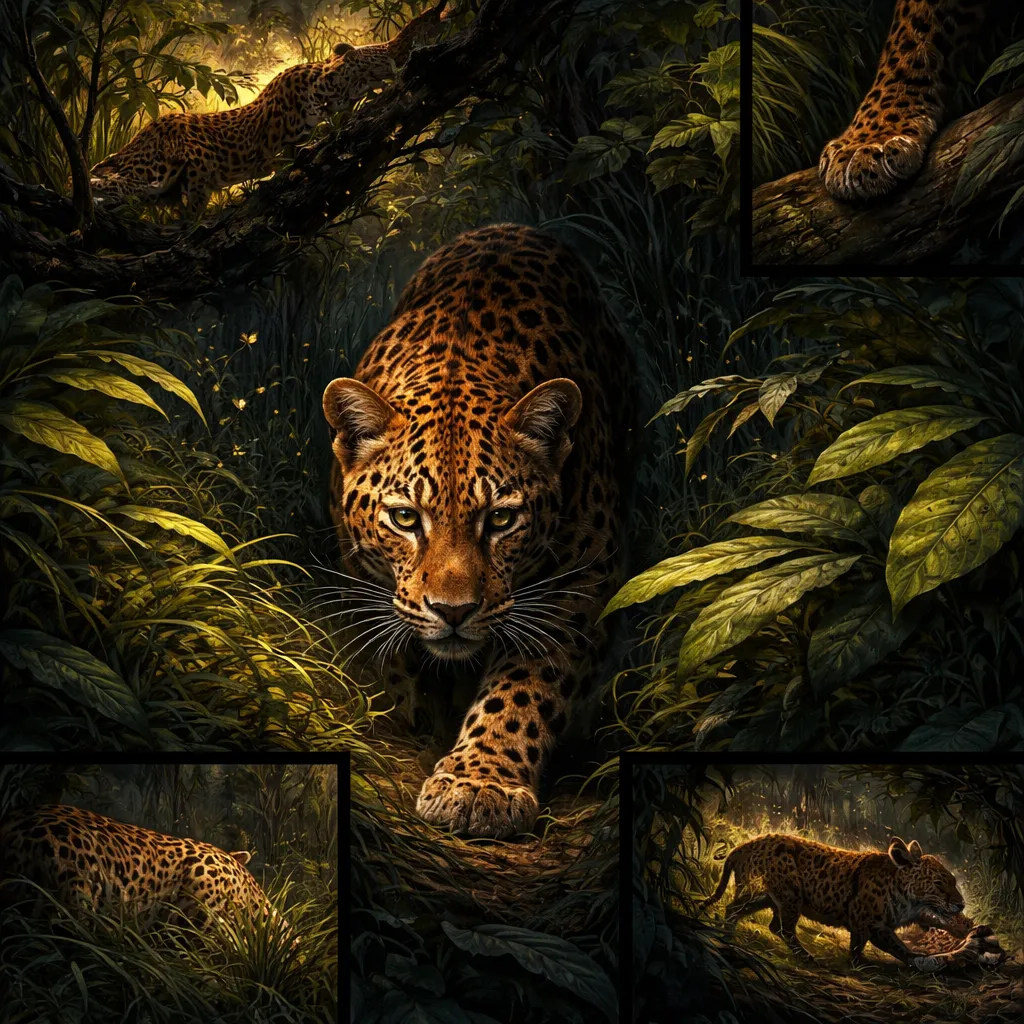

Have you ever seen a picture of a leopard resting on a tree branch? Its golden coat is covered in beautiful black spots, and it looks both powerful and graceful. Leopards are mysterious, strong cats that live in many parts of the world. Learning about leopards takes us on a quiet adventure to forests, mountains, and grasslands. Let’s move silently and begin our journey of learning about leopard secrets and skills.
English Language Learning
Vocabulary and Spelling
Our stealthy friend is called a leopard.
The word "leopard" is a noun. A noun names a person, place, or thing. So, a leopard is a thing—a powerful, wild cat.
Spelling "leopard" is interesting: L-E-O-P-A-R-D. The 'L' starts the word, the 'E' and 'O' are in the middle, and it ends with 'P-A-R-D'. L-E-O-P-A-R-D spells leopard.
Sound and Pronunciation
Let’s say the word correctly. It sounds like this: /ˈlep.ɚd/.
We can say it in two clear parts. First, say "lep". It rhymes with "step". Next, say "erd". It’s a soft sound, like the end of "word".
Now, put it together! "Lep" "erd". Leopard! Great!
The word "leopard" has two beats, or two syllables. Clap your hands twice: Leop-ard. It’s a smooth, quiet word.
Related Words
Learning about leopards is more fun with new words! Here are some important ones.
Body Part: The black spots on a leopard’s fur are called rosettes because they look a bit like roses. Its sharp nails are called claws.
Action: Leopards are excellent at stalking their prey, which means moving very slowly and quietly before they attack.
Home: A leopard’s territory is its range. It marks and defends this area.
A Famous Saying
There is a well-known phrase: "A leopard can’t change its spots."
This means that it is very hard for someone to change their basic nature or character. It’s a saying that comes from the leopard’s unchanging beautiful spots. It reminds us that some things are a core part of who we are.
Say the saying with me: "A leopard can’t change its spots." It’s a way to talk about character.
Now you know the word "leopard"! Are you ready to stalk into some amazing facts? Let’s prowl from words to wonderful knowledge!
Animal Knowledge
Who Are They? – Family and Group
What kind of animal is a leopard? Leopards are mammals. They have fur, are warm-blooded, and mother leopards feed their babies milk.
They are part of the big cat family, in the genus Panthera. Their close cousins are lions, tigers, and jaguars. They are the smallest of the four "big cats" but are incredibly strong.
What Do They Look Like? – Amazing Bodies
Leopards are about the size of a large dog but much more muscular. They have a beautiful coat of golden-yellow fur covered in black rosettes. Some leopards are all black, and we call them black panthers!
Their most famous feature is their spotted coat. The pattern is perfect camouflage, helping them hide in dappled sunlight and shadows. They have a long tail for balance and powerful legs for climbing and jumping.
Leopards have special adaptations. They are phenomenal climbers. They can drag prey much heavier than themselves up into trees to keep it safe from other animals. They have excellent night vision.
Where Do They Live and How? – Home and Habits
Leopards live in Africa and parts of Asia. Their homes are rainforests, mountains, grasslands, and even near deserts. They are very adaptable and can live near people.
Leopards are carnivores. This means they are meat-eaters. They hunt animals like deer, antelope, and monkeys. They are ambush predators, using stealth and a quick burst of speed.
Leopards are solitary and secretive. They are most active at night, making them nocturnal. They spend their time patrolling their large territory, hunting, and resting in trees. A baby leopard is called a cub.
A Leopard’s Life Story – Growing Up
A baby leopard is called a cub. Leopards are mammals, so cubs are born live from their mother. A mother leopard usually has two or three tiny, blind cubs at a time.
The mother leopard is a fierce protector. She hides her cubs in a den for the first few weeks. She feeds them milk and later brings them meat. She teaches them how to hunt and survive.
Cubs are born with a grayish coat and faint spots. They open their eyes after about ten days. They stay with their mother for up to two years, learning all the skills they need before going off on their own.
How Do They "Talk"? – Communication
Leopards are not as loud as lions, but they do communicate. They can growl, snarl, and make a sound called a "saw" which is like rough wood being cut.
They use scent marking a lot. They have scent glands and will scratch trees or spray urine to leave messages for other leopards. These messages say, "This is my area."
Their best senses are their incredible eyesight and hearing. They can see very well in the dark, which helps them hunt at night. Their ears can hear the smallest rustle in the grass.
Are They Okay? – Taking Care of Them
Leopards are facing many challenges. They are listed as vulnerable on some lists, which means they are at risk. In some areas, they are endangered.
The main threats are people taking their forest homes for farms and cities, hunting for their beautiful fur, and conflict with people when leopards take farm animals.
You can be a leopard guardian! You can learn and teach others about these amazing cats. You can support groups that protect wild habitats and work to reduce conflict between people and leopards. You can choose products that are wildlife-friendly.
Life Connections and Inspiration
How to Be With Them – Safety and Love
Leopards are magnificent, powerful, and wild predators. We must always respect them and keep a very, very safe distance.
The rule is: Observe from an extreme distance, if at all. We watch them in nature documentaries or at zoos with excellent, natural habitats. In the wild, we never try to find, follow, or approach a leopard. If you are on a safari, you stay in the vehicle and listen to your guide.
We show our love by wanting them to live wild and free, with plenty of space and prey. We can be a voice for protecting the wild corridors that connect their habitats.
Super Qualities We Learn from Them
Leopards teach us wonderful things. One super quality is adaptable strength and self-reliance. Leopards can live in many different environments, from snowy mountains to hot deserts. They rely on their own skills to survive. They teach us to be strong, adaptable, and confident in our own abilities.
Another quality is graceful patience and focus. Leopards can wait silently and motionlessly for the perfect moment to act. They remind us that being patient, focused, and choosing the right moment can lead to success.
Think about it: How can you be more adaptable when your plans change? How can you practice patience and focus on a task, like homework or a puzzle?
Take Action! – Your "Leopard Camouflage" Project
Let’s do a fun and creative activity! Your project is to create a leopard camouflage picture.
On a piece of paper, use yellow, gold, and brown crayons to color a background. It could be a forest floor with leaves and light. Now, on a separate paper, draw a leopard. Color it with golden yellow and add black rosette spots. Cut out your leopard. Now, place it on your background. Can you make it "hide"? Move it to a spot where its colors blend in. This shows how camouflage works! Write a sentence about why camouflage is important for a leopard.
Closing
Learning about leopard mysteries is a thrilling adventure! We learned the word "leopard" and how to say its two-part name. We discovered amazing facts about their rosette spots, their incredible climbing, and their solitary, patient life. We know that leopards are adaptable, powerful cats who need our help to protect their wild homes. You can use your new words to share the secret life of these spotted cats. You can use your knowledge to understand the importance of every creature in the wild. The animal world is full of graceful and patient teachers. Always remember to respect all wildlife from a safe distance, be adaptable in your own life, and move with patience and focus toward your goals. Keep exploring with quiet curiosity, value your own strengths, and be a voice for the protection of nature. Your observant eyes and caring heart make you a true friend to the elusive leopard.