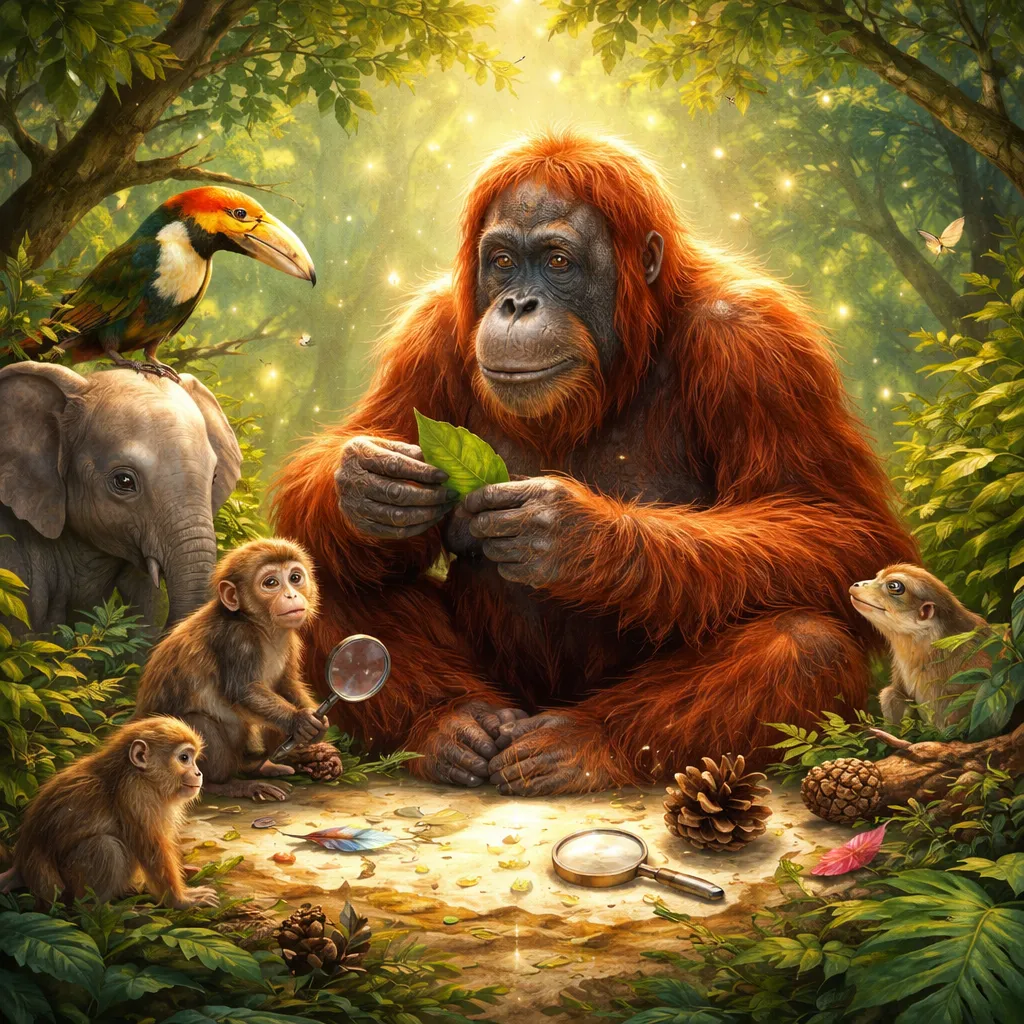

Imagine you’re looking up into the treetops of a rainforest and you see a large animal with long, reddish-orange hair and very thoughtful eyes, moving slowly and carefully. That’s an orangutan! Their name means "person of the forest," and watching them can feel like looking at a wise, old friend. Learning about orangutans is a thoughtful adventure that takes us to the vanishing rainforests of Southeast Asia. Let’s begin our journey of learning about orangutan wisdom and their life in the trees.
English Language Learning
Vocabulary and Spelling Our wise forest friend is called an orangutan. The word "orangutan" is a noun. A noun names a person, place, or thing. So, an orangutan is a thing—a very intelligent, living animal. Spelling "orangutan" is interesting: O-R-A-N-G-U-T-A-N. The 'O' starts the word, the 'R' and 'A' are in the middle, and it ends with 'N-G-U-T-A-N'. O-R-A-N-G-U-T-A-N spells orangutan.
Sound and Pronunciation Let’s say the word correctly. It sounds like this: /əˈræŋ.ə.tæn/. We can say it in four clear parts. First, say "uh". It’s a soft, quick sound. Next, say "rang". It rhymes with "bang". Then, say "uh" again. Last, say "tan". It rhymes with "can". Now, put it together! "Uh" "rang" "uh" "tan". Orangutan! Great job! The word "orangutan" has four beats, or four syllables. Clap four times: O-rang-u-tan. It’s a unique, thoughtful-sounding word.
Related Words Learning about orangutans is more fun with new words! Here are some important ones. Home: The high, leafy roof of the rainforest is called the canopy. This is where orangutans live. Action: The way orangutans swing from branch to branch using their long arms is called brachiation. Baby: A baby orangutan is called an infant.
A Famous Saying The name itself is a saying: "Orangutan means 'person of the forest.'" This comes from the Malay and Indonesian languages. It is a name of great respect, showing how much people have long seen their intelligence and human-like qualities. It reminds us that we are connected to all living things. Say the meaning with me: "Orangutan means 'person of the forest.'" It’s a name that shows respect.
Now you know the word "orangutan"! Are you ready to explore the life of these great apes? Let’s swing from words to wonderful knowledge!
Animal Knowledge
Who Are They? – Family and Group What kind of animal is an orangutan? Orangutans are mammals. They have hair, are warm-blooded, and mother orangutans feed their babies milk. They are one of the great apes. This family also includes gorillas, chimpanzees, bonobos, and humans. There are three species: Bornean, Sumatran, and Tapanuli orangutans.
What Do They Look Like? – Amazing Bodies Orangutans are the largest tree-dwelling animals on Earth! They have long, shaggy, reddish-orange hair. Male orangutans have wide, fatty cheek pads called flanges and a large throat pouch. Their most famous feature is their incredibly long, strong arms. Their arm span can be up to seven feet wide—taller than most grown-ups! They use their arms to swing through the forest. Their hands and feet are perfect for grasping branches. Orangutans have special adaptations. They are very intelligent and can learn to use tools, like sticks to get honey from a beehive. They are mostly solitary, which is unusual for great apes. They have a good memory to remember where fruit trees are.
Where Do They Live and How? – Home and Habits Orangutans live only on the islands of Borneo and Sumatra in Southeast Asia. Their home is the tropical rainforest canopy. They spend almost all their time in the trees. Orangutans are frugivores. This means they eat mostly fruit. Their favorite food is wild figs. They also eat leaves, flowers, bark, and insects. They play a very important role in the forest by spreading seeds from the fruit they eat. Orangutans are mostly solitary, except for mothers with their young. They are active during the day. They spend their time slowly and carefully moving through the trees, looking for food, and building a new sleeping nest every night out of branches and leaves.
An Orangutan’s Life Story – Growing Up A baby orangutan is called an infant. Orangutans are mammals, so infants are born live from their mother. A mother orangutan usually has one infant at a time. The mother orangutan has the longest childhood dependence of any animal except humans. The infant clings to its mother constantly for the first two years and drinks her milk. The mother teaches it everything about the forest for up to eight or nine years. Infants are born with a pink face and bright orange hair. They are completely dependent on their mother. They learn by watching her every move—what to eat, how to build a nest, and how to move through the trees. This long childhood is for learning all the complex skills they need.
How Do They "Talk"? – Communication Orangutans are usually quiet, but they have ways to talk. They can make long calls, especially adult males, which can be heard for miles through the forest. They also grunt, sigh, and smack their lips. They use their bodies a lot. A male might make a long call to tell other males to stay away. They are very good at understanding each other’s feelings through facial expressions and gestures. Their best senses are their eyesight and memory. They have excellent vision for seeing in the dim forest. Their amazing memory helps them remember the locations of hundreds of fruit trees and when they will have ripe fruit.
Are They Okay? – Taking Care of Them All orangutan species are critically endangered. This is the highest level of danger before extinction. There are very few left in the wild. The main threat is deforestation. People are cutting down the rainforest to make palm oil plantations, mines, and paper. This destroys the orangutan’s home. They are also sometimes hunted or captured for the illegal pet trade. You can be an orangutan hero! You can learn and tell everyone about their situation. You can check the products you buy and choose ones without palm oil or with sustainable palm oil. You can support groups that rescue orphaned orangutans and protect rainforests. Recycling paper and cardboard helps save trees too.
Life Connections and Inspiration
How to Be With Them – Safety and Love Orangutans are strong, intelligent, and wild animals. They are also fragile because their home is disappearing. We must do everything we can to protect them and never disturb them. The rule is: Protect their home and observe from an ethical distance. We watch them in nature documentaries or at ethical wildlife sanctuaries that care for orphaned orangutans. In the wild, we must never try to touch, feed, or get close to an orangutan. Responsible ecotourism keeps a very far distance. We show our love by being mindful consumers and protecting the rainforest. We can be a voice for the trees and the "people of the forest" who live in them.
Super Qualities We Learn from Them Orangutans teach us profound lessons. One super quality is quiet independence and thoughtful action. Orangutans spend most of their time alone, moving slowly and thinking about their next move. They teach us the value of being comfortable with ourselves, thinking before we act, and being independent. Another quality is patient teaching and deep learning. A mother orangutan teaches her child for many years with incredible patience. The child learns by watching closely. This reminds us of the importance of patient learning, good teaching, and the deep bond between a student and a teacher, or a parent and a child. Think about it: How can you be more independent and thoughtful in your choices? Who is a patient teacher in your life, and how can you be a good, observant learner?
Take Action! – Your "Orangutan Nest" Project Let’s do a thoughtful and creative activity! Your project is to build a model of an orangutan’s sleeping nest. Find some small, bendy sticks, twigs, or even pipe cleaners. In a shoebox, create a few tree branches using thicker sticks or cardboard tubes. Now, use your bendy materials to build a nest platform in the fork of a "branch." Weave them together to make a round, bowl-shaped nest. You can add paper leaves for comfort. Place a small toy or drawing of an orangutan in the nest. This shows how orangutans carefully build a new, safe bed every single night.
Closing Learning about orangutan wisdom is a profound and important adventure! We learned the word "orangutan" and how to say its four-part name. We discovered amazing facts about their long arms, their nightly nests, and their patient life in the treetops. We know that orangutans are intelligent, solitary thinkers who are in grave danger because their forest home is being cut down. You can use your new words to become a powerful voice for these "people of the forest." You can use your knowledge to make smart choices as a consumer and to value patience, learning, and independence. The animal world is full of wise and thoughtful teachers. Always remember to respect all wildlife, protect our planet’s forests, and value the deep connections in nature. Keep exploring with a thoughtful heart, learn with patience, and be a friend to the wild. Your mindful actions and strong voice can help ensure the wise orangutan continues to live in the Earth’s magnificent rainforests.