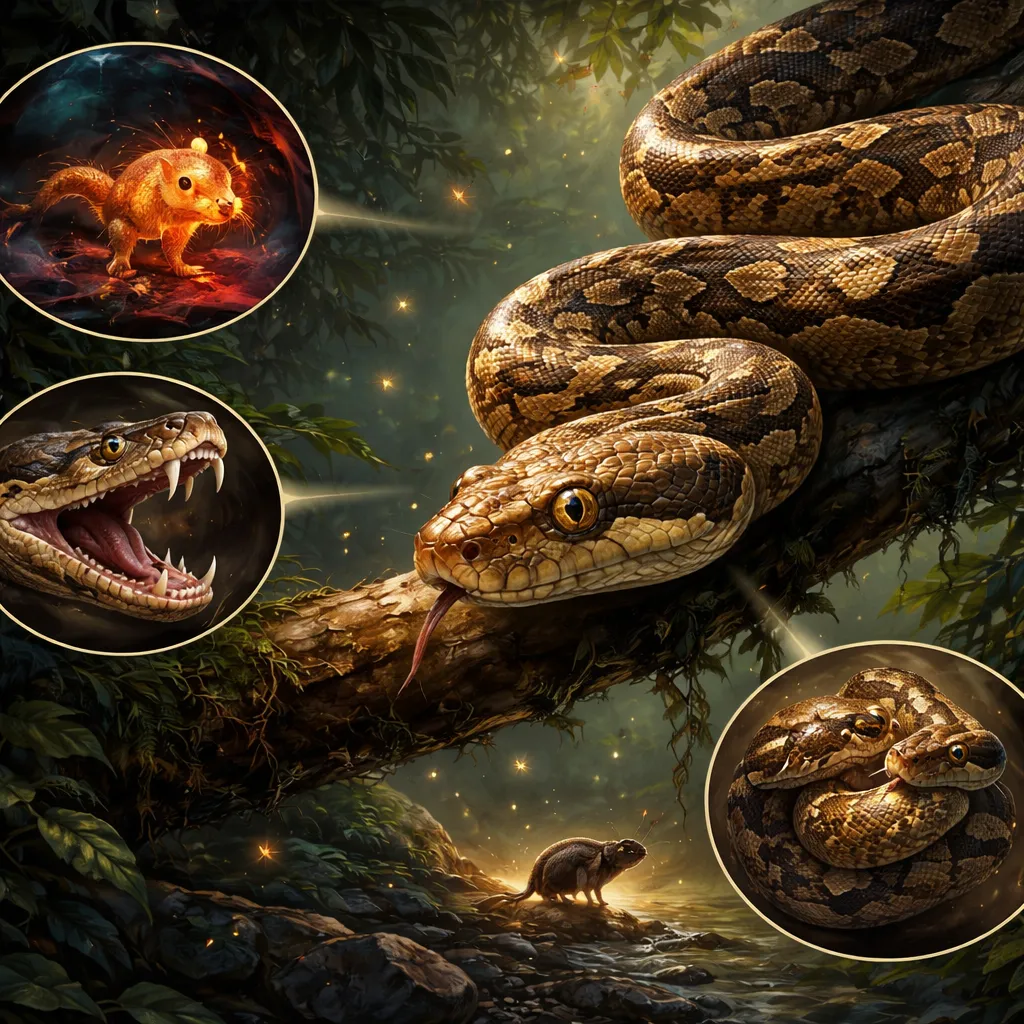

Imagine you’re exploring a steamy jungle or a dry grassland and you see one of the world’s longest snakes, coiled peacefully on a tree branch or resting in the sun. It moves with slow, powerful grace. That’s a python! These magnificent snakes are constrictors, known for their incredible strength and patience. Learning about pythons is a gripping adventure into the world of powerful, non-venomous snakes. Let’s begin our journey of learning about python power and care.
English Language Learning
Vocabulary and Spelling Our powerful, coiling friend is called a python. The word "python" is a noun. A noun names a person, place, or thing. So, a python is a thing—a very large, living snake. Spelling "python" is simple: P-Y-T-H-O-N. The 'P' starts the word, the 'Y' and 'T' are in the middle, and it ends with 'H-O-N'. P-Y-T-H-O-N spells python.
Sound and Pronunciation Let’s say the word correctly. It sounds like this: /ˈpaɪ.θɑːn/. We can say it in two clear parts. First, say "pie". It’s just like the dessert, pie! Next, say "thon". It rhymes with "gone". Now, put it together! "Pie" "thon". Python! Great! The word "python" has two beats, or two syllables. Clap your hands twice: Py-thon. It’s a strong, smooth word.
Related Words Learning about pythons is more fun with new words! Here are some important ones. Action: The way a python squeezes its prey is called constriction. A baby python is a hatchling. Body Part: The special holes on a python’s face that sense heat are heat-sensing pits. Home: A python’s home in the trees or on the ground is its habitat.
A Famous Idea Because of their patient, coiling nature, people might say: "As patient as a python." This means someone can wait calmly and quietly for the perfect moment to act. It comes from the python’s hunting strategy. It reminds us that patience and timing are powerful skills. Say the idea with me: "As patient as a python." It’s about calm, powerful waiting.
Now you know the word "python"! Are you ready to coil into some amazing facts? Let’s slither from words to wonderful knowledge!
Animal Knowledge
Who Are They? – Family and Group What kind of animal is a python? Pythons are reptiles. They are a type of snake. They are cold-blooded, have scaly skin, and lay eggs. They belong to the Pythonidae family. They are constrictors, which means they squeeze their prey. They are not venomous. Their cousins are boas. Some, like the Reticulated Python, are among the longest snakes in the world.
What Do They Look Like? – Amazing Bodies Pythons are very long, muscular snakes. Some can grow longer than a school bus! They have beautiful patterns of brown, green, or yellow. Their most famous features are their incredible length and strength and their heat-sensing pits. Their body is a super squeezing machine! Their muscles are incredibly strong for constricting. They have special sensors along their lips called labial pits that can sense the tiny heat given off by warm-blooded animals, helping them hunt in the dark. Pythons have special adaptations. Like all snakes, they can unhinge their jaws to swallow large prey whole. They have sharp, backward-curving teeth to grip their meal. After a big meal, they can rest for weeks or even months while they digest.
Where Do They Live and How? – Home and Habits Pythons live in warm regions of the Old World. Their homes are rainforests, grasslands, swamps, and woodlands in Africa, Asia, and Australia. They are excellent climbers and swimmers. Pythons are carnivores. This means they are meat-eaters. They eat animals like rats, birds, monkeys, pigs, and deer. They are ambush hunters, waiting perfectly still for prey to come close, then striking and coiling around it. Pythons are solitary. They are most active at night. They spend their time resting, hiding, and waiting for the right moment to hunt. A group of pythons is called a den or a pit.
A Python’s Life Story – Growing Up A baby python is called a hatchling. Pythons are reptiles that lay eggs. A mother python lays a clutch of 10 to 100 eggs, depending on the species. The mother python is a dedicated parent! Unlike most snakes, she cares for her eggs. She coils her body around them to keep them warm and safe until they hatch. She will even shiver her muscles to create heat! Hatchlings use a special "egg tooth" to break out of their shell. They are independent from the start and receive no further care. They are born with the instinct to hunt. They grow slowly but steadily over many years. Pythons can live for a very long time, over 20 years in the wild.
How Do They "Talk"? – Communication Pythons are generally quiet. They may hiss if they feel threatened. They do not have vocal cords for complex sounds. They communicate through body language. Coiling up tightly, pulling their head back into an ‘S’ shape, or slowly moving away are all ways to send messages. Their most dramatic "talk" is their powerful constriction when hunting. Their best senses are their heat vision (from their labial pits) and their excellent sense of smell (using their forked tongue). These help them find prey in complete darkness. They can also feel vibrations through the ground.
Are They Okay? – Taking Care of Them Many python species are facing threats. Some are endangered or vulnerable. Their populations are decreasing because of human activities. The main threats are habitat loss, being hunted for their beautiful skin, and being captured for the pet trade. In some places, like the Florida Everglades, released pet pythons have become an invasive species, which harms the local environment. You can be a python protector! You can learn and tell others about their important role in nature. Never buy products made from python skin. If a python is your dream pet, remember they grow very large and live a long time—it’s a huge responsibility. Always choose a pet that was bred in captivity and never release any pet into the wild.
Life Connections and Inspiration
How to Be With Them – Safety and Love Pythons are powerful, wild constrictors. They are not pets for beginners and can be dangerous. We must always admire them with the greatest respect and from a very safe distance. The rule is: Observe with awe, from far away. Never try to touch, handle, or approach a wild python. Only trained experts should handle large constrictors. If you visit a zoo, follow all safety rules. If you have a pet python, it is a lifelong commitment that requires expert knowledge, a secure enclosure, and proper care. We show our love by respecting their power, protecting their natural habitats, and making responsible choices as pet owners or wildlife admirers.
Super Qualities We Learn from Them Pythons teach us profound lessons. One super quality is immense patience and controlled power. A python waits calmly for the right opportunity and then uses its strength with precise control. It teaches us the value of patience, of knowing when to act, and of using our own strength wisely and purposefully. Another quality is dedicated nurturing and warmth. The mother python diligently coils around her eggs to protect and warm them. This shows a different side of these powerful creatures—one of care and dedication. It reminds us that even the strongest among us can be nurturing and protective. Think about it: When is a time you need to be patient and wait for the right moment? Who do you protect and care for with dedication, like a python mother with her eggs?
Take Action! – Your "Python Coil" Project Let’s do a patient and creative activity! Your project is to create a model of a python coiled around its eggs. Use modeling clay or crumpled paper to form a large, coiled snake body. In the center of the coil, place some small, white beads or clay balls as eggs. You can paint or color your python with a beautiful pattern. This shows the protective and patient nature of the mother python.
Closing Learning about python power is a patient and awe-inspiring adventure! We learned the word "python" and how to say its two-part name. We discovered amazing facts about their heat-sensing pits, their constricting strength, and the mother’s careful protection of her eggs. We know that pythons are patient, powerful snakes that are facing threats and need our understanding and responsible actions. You can use your new words to share the fascinating story of these giant constrictors. You can use your knowledge to be a responsible wildlife enthusiast and a voice for reptile conservation. The animal world is full of patient and nurturing teachers. Always remember to respect wildlife from a safe distance, use patience and controlled strength in your actions, and show dedication in caring for others. Keep exploring with calm curiosity, move through life with purposeful strength, and be a friend to the wild. Your thoughtful actions and patient spirit make you a true friend to the amazing python.