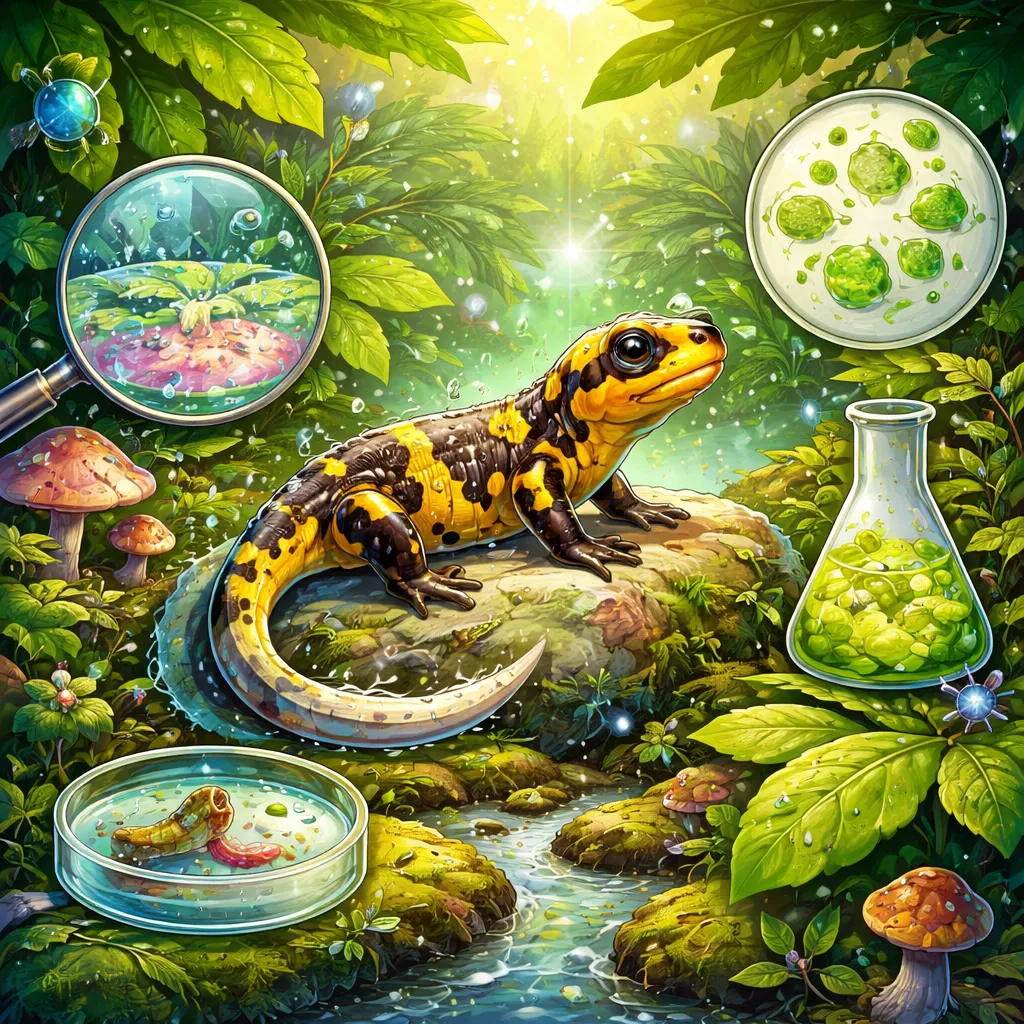

Have you ever been on a walk in a damp forest, gently turned over a log, and seen a sleek, colorful creature that looks like a lizard but feels cool and wet? That’s a salamander! These amazing amphibians are secretive animals that love moisture and have a superpower—they can regrow lost body parts! Learning about salamanders is a damp and wonderful adventure into the world of frogs and lizards' lesser-known cousins. Let’s begin our journey of learning about salamander secrets and skills.
English Language Learning
Vocabulary and Spelling Our moist, secretive friend is called a salamander. The word "salamander" is a noun. A noun names a person, place, or thing. So, a salamander is a thing—a living amphibian. Spelling "salamander" is interesting: S-A-L-A-M-A-N-D-E-R. S-A-L-A-M-A-N-D-E-R spells salamander.
Sound and Pronunciation Let’s say the word correctly. It sounds like this: /ˈsæl.əˌmæn.dɚ/. We can say it in four clear parts. First, say "sal". It rhymes with "pal". Next, say "uh". It’s a soft, quick sound. Then, say "man". It’s just like the word "man". Last, say "der". It sounds like "durr". Now, put it together! "Sal" "uh" "man" "der". Salamander! Great! The word "salamander" has four beats, or four syllables. Clap four times: Sal-a-man-der. It’s a long, slithery word.
Related Words Learning about salamanders is more fun with new words! Here are some important ones. Baby: A baby salamander, which lives in water and has gills, is a larva (plural: larvae). Body Part: The soft, wet skin of a salamander is moist skin. Its home in the forest is a microhabitat. Action: The amazing ability to grow back a lost tail or leg is regeneration.
A Famous Idea Because of their moist, slippery skin, people sometimes say: "As slippery as a salamander." This means something is hard to catch or hold onto. It reminds us that some things in nature are delicate and best observed without touching. Say the idea with me: "As slippery as a salamander." It’s about being elusive and delicate.
Now you know the word "salamander"! Are you ready to explore their damp world? Let’s creep from words to wonderful knowledge!
Animal Knowledge
Who Are They? – Family and Group What kind of animal is a salamander? Salamanders are amphibians. They are cold-blooded, have moist skin, and most start life in water. They are not lizards! They belong to the order Caudata or Urodela. Their closest relatives are frogs and caecilians. There are over 700 species, from tiny newts to the giant Japanese Salamander. They are one of the most diverse groups of amphibians.
What Do They Look Like? – Amazing Bodies Salamanders look a bit like lizards but with soft, moist skin and no scales. They have four legs, a long tail, and many are brightly colored. Their most famous features are their moist, permeable skin and their ability to regenerate. Their body is full of super tools! Their skin must stay wet so they can breathe through it. Their bright colors can warn predators that they are poisonous. Some can regrow not just tails, but also legs, jaws, and even parts of their heart! Salamanders have special adaptations. They have an excellent sense of smell. They are mostly nocturnal. Some species keep their gills and live in water their whole lives, while others lose gills and live on land as adults.
Where Do They Live and How? – Home and Habits Salamanders live in moist places all over the world, except Australia and Antarctica. Their homes are forests, under rocks and logs, near streams, and in caves. They must live where it is damp. Salamanders are carnivores. This means they are meat-eaters. They eat insects, worms, slugs, and other small creatures. They are helpful garden friends because they eat pests. They catch food with a quick, sticky tongue or by snapping their jaws. Salamanders are solitary and shy. They are most active at night or on rainy days. They spend their time hiding in cool, damp places and coming out to hunt. A group of salamanders is called a congress.
A Salamander’s Life Story – Growing Up A baby salamander is called a larva. Most salamanders start life as an egg laid in water. The eggs hatch into larvae, which look like tiny adults but have feathery gills to breathe underwater. In many species, the parents do not care for the eggs or larvae. The larvae must fend for themselves. They live in the water, growing and changing. The larvae go through metamorphosis. They lose their gills, develop lungs, and their legs grow stronger for life on land. Some, like the Axolotl, never completely change and keep their gills, living in water forever. Salamanders can live for many years, some over 20.
How Do They "Talk"? – Communication Salamanders are very quiet. They do not make sounds like frogs. They communicate through smell and touch. They release special chemicals into the water or air to send messages about territory or to find a mate. They also use body language, like raising their tail or displaying their bright belly. Their best senses are their sense of smell and touch. They have a great sense of smell to find food and mates. Their skin is very sensitive to vibrations and chemicals in the water.
Are They Okay? – Taking Care of Them Many salamander species are in serious trouble. They are endangered or threatened. They are very sensitive to changes in their environment. The main threats are pollution (which hurts their permeable skin), loss of forest and wetland homes, climate change, and a deadly fungus. They are also sometimes caught for the pet trade. You can be a salamander saver! You can help by protecting forests and clean waterways. Never use pesticides in your garden. If you see a salamander in the wild, look but don’t touch—your hands can hurt their skin. Never take a salamander from the wild. Support groups that protect amphibians.
Life Connections and Inspiration
How to Be With Them – Safety and Love Salamanders are delicate, wild amphibians. Their skin is very sensitive. We must admire them with great care and without touching. The rule is: Observe with your eyes, not with your hands. If you find a salamander under a log, look carefully and then gently put the log back exactly as you found it. Never handle a wild salamander. The oils and salts on your hands can harm their skin. If you have a pet salamander, it must be one bred in captivity, and you must learn to care for its specific needs. We show our love by being gentle observers and by protecting the clean, damp, and leafy places they need to survive.
Super Qualities We Learn from Them Salamanders teach us wonderful lessons. One super quality is incredible regeneration and resilience. A salamander can lose a leg and grow a perfect new one. It teaches us about the power of healing, bouncing back from injury, and the amazing ability of the body to renew itself. It reminds us to be resilient. Another quality is adaptation to two worlds. Salamanders often live both in water and on land, adapting to different environments. This teaches us flexibility and the ability to thrive in different situations by using different "tools" or skills. Think about it: How can you show resilience when you face a setback, like a salamander regrowing a limb? How can you adapt to different situations, like moving between two different "worlds" (like home and school)?
Take Action! – Your "Salamander Lifecycle" Project Let’s do a resilient and creative activity! Your project is to draw the amazing lifecycle of a salamander. Divide a paper into four sections. In the first, draw eggs in water. In the second, draw a larva with gills swimming. In the third, draw the larva growing legs. In the fourth, draw the adult salamander on land. Use arrows to show the change. This shows the incredible transformation, or metamorphosis, that many salamanders go through.
Closing Learning about salamander secrets is a moist and magical adventure! We learned the word "salamander" and how to say its four-part name. We discovered amazing facts about their permeable skin, their power of regeneration, and their life in two worlds—water and land. We know that salamanders are resilient, adaptable amphibians that are in danger and need our gentle protection. You can use your new words to share the hidden story of these damp forest dwellers. You can use your knowledge to be a protector of clean water and healthy forests. The animal world is full of resilient and adaptable teachers. Always remember to respect wildlife from a safe distance, be resilient in the face of challenges, and adapt to changes with flexibility. Keep exploring with gentle curiosity, move through your world with care, and be a friend to the wild. Your thoughtful actions and gentle spirit make you a true friend to the amazing salamander.