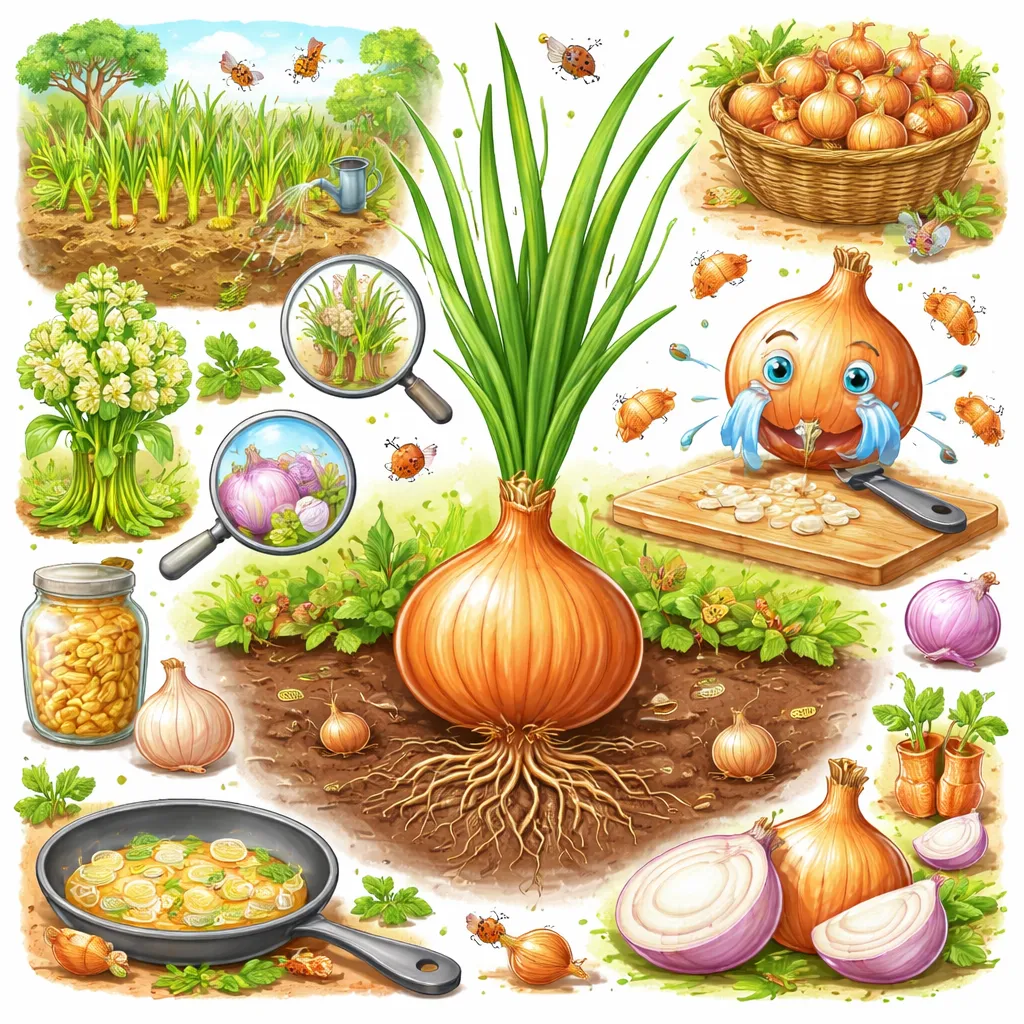

Have you ever helped in the kitchen, cutting a round, brown onion, and suddenly your eyes started to water? This amazing plant makes us cry, but it also makes our food taste wonderful! It grows mostly underground as a plump, layered bulb, but sends up tall, green, hollow leaves toward the sun. People have been eating and using onions for thousands of years, in almost every country in the world. Let’s peel back the layers and learn about the incredible Onion plant.
Let’s Learn the Word! – Open the Treasure Box of Language
Formal Name and Pronunciation
This layered plant is called an Onion. Its scientific name is Allium cepa. You can say it like this: /ˈʌn.jən/ (UN-yun). The “On” sounds like “sun,” and “ion” sounds like the word. On-ion. Say it: Onion. It’s a simple, round-sounding word.
The Etymology Tale
The word “Onion” is very old! It comes from the Latin word “unio,” which means “oneness” or “a single pearl.” This name might be because an onion grows as one single bulb, or because its many layers are united into one. Its name is about unity and coming together, just like its layers.
Nicknames and Friendly Aliases
Onions are named for their color and shape. There is the Yellow Onion, Red Onion, White Onion, and Sweet Onion. Small ones are Pearl Onions or Cocktail Onions. The green stalks are Green Onions or Scallions. A young, small bulb is a Spring Onion.
Building Your Word Web: Core Parts
Let’s learn the words for an Onion plant’s clever body. The Bulb is the round, layered part we eat. Each Layer is a thick, fleshy leaf that stores food. The Skin or Tunic is the thin, papery covering that protects the bulb. The Leaf is the tall, green, hollow shoot. The Root is the small, hairy bunch at the base. The Stem is the short, flat disk at the bottom of the bulb. A String of braided onions is an onion braid.
Action and State Words
Onion plants are quiet growers. A small bulb or seed is planted. The plant grows tall leaves. The bulb swells and forms layers underground. The plant is harvested and cured (dried). The bulb is peeled, chopped, or sliced. An onion plant is pungent, layered, biennial (takes two years, but harvested in one), and versatile.
Ecosystem Friends Vocabulary
An onion patch has a strong smell. This smell can help confuse or deter some pest insects from the garden, protecting other plants. If left to flower, the round, fluffy flower ball can attract bees and other pollinators. The plant is mostly a quiet, underground neighbor in the garden community.
Cultural Imprint in Language
Onions are a symbol of eternity, layers of meaning, and basic sustenance. Because of their many layers, people say something has “layers like an onion” when it has many parts or secrets to discover. An old saying is, “Life is like an onion: you peel it off one layer at a time, and sometimes you weep.” It represents the idea that even simple things can be complex and can bring strong feelings.
Ready for Discovery
We know its layered, unified name. Are you ready to be a kitchen scientist and discover why this humble bulb makes us cry and tastes so good? Let’s explore the secrets of the Onion plant.
Discover the Plant’s Secrets! – A Nature Detective’s Notebook
The Plant Passport
The Onion belongs to the Amaryllidaceae family. Its genus is Allium, making it a close cousin to garlic, leeks, and chives. It is a biennial plant, but we harvest the bulb in its first year. The edible part is a bulb, made of many swollen, tightly packed leaf bases (the layers). The leaves are long, hollow, and blue-green. It can produce a globe of small white flowers on a tall stalk in its second year. It grows in many climates all over the world.
Survival Smarts
The onion’s brilliance is in its bulb. The bulb is a storage unit. It stores water and sugars to help the plant survive dry periods or winter. Its famous defense is a chemical reaction. When you cut an onion, you break its cells and release a gas. This gas mixes with the water in your eyes to make a mild acid. Your eyes water to wash the acid away! This clever trick protects the onion from animals that might want to eat it.
Its Role and Gifts
In the garden, onions are good companions, their strong smell helping to mask the scent of more vulnerable plants. Their greatest gift is the bulb. Onions are a foundational vegetable in cooking. They add sweetness when cooked slowly and a sharp bite when raw. They are used in soups, stews, sauces, and as a garnish. They are also rich in vitamins and have been used in traditional medicines.
Human History and Cultural Symbol
Onions are one of the oldest cultivated vegetables. They were grown in ancient Egypt over 5,000 years ago! Workers building the pyramids were paid with onions, garlic, and bread. Ancient Greeks and Romans ate them for strength. They were brought to the Americas by European explorers. Today, they are a kitchen staple everywhere. They represent ancient history, hard work, and the simple, powerful flavors that build a meal.
Fun “Wow!” Facts
Get ready for a space fact! Onions were one of the first vegetables grown in space! In 2004, astronauts grew them in a special growth chamber on the International Space Station. And here’s a chemistry fact: The gas that makes you cry is called syn-propanethial-S-oxide. Try saying that three times fast!
From Tiny Seed to Plump Bulb
The story of the Onion plant is one of quiet, underground growth. Would you like to grow your own plump, tasty bulbs? You can grow onions in a pot or garden bed! Let’s see how.
Let’s Grow It Together! – A Little Guardian’s Action Guide
Good for Home Growing?
Yes, very good! Onions are easy to grow and don’t need a lot of space. You can grow a nice crop in a deep, wide pot on a sunny patio or in a garden bed. You can start from tiny seeds, but it’s easier for beginners to start with small bulbs called “sets.” It’s very satisfying to pull your own onion from the soil.
Little Gardener’s Toolkit
You will need onion sets (small, dry onion bulbs) or onion seeds from a garden store. Get a wide, deep pot with drainage holes. Use rich, well-draining potting soil. Have a watering can, a sunny spot, and a little patience ready.
Step-by-Step Growing Guide
Planting Your Layered Friend
Plant onion sets in early spring. Push each small set into the soil so the very tip is just peeking out. Space them about 4 inches apart. If using seeds, plant them ¼ inch deep. Water the soil well. Place the pot in the sunniest spot you have. Onions love sunshine.
Care Calendar
Keep the soil moist, especially when the plants are young. Onions have shallow roots, so they dry out fast. They need full sun. You can feed them with a little liquid fertilizer once a month. The most important job is keeping the area weeded so the onions don’t have to compete for food and water.
Watch and Be Friends
Watch the green, hollow leaves shoot up. The more leaves it grows, the bigger the bulb will be underground. The bulb grows silently. In late summer, the green tops will start to turn yellow and fall over. This is a sign the onion is done growing. Stop watering. When most tops are brown, it’s time to gently pull your onion from the soil!
Problem Diagnosis
If leaves turn yellow very early, it might be overwatered. Let the soil dry a bit. If the plant makes a flower stalk too soon (called “bolting”), the bulb won’t get big. Eat that onion first. The most common problem is not enough sun, which makes small bulbs. Onions are tough and have few pests.
Your Rewards and Gifts
Your gift is the joy of harvesting your own food. You are learning about plant growth, patience, and the full journey from a tiny set to a cooking ingredient. Caring for onions teaches observation, responsibility, and the delicious satisfaction of eating something you grew yourself. You become a grower of your own flavors.
Creative Fun
Start a Layer by Layer Garden Journal. Draw your onion plant’s tall leaves. Measure the leaf height each week. When you harvest, peel an onion layer by layer and count them. Create onion-print art by dipping a halved onion in paint and stamping it on paper. With an adult, caramelize your homegrown onions to make a sweet jam. Research ancient Egypt and draw a picture of a pyramid builder getting paid in onions. Write a funny poem about “The Onion That Made Me Cry.”
Growing a Bulb of Your Own
By planting onions, you are not just growing a vegetable. You are growing a history lesson, a science experiment, and a key ingredient for your family’s meals. You are a cultivator of taste and time.
Conclusion and Forever Curiosity
What a layered, tearful, and wonderful journey! You started to learn about the Onion plant, you discovered its secrets as the layered, gas-defended treasure of the soil, and you learned how to grow your own supply of this ancient vegetable. You now know the Onion plant is not just something that makes you cry; it is a chemical protector, a time capsule of human history, a builder of flavors, and a teacher of quiet growth. Remember, its true value is hidden in its many united layers, waiting to be discovered. Your curiosity helps you see the amazing science and stories in everyday foods. Keep peeling back the layers of the natural world, asking questions, and planting seeds of knowledge that grow into understanding. Your adventure to learn about the Onion plant shows us that even the simplest, most common bulb can have a powerful story and bring everyone to tears—in the best way possible.