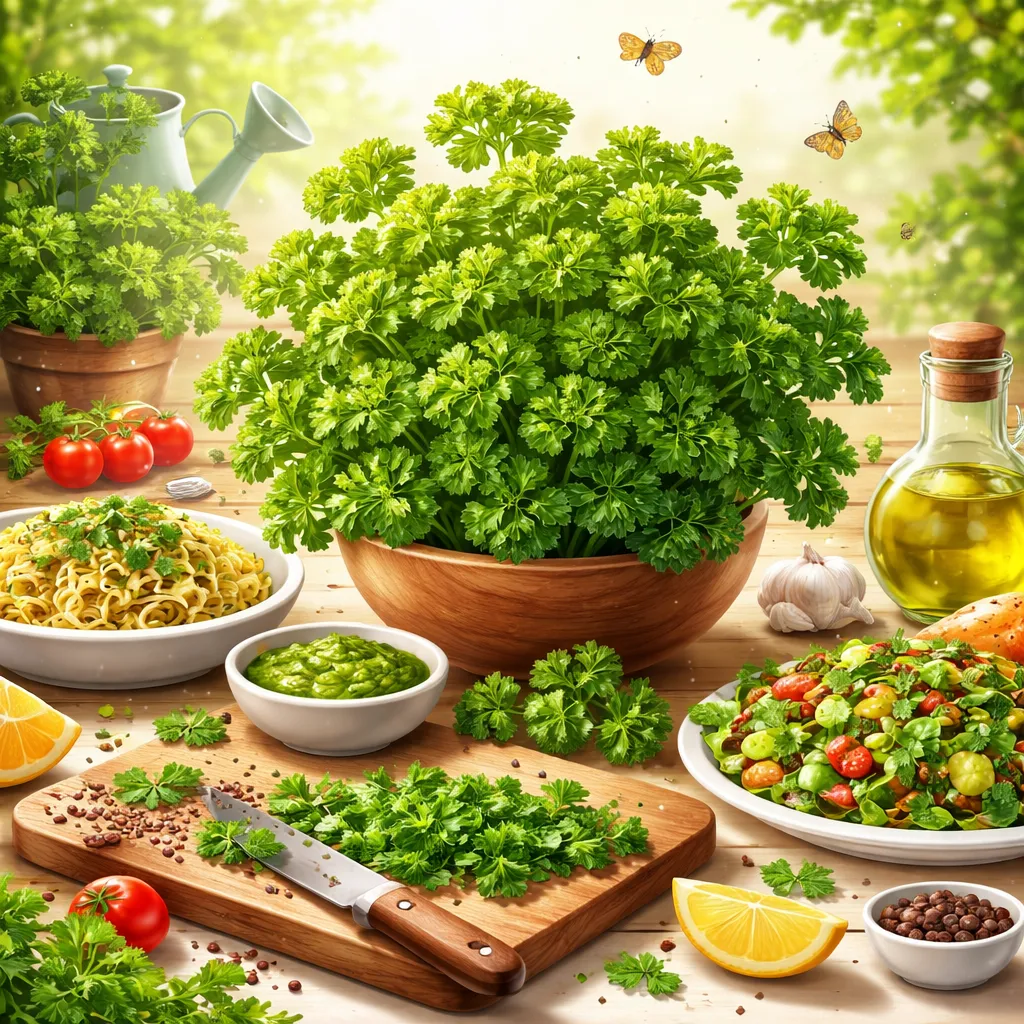

Have you ever looked at a plate of delicious food and seen a little sprig of bright, curly green leaves on the side? That fresh, cheerful touch is almost always parsley! It’s not just a pretty decoration. This plant is a super healthy herb that people have used for thousands of years to add a clean, fresh taste to soups, salads, and sauces. It grows in a beautiful, lush green clump. Let’s discover the story of the friendly and familiar Parsley plant.
Let’s Learn the Word! – Open the Treasure Box of Language
Formal Name and Pronunciation
This fresh green herb is called Parsley. Its scientific name is Petroselinum crispum. You can say it like this: /ˈpɑːr.sli/ (PAR-slee). The “Pars” rhymes with “cars,” and “ley” sounds like “lee.” Par-sley. Say it: Parsley. It’s a bright, breezy-sounding word.
The Etymology Tale
The name “Parsley” has rocky roots! It comes from the Greek words “petros” (rock) and “selinon” (celery). So, it means “rock celery,” because wild parsley was first found growing in rocky soils in the Mediterranean region. It’s a cousin to celery! Its name tells us about its first home.
Nicknames and Friendly Aliases
Parsley is known by the shape of its leaves. The most common type is Curly Parsley or Common Parsley. The flat-leaf kind is Italian Parsley or Flat-Leaf Parsley. Because it is used so much in cooking, it is simply called a Culinary Herb. In some places, the root is eaten and called Hamburg Parsley or Turnip-Rooted Parsley.
Building Your Word Web: Core Parts
Let’s learn the words for a Parsley plant’s friendly body. The Leaf is the main part—it can be tightly curled or flat and divided. The Stem is grooved and hollow. The Taproot is a long, thick root (especially in Hamburg parsley). The Flower is small, yellow-green, and grows in an umbrella-shaped cluster. A Sprig is a small stem with several leaves. A Bunch is many sprigs together. A Clump of plants is a parsley patch.
Action and State Words
Parsley plants are patient growers. They are biennial—they live for two years. In the first year, they grow a leafy clump. In the second year, they shoot up a tall flower stalk. Leaves are harvested by cutting. The plant is used as a garnish or seasoning. A parsley plant is lush, bright green, slow-to-sprout, and nutritious.
Ecosystem Friends Vocabulary
A parsley patch is a nursery! It is a host plant for the beautiful Black Swallowtail butterfly. The butterfly lays its eggs on the leaves, and the caterpillars munch on them as they grow. The flowers attract other beneficial insects like parasitic wasps that help control garden pests. Growing parsley is a way to help butterflies!
Cultural Imprint in Language
Parsley is linked to freshness, celebration, and even superstition. The ancient Greeks crowned their heroes with parsley wreaths. An old saying is, “Parsley on the plate brings a smile to your mate,” meaning it makes a meal look happy and complete. In some older tales, it was said parsley seeds went to the devil and back nine times before sprouting, which is why they take so long to grow! It represents new beginnings and patience.
Ready for Discovery
We know its fresh, rocky-celery name. Are you ready to be a garden detective and discover why this common herb is a butterfly’s best friend? Let’s explore the life of the Parsley plant.
Discover the Plant’s Secrets! – A Nature Detective’s Notebook
The Plant Passport
Parsley belongs to the Apiaceae family, the carrot and celery family. Its scientific name is Petroselinum crispum. It is a biennial herb. In the first year, it forms a low, bushy rosette of bright green leaves. In the second year, it sends up a tall flowering stem that can reach 3 feet. The leaves are divided and can be curly or flat. It grows best in cooler weather and rich, moist soil. It is grown all over the world.
Survival Smarts
Parsley’s first trick is patience. Its seeds are slow to germinate (sprout), sometimes taking 3-4 weeks. This may be a way to wait until conditions are just right. As a biennial, it stores energy in its roots during the first year to power big growth and seeding in the second. The chemicals that give it its fresh taste may help protect it from some pests. It is a tough plant that can handle a light frost.
Its Role and Gifts
In the garden, parsley is a beneficial insect magnet. Its greatest gift is its nutritional value. Parsley is packed with vitamins (especially Vitamin C and K) and minerals. The leaves are used as a vibrant garnish that actually helps digestion. They are chopped into salads, sauces (like gremolata), soups, and stews. The root of Hamburg parsley is cooked as a vegetable. It is a true “super-herb.”
Human History and Cultural Symbol
Parsley has been cultivated for over 2,000 years. The Romans used it to cover strong food smells and to make wreaths. Charlemagne ordered it grown in his gardens in the 9th century. It spread throughout Europe and was brought to the Americas by early settlers. Today, it is one of the most common and recognizable herbs worldwide. It symbolizes cleanliness, health, and the simple pleasure of a fresh meal.
Fun “Wow!” Facts
Get ready for a butterfly fact! If you see a green, black, and yellow striped caterpillar on your parsley, congratulations! You are hosting a Black Swallowtail butterfly caterpillar. Just plant a little extra parsley to share. And here’s a breath fact: Chewing on a sprig of fresh parsley is a natural way to freshen your breath after a meal!
From Seed to Second Year
The story of the Parsley plant is one of patience and partnership. Would you like to grow your own butterfly café and kitchen helper? You can grow parsley easily in a pot or garden! Let’s see how.
Let’s Grow It Together! – A Little Guardian’s Action Guide
Good for Home Growing?
Yes, it’s excellent! Parsley is a perfect container plant. It stays in a neat, leafy clump in its first year. You can grow it in a medium-sized pot on a sunny windowsill, balcony, or in a garden bed. It’s a must-grow for any child who wants to attract butterflies. The hardest part is waiting for the seeds to sprout!
Little Gardener’s Toolkit
You will need a packet of parsley seeds (choose curly or flat-leaf). Get a medium pot with drainage holes. Use rich, moist potting soil. Have a watering can, a sunny spot, and a big dose of patience ready.
Step-by-Step Growing Guide
Planting Your Patient Friend
Plant seeds in early spring or late summer. Parsley likes cool soil. Soak the seeds in warm water overnight to help them wake up. Plant them about ¼ inch deep. Water the soil well. Keep the soil moist. Place the pot in a spot that gets sun for part of the day. Mark your calendar and be patient—it can take 3 weeks to see green!
Care Calendar
Keep the soil consistently moist, not soggy. It likes morning sun and afternoon shade in hot climates. You can feed it with a little liquid fertilizer every few weeks. The most important care is to keep picking the outer leaves! This tells the plant to make more. In the first year, you’ll have leaves until winter.
Watch and Be Friends
Watch closely for the first little loops of green. Then see the first true parsley leaves form. Watch your plant become a beautiful, green fountain. Check the leaves for tiny yellow eggs or striped caterpillars—you might be raising butterflies! Harvest by cutting stems from the outside. In the second spring, watch it shoot up a tall stalk and make lacy flowers.
Problem Diagnosis
If the plant turns yellow, it might need more nitrogen (try a little fertilizer) or less water. If it gets tall and leggy, it needs more sun. Aphids might visit; spray them off with water. The most common “problem” is giving up on the seeds before they sprout. Be patient, they are worth the wait!
Your Rewards and Gifts
Your gift is growing your own freshness and supporting wildlife. You are learning about plant life cycles, beneficial insects, and the satisfaction of growing a kitchen staple. Caring for parsley teaches deep patience, daily observation, and the joy of sharing your garden with beautiful creatures. You become a grower of life.
Creative Fun
Start a Butterfly Café Journal. Draw your parsley plant. Press a curly leaf. With an adult, make a simple parsley pesto or add chopped parsley to scrambled eggs. Create a “life cycle” drawing of the Black Swallowtail butterfly. Design a restaurant menu and draw parsley garnishes on every dish. Write a “Please Take One” sign for caterpillars next to your plant. Make a crown from parsley stems and leaves, like an ancient Greek hero.
Growing a Circle of Life
By planting parsley, you are not just growing an herb. You are growing a habitat, a lesson in patience, and a direct connection to your food and local ecosystem. You are a cultivator of freshness and life.
Conclusion and Forever Curiosity
What a fresh, patient, and life-filled journey! You started to learn about the Parsley plant, you discovered its secrets as the slow-sprouting, butterfly-hosting biennial hero of the kitchen, and you learned how to nurture your own patch of green. You now know the Parsley plant is not just a garnish; it is a butterfly nursery, a package of vitamins, a lesson in the value of waiting, and a global symbol of a finished, beautiful meal. Remember, its true value unfolds with time, just like its seeds. Your curiosity helps you see the incredible connections in your garden, from the soil to the plate to the butterfly. Keep planting seeds of all kinds, watching for the small wonders, and tasting the fresh rewards of your care. Your adventure to learn about the Parsley plant shows us that the most common, bright green leaves can hold stories of history, science, and beautiful, fluttering life.