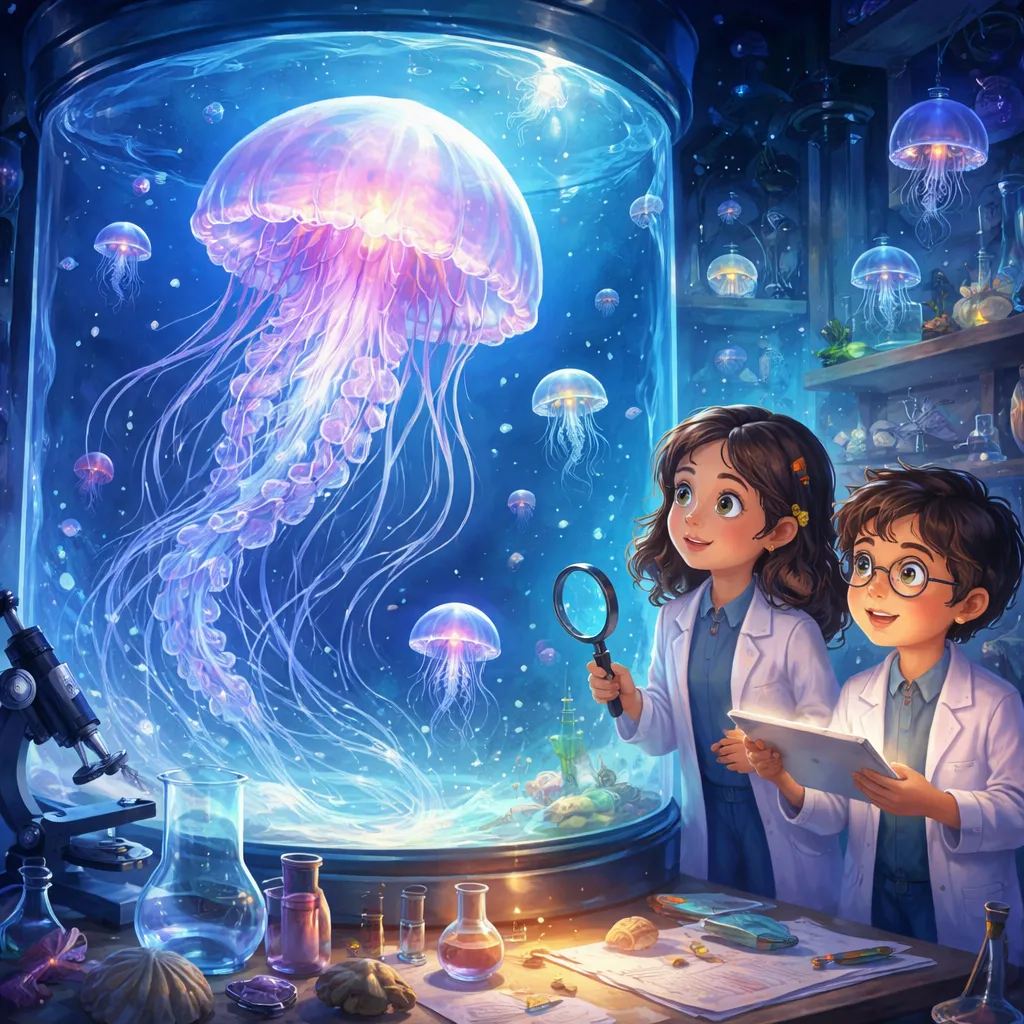

Imagine you’re walking on a beach and you see a clear, blobby shape washed up on the sand, or you’re at an aquarium watching a beautiful, pulsing creature with long, flowing ribbons drift peacefully in a tank. That’s a jellyfish! These ancient and graceful animals have been swimming in our oceans for millions of years. Learning about jellyfish is a mesmerizing adventure into a world of simple beauty and fascinating biology. Let’s begin our journey of learning about jellyfish float and flow.
English Language Learning
Vocabulary and Spelling Our graceful, drifting friend is called a jellyfish. The word "jellyfish" is a noun. A noun names a person, place, or thing. So, a jellyfish is a thing—a soft, living animal of the ocean. Spelling "jellyfish" is two words put together: J-E-L-L-Y and F-I-S-H. J-E-L-L-Y-F-I-S-H spells jellyfish.
Sound and Pronunciation Let’s say the word correctly. It sounds like this: /ˈdʒel.i.fɪʃ/. We can say it in three clear parts. First, say "jell". It rhymes with "bell". Next, say "ee". It’s a long 'e' sound. Last, say "fish". It’s the same as the animal, a fish. Now, put it together! "Jell" "ee" "fish". Jellyfish! Great! The word "jellyfish" has three beats, or three syllables. Clap three times: Jel-ly-fish. It’s a soft, wobbly word.
Related Words Learning about jellyfish is more fun with new words! Here are some important ones. Body Part: The long, trailing threads of a jellyfish are tentacles. The main bell-shaped body is the bell or umbrella. Group: A group of jellyfish is called a smack, a bloom, or a swarm. Baby: A baby jellyfish, in one stage of its life, is called an ephyra.
A Famous Idea Because of their delicate and floating nature, people sometimes say: "As delicate as a jellyfish." This means something is very fragile, gentle, and must be handled with care. It reminds us to be gentle and appreciate the fragile beauty in the world. Say the idea with me: "As delicate as a jellyfish." It’s about handling things gently.
Now you know the word "jellyfish"! Are you ready to float into some amazing facts? Let’s drift from words to wonderful knowledge!
Animal Knowledge
Who Are They? – Family and Group What kind of animal is a jellyfish? Jellyfish are very simple animals called invertebrates. They have no bones, no brain, and no heart! They are not actually fish at all. They are part of the Cnidaria family. Their name comes from the Greek word for "stinging nettle." Their close cousins are sea anemones and corals. They are some of the oldest animals on Earth.
What Do They Look Like? – Amazing Bodies Jellyfish come in many sizes, from as small as your fingernail to larger than a person! Most have a see-through, bell-shaped body and long, stringy tentacles. Their most famous features are their gelatinous, see-through bodies and their stinging tentacles. Their body is 95% water! The bell is made of a jelly-like substance called mesoglea. Their tentacles are lined with special stinging cells called nematocysts. These are like tiny harpoons that shoot out to sting prey or for defense. Jellyfish have special adaptations. They are drifters, carried by ocean currents. They pulse their bell to move up and down in the water. They have a simple nervous system that can sense light, smell, and touch, but they don’t have a centralized brain.
Where Do They Live and How? – Home and Habits Jellyfish live in every ocean, from the surface to the deep sea. Some even live in fresh water! Their home is the open ocean, coasts, and estuaries. Jellyfish are carnivores. This means they are meat-eaters. They eat tiny plankton, fish eggs, and small fish. They catch their food by drifting with their tentacles outstretched. When something touches a tentacle, the stinging cells fire, and the tentacle brings the food to the mouth. Jellyfish are usually solitary but can gather in huge groups called blooms. They are active at all times. They spend their time drifting, pulsing gently, and feeding. They do not hunt actively but are passive drift-net feeders.
A Jellyfish’s Life Story – Growing Up A baby jellyfish starts as a planula larva. Jellyfish have a two-part life cycle that is super strange! They can reproduce both sexually (making larvae) and asexually (cloning themselves). The adult jellyfish (called a medusa) releases eggs and sperm into the water. The fertilized egg becomes a tiny larva that swims away and attaches to a rock. It grows into a polyp, which looks like a tiny sea anemone. This polyp is the second stage! It can clone itself, making stacks of tiny jellyfish discs. These discs pop off one by one and become tiny jellyfish called ephyra. The ephyra grows into the adult medusa. So, a jellyfish has two completely different body forms!
How Do They "Talk"? – Communication Jellyfish are very simple animals. They do not talk in any way we understand. They have no brain for thinking or making decisions. They can sense their environment. They have a simple nerve net that helps them react to touch, light, and chemicals in the water. If they are touched, they might pulse away or sting. Their best sense is their ability to sense light and chemicals. Some jellyfish have simple eyespots that can tell light from dark, which helps them know which way is up. They can also sense smells in the water to find food.
Are They Okay? – Taking Care of Them Jellyfish populations are generally doing very well. In fact, in some places, there are too many because of changes in the ocean. But they are important parts of the ecosystem. The main threats to jellyfish are not to their survival, but to the balance of the ocean. Pollution, overfishing of their predators, and warmer water can cause huge "jellyfish blooms" that cause problems. Plastic bags in the ocean look like jellyfish to animals that eat them, like sea turtles. You can be a jellyfish friend! The best thing you can do is help the ocean. You can reduce plastic use, especially single-use bags. You can keep beaches clean. If you see a jellyfish in the water or on the beach, admire it from a safe distance and never touch it.
Life Connections and Inspiration
How to Be With Them – Safety and Love Jellyfish are beautiful but can be dangerous because of their sting. We must admire them with caution and respect. The rule is: Look with your eyes, not with your hands. If you see a jellyfish in the water while swimming, calmly swim away. Never touch a jellyfish, even if it is on the beach—it can still sting! If you are stung, tell an adult right away. They can help rinse it with salt water (not fresh water) and use something like vinegar if advised. We show our love by being safe and by protecting the clean ocean they live in. We can be careful visitors to their watery world.
Super Qualities We Learn from Them Jellyfish teach us profound lessons. One super quality is resilient adaptability and going with the flow. Jellyfish have survived for hundreds of millions of years by being simple, adaptable, and drifting with the currents. They teach us that sometimes, resilience means being flexible, adapting to changes, and not fighting against every current. Another quality is the beauty of simplicity and ancient design. A jellyfish is a very simple creature, yet it is perfectly designed for its life in the ocean. It reminds us that complexity isn't always better, and that there is grace and efficiency in simple, ancient designs. Think about it: When is a time you can "go with the flow" instead of fighting against a situation? What is something simple that you find beautiful or perfectly made?
Take Action! – Your "Jellyfish in a Bottle" Project Let’s do a gentle and creative activity! Your project is to create a calming jellyfish in a bottle. Take a clear plastic bottle and fill it with water. Cut a thin, clear plastic bag into the shape of a jellyfish bell. Make several long, thin strips for tentacles and attach them. Put your jellyfish in the bottle, seal the lid, and add a drop of blue food coloring if you like. Gently turn the bottle and watch your jellyfish float and drift. This shows the peaceful, drifting movement of a real jellyfish.
Closing Learning about jellyfish mysteries is a calming and wondrous adventure! We learned the word "jellyfish" and how to say its three-part name. We discovered amazing facts about their stinging cells, their two-part life cycle, and their life as ancient ocean drifters. We know that jellyfish are resilient, simple creatures that remind us of the ocean's delicate balance. You can use your new words to share the fascinating story of these gelatinous swimmers. You can use your knowledge to be a safe and responsible ocean lover. The animal world is full of resilient and simple teachers. Always remember to respect wildlife from a safe distance, be adaptable and go with the flow when needed, and appreciate the beauty in simple, ancient designs. Keep exploring with a sense of wonder, float through challenges with grace, and be a friend to the wild. Your thoughtful actions and gentle spirit make you a true friend to the amazing jellyfish.