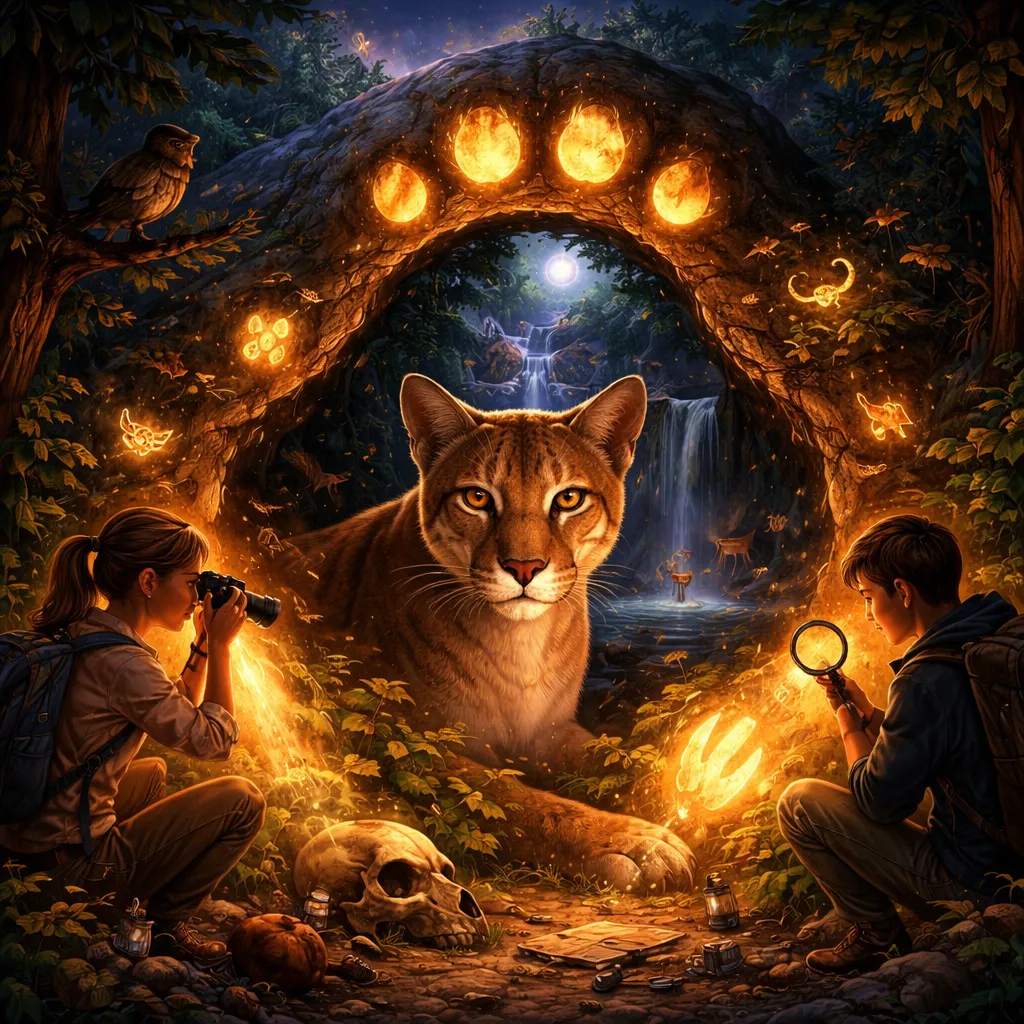

Have you ever heard of a mountain lion, a puma, or a panther? These are all names for the same amazing animal: the cougar! It is a large, powerful cat that roams the mountains, forests, and even deserts of the Americas. Learning about cougars is a quiet adventure into the world of a secretive and graceful hunter. Let’s move silently and start our journey of learning about cougar mysteries.
English Language Learning
Vocabulary and Spelling Our stealthy big cat is called a cougar. The word "cougar" is a noun. A noun names a person, place, or thing. So, a cougar is a thing—a large, wild cat. Spelling "cougar" is straightforward: C-O-U-G-A-R. The 'C' starts the word, the 'O' and 'U' are in the middle, and it ends with 'G-A-R'. C-O-U-G-A-R spells cougar.
Sound and Pronunciation Let’s say the word correctly. It sounds like this: /ˈkuː.ɡɚ/. We can say it in two clear parts. First, say "coo". It sounds like the noise a dove makes, "coo". Next, say "ger". It’s a soft sound, like the end of "tiger". Now, put it together! "Coo" "ger". Cougar! Great! The word "cougar" has two beats, or two syllables. Clap your hands twice: Cou-gar. It’s a smooth, quiet word.
Related Words Learning about cougars is more fun with new words! Here are some important ones. Baby: A baby cougar is called a cub or a kitten. Action: Cougars are experts at stalking and pouncing on their prey. They are ambush hunters. Home: The large area where a cougar lives and hunts is called its territory.
A Famous Saying People sometimes say: "As silent as a cougar." This means to be very, very quiet. Cougars are known for moving through the forest without making a sound. It’s a way to describe someone who is stealthy and moves with great care. Say the phrase with me: "As silent as a cougar." Can you tiptoe as quietly as a cougar?
Now you know the word "cougar"! Are you ready to stalk into some amazing facts? Let’s prowl from words to wonderful knowledge!
Animal Knowledge
Who Are They? – Family and Group What kind of animal is a cougar? Cougars are mammals. They have fur, are warm-blooded, and mother cougars feed their babies milk. They are part of the cat family, but they are not considered one of the "big cats" that can roar. They are in a group called Puma. They are more closely related to house cats and can purr!
What Do They Look Like? – Amazing Bodies Cougars are large, powerful cats, about the size of a very big dog. They have short fur that is usually a tan or brownish-gray color. Their most famous features are their long, thick tail and their powerful back legs. They have a uniform color with no spots, but their cubs are born with spots and blue eyes. Their long tail helps them balance when running and jumping. They have large paws and sharp, retractable claws. Cougars have special adaptations. They are built for power and stealth. They have excellent night vision and can jump up to 18 feet straight up in the air! Their flexible spine helps them make quick turns.
Where Do They Live and How? – Home and Habits Cougars live in the Americas, from Canada all the way down to South America. Their homes are mountains, forests, swamps, and even deserts. They are very adaptable and can live in many different places. Cougars are carnivores. This means they are meat-eaters. They hunt animals like deer, elk, and smaller mammals. They are solitary hunters and usually hunt at night or at dawn and dusk. Cougars are solitary and secretive. They are most active at night, making them nocturnal. They spend their time patrolling their large territory, hunting, and resting. A male cougar’s territory can be as big as 100 square miles!
A Cougar’s Life Story – Growing Up A baby cougar is called a cub or kitten. Cougars are mammals, so cubs are born live from their mother. A mother cougar usually has one to six tiny, spotted cubs at a time. The mother cougar is a fierce and caring protector. She hides her cubs in a den, like a cave or thick brush. She feeds them milk and later teaches them how to hunt. The cubs stay with her for up to two years. Cubs are born with blue eyes and spots on their fur, which help them hide. The spots fade as they grow older. They learn everything from their mother and then leave to find their own territory.
How Do They "Talk"? – Communication Cougars are usually quiet, but they can make many sounds. They growl, hiss, purr, and chirp. They do not roar. Mothers call their cubs with a soft whistle or chirp. They use scent marking a lot. They scratch trees and leave droppings to mark the borders of their territory. This tells other cougars, "This is my area." Their best senses are their incredible hearing and eyesight. They can hear the smallest rustle and see very well in the dark, which helps them hunt at night.
Are They Okay? – Taking Care of Them Cougar populations are generally stable, but they face challenges. In some areas, they are threatened by habitat loss and conflict with people. The main threats are people building houses and roads in their habitat, which fragments their territory. Sometimes they are hunted, and they can get hit by cars. Conflicts can happen if they prey on farm animals. You can be a cougar friend! You can learn and teach others about these important predators. You can support groups that protect wild corridors so cougars can move safely between areas. If you live in cougar country, you can keep pets indoors and remove food that might attract them.
Life Connections and Inspiration
How to Be With Them – Safety and Love Cougars are wild, powerful predators. We must always respect them and keep a very safe distance. The rule is: Observe from an extreme distance. We watch them in nature documentaries or at zoos with large, natural habitats. In the wild, we never try to approach a cougar. If you are hiking in cougar country, go in groups, make noise, and keep children close. If you see a cougar, do not run. Stand tall, make yourself look big, and back away slowly. We show our love by protecting the vast wild spaces they need to roam and hunt. We can be voices for keeping wilderness areas connected and healthy.
Super Qualities We Learn from Them Cougars teach us wonderful things. One super quality is quiet independence and self-reliance. Cougars live and hunt alone, relying on their own skills and strength. They teach us to be confident, to rely on ourselves, and to be comfortable in our own company. Another quality is patience and perfect timing. Cougars can wait silently for the perfect moment to strike. They remind us that being patient, watching carefully, and choosing the right moment can lead to success in our own tasks and goals. Think about it: When is a time you had to be independent and rely on your own skills? How can you practice patience in your daily life, like waiting for your turn or working on a long project?
Take Action! – Your "Cougar Territory" Project Let’s do a fun and independent activity! Your project is to create a map of a cougar’s territory. On a large piece of paper, draw a landscape with mountains, forests, a river, and a meadow. This is your cougar’s home. Mark the boundaries of its territory. Draw important places: a den for resting, a lookout point, a deer trail for hunting. Now, draw a simple cougar and cut it out. Move your cougar around the map, telling a story about its day. Where does it go to drink? Where does it hunt? Where does it rest? This shows how a cougar uses its large home range.
Closing Learning about cougar secrets is a thrilling adventure! We learned the word "cougar" and how to say its two-part name. We discovered amazing facts about their silent stalking, their solitary life, and their adaptability. We know that cougars are patient, independent animals who are important members of their ecosystem. You can use your new words to share the hidden life of these great cats. You can use your knowledge to understand the importance of predators and wild spaces. The animal world is full of patient and self-reliant teachers. Always remember to respect all wildlife from a safe distance, value your own independence, and move through life with patience and good timing. Keep exploring with quiet curiosity, be confident in your own abilities, and be a voice for the protection of wilderness. Your observant eyes and caring heart make you a true friend to the mysterious cougar.