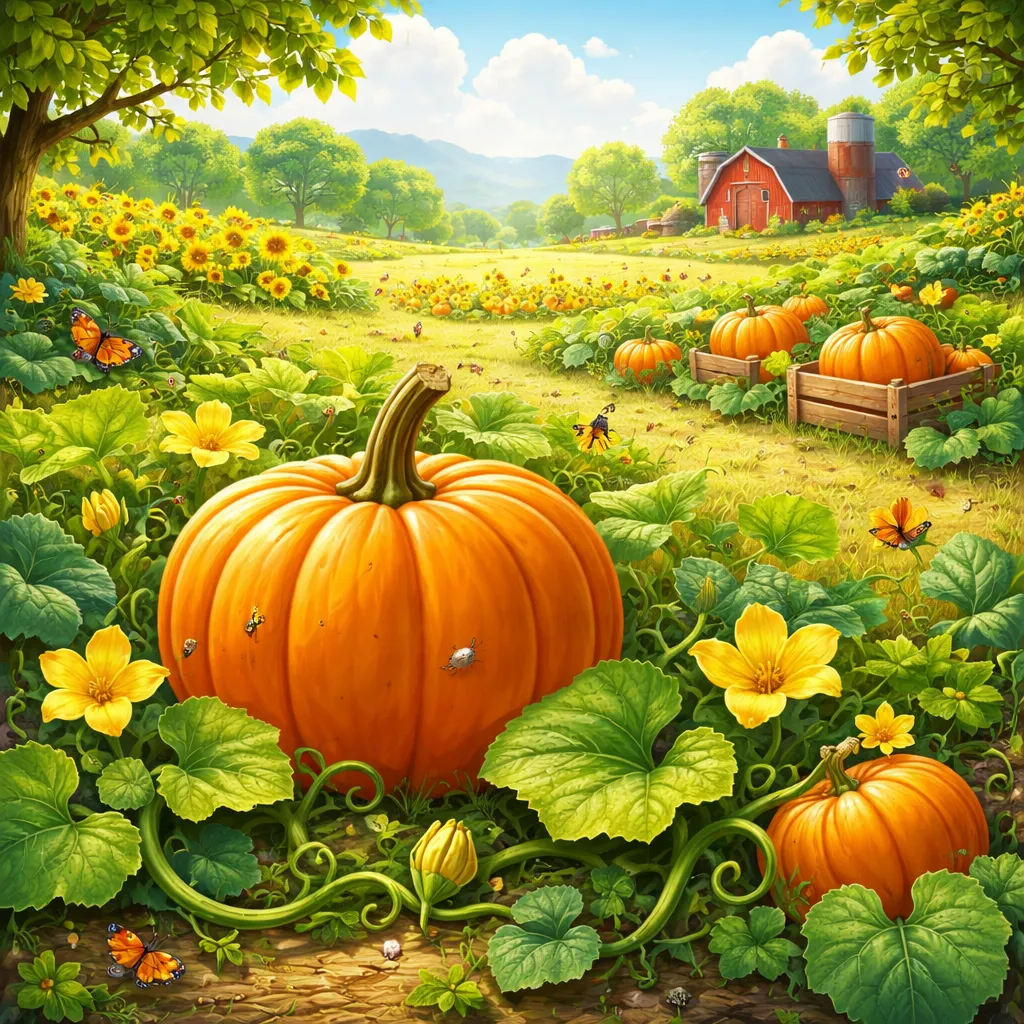

Imagine the biggest, most famous vegetable of autumn. It’s round, orange, and perfect for carving into a glowing jack-o’-lantern! This amazing plant grows from a tiny seed into a giant, sprawling vine that can take over a whole garden. In summer, it has huge leaves and bright yellow flowers. Then, little green balls appear and swell into the big, beautiful pumpkins we love. Let’s get ready for a giant adventure to learn about the incredible Pumpkin plant.
Let’s Learn the Word! – Open the Treasure Box of Language
Formal Name and Pronunciation
This autumn giant is called a Pumpkin. Its scientific name is Cucurbita pepo. You can say it like this: /ˈpʌmp.kɪn/ (PUMP-kin). The “Pump” rhymes with “jump,” and “kin” is like family. Pump-kin. Say it: Pumpkin. It’s a plump, fun word.
The Etymology Tale
The word “Pumpkin” has a cozy history. It came from the Greek word “pepōn,” meaning a large melon. This became the Latin “pepon” and the French “pompon.” In English, it became “pumpion” and finally “pumpkin.” Its name is all about being a big, round, ripe fruit.
Nicknames and Friendly Aliases
Pumpkins have many festive names. They are often called Autumn Squash or Field Pumpkins. Small, sweet ones are Sugar Pumpkins or Pie Pumpkins. The giant ones grown for contests are Atlantic Giants. A white pumpkin is a Ghost Pumpkin. Because they are a type of squash, they are in the Winter Squash family.
Building Your Word Web: Core Parts
Let’s learn the words for a Pumpkin plant’s giant body. The Vine is the long, thick, hairy stem that runs along the ground. The Leaf is enormous, shaped like a spiky heart. The Flower is a big, bright yellow trumpet. The Fruit is the pumpkin itself—a giant berry called a pepo. The Stem is the hard, woody handle on top. The Tendril is the curly thread that helps the vine climb. A Pile of pumpkins is a pumpkin patch.
Action and State Words
Pumpkin plants are space-taking growers. The vine sprawls and runs across the ground. The large leaves shade the soil. The flowers are pollinated by bees. The fruit swells and ripens from green to orange. Pumpkins are harvested by cutting the stem. A pumpkin plant is sprawling, hairy, sun-loving, and annual.
Ecosystem Friends Vocabulary
A pumpkin patch is a mini jungle habitat. The big, shady leaves are perfect hiding spots for toads, lizards, and spiders. The huge yellow flowers are a favorite restaurant for bumblebees and squash bees, which are essential for pollination. Sometimes, squash bugs or vine borers (pests) might visit. It’s a whole world under those leaves.
Cultural Imprint in Language
The pumpkin is a powerful symbol of harvest, autumn, and magic. It is central to Halloween and Thanksgiving. The story of Cinderella features a pumpkin turned into a carriage! The phrase “turn into a pumpkin” means it’s very late and time to go home, from the Cinderella tale. Pumpkins represent transformation, abundance, and festive joy.
Ready for Discovery
We know its big, round, festive name. Are you ready to be a garden explorer and discover how a tiny seed can make a fruit that’s bigger than a basketball? Let’s explore the giant world of the Pumpkin plant.
Discover the Plant’s Secrets! – A Nature Detective’s Notebook
The Plant Passport
Pumpkin belongs to the Cucurbitaceae family, the gourd family. Its genus is Cucurbita. It is a tender, warm-season annual vine. The vines can grow over 20 feet long! The leaves are huge, sometimes wider than a dinner plate. The flowers are bright yellow and separate into male and female. The fruit is a type of berry with a hard rind. It is native to North America and loves hot summers with lots of space, sun, and water.
Survival Smarts
The pumpkin vine is a master of space and sun. It grows incredibly fast, sending out long runners to cover the ground. This smothers weeds and claims territory. The huge leaves act like solar panels, catching as much sunlight as possible. The hairy stems and leaves can help protect against some pests. The hard, thick rind of the ripe pumpkin protects the seeds inside through the winter, a perfect storage system.
Its Role and Gifts
In a garden, pumpkin vines form a living mulch, keeping the soil moist and cool. Its greatest gifts are its fruit and seeds. Pumpkin flesh is used for pies, soups, and roasts. The seeds (pepitas) are a tasty, healthy snack. The flowers are edible too! Pumpkins are also grown for decoration, feed for animals, and for giant competitions. They are the ultimate gift of the autumn harvest.
Human History and Cultural Symbol
Pumpkins are one of the oldest domesticated plants, grown in the Americas for over 7,000 years. Native American tribes used them as a staple food. Early European settlers learned to grow and cook them, leading to the first Thanksgiving meals. The tradition of carving jack-o’-lanterns came from Irish folklore. The pumpkin represents the deep agricultural history of the Americas and the joy of the harvest season.
Fun “Wow!” Facts
Get ready for a weight fact! The world record for the heaviest pumpkin is over 2,700 pounds—that’s as heavy as a small car! And here’s a flower fact: You can tell male and female pumpkin flowers apart. Females have a tiny, baby pumpkin at the base of the flower. Males just have a thin stem.
From Tiny Seed to Giant Gourd
The story of the Pumpkin plant is the story of summer patience and space. Would you like to grow your own piece of autumn magic? You can try growing a pumpkin in a very large space! Let’s see how.
Let’s Grow It Together! – A Little Guardian’s Action Guide
Good for Home Growing?
Yes, but it needs a LOT of room! Pumpkins are not for small pots. They need a huge garden bed or a very large, sunny area where the vines can run. You can try growing a single “bush-type” pumpkin variety in an extra-large raised bed. It’s a long-term, exciting project perfect for a child with a sunny backyard.
Little Gardener’s Toolkit
You will need pumpkin seeds (choose a small variety like ‘Small Sugar’ for first-timers). You need a huge sunny spot with rich soil. Have a watering can, lots of compost or fertilizer, and plenty of patience ready. You might also want a board or tile to place under growing pumpkins to keep them clean.
Step-by-Step Growing Guide
Planting Your Future Giant
Plant seeds directly in the garden after the last frost, when the soil is very warm. Plant 3-4 seeds in a small “hill” of soil, about 1 inch deep. Space hills at least 6 feet apart for large vines. Water well. Choose the sunniest spot in your yard. Pumpkins are sun worshippers.
Care Calendar
Water deeply and regularly, especially when flowers and fruits are forming. They are heavy feeders, so give them liquid fertilizer every 2-3 weeks. The most important job is giving the vines space to roam. Once a few fruits start to form on a vine, you can pinch off the fuzzy end of the vine to tell the plant to focus energy on those pumpkins.
Watch and Be Friends
Watch the first large leaves appear. The vine will start its long journey across the garden. Look for the big yellow flowers. Find a female flower (with a tiny pumpkin at its base) and watch it grow bigger every day. You can carefully lift the growing pumpkin and slide a flat board underneath to keep it from rotting on the damp soil. Measure your pumpkin’s width each week!
Problem Diagnosis
If you have flowers but no pumpkins, you might need more bees for pollination. You can help by using a small paintbrush to move pollen from a male flower to a female flower. If leaves get powdery white mildew, water at the soil, not the leaves. Squash bugs might appear; pick them off. The most common problems are not enough sun or space.
Your Rewards and Gifts
Your gift is the magic of growing your own Halloween! You are learning about pollination, plant energy, and patience on a giant scale. Caring for a pumpkin teaches long-term planning, observation, and the awesome satisfaction of harvesting something you nurtured from a seed smaller than your fingernail. You become a grower of autumn magic.
Creative Fun
Start a Giant’s Growth Journal. Draw your vine’s progress. Measure the length of the vine and the width of the fruit. Paint your harvested pumpkin instead of carving it. With an adult, bake pumpkin seeds with a little salt for a snack. Research Native American Three Sisters gardening (corn, beans, squash) and draw a picture. Create a “pumpkin character” and write a short story about its life in the patch. Build a tiny scarecrow to watch over your pumpkin patch.
Growing a Patch of Autumn
By planting a pumpkin, you are not just growing a vegetable. You are growing a living lesson in agriculture, a connection to history and holidays, and the most festive centerpiece imaginable. You are a cultivator of joy and tradition.
Conclusion and Forever Curiosity
What a giant, sprawling, and festive journey from a seed to a symbol of harvest! You started to learn about the Pumpkin plant, you discovered its secrets as the space-taking, sun-loving giant of the vine world, and you learned about the patience needed to grow your own piece of autumn. You now know the Pumpkin plant is not just for carving; it is a lesson in exponential growth, a hub for garden life, a historical food source, and a global icon of celebration. Remember, its true potential is unlocked with space, sun, and time. Your curiosity is the seed that grows into giant understanding. Keep making space for big projects, celebrating the harvests of your efforts, and asking about the stories behind our favorite traditions. Your adventure to learn about the Pumpkin plant shows us that the biggest, most joyful things start from the smallest seeds, with plenty of room to grow.