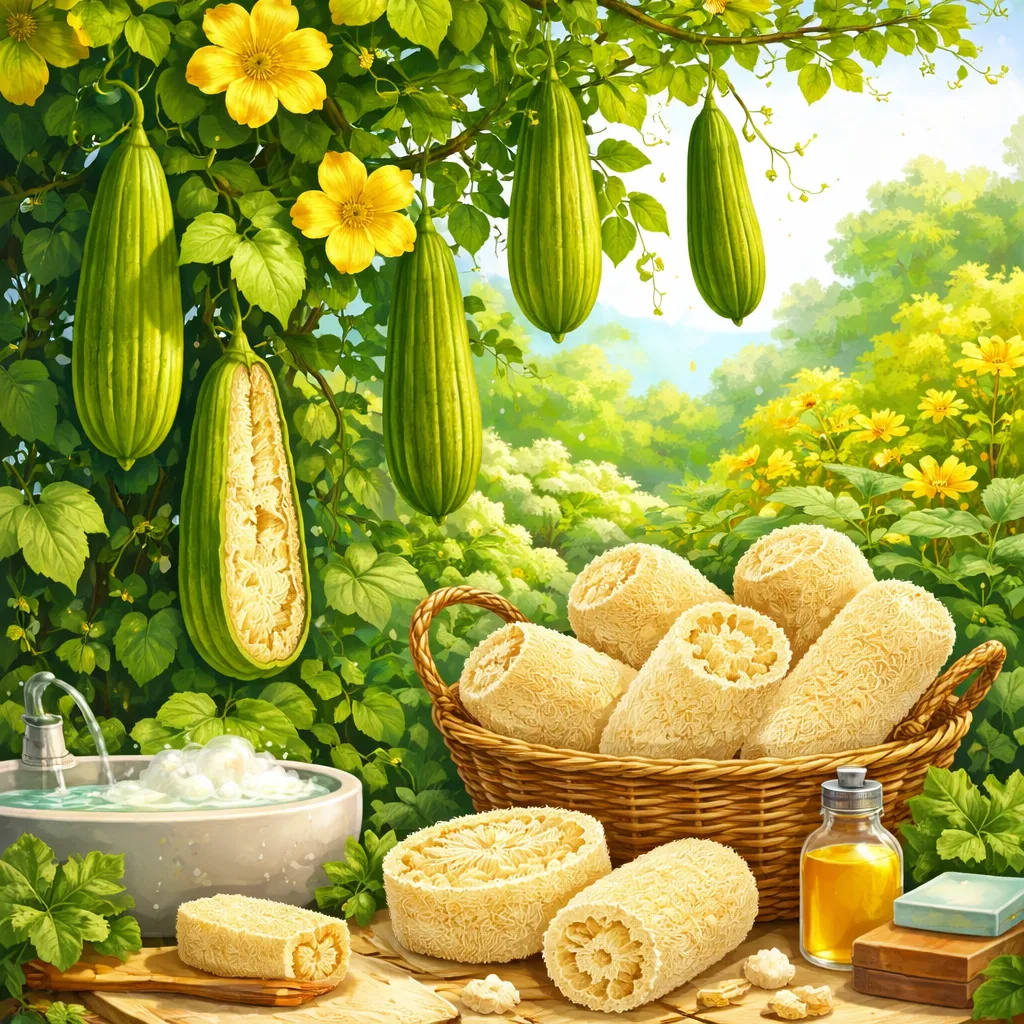

Have you ever seen a rough, scratchy, brown sponge in the bathroom that looks like it’s made from a plant? Believe it or not, that sponge was a plant! It starts as a long, green, ridged vegetable growing on a giant, climbing vine. If you pick and eat it young, it’s a tasty food. If you let it grow old and dry out, it becomes the scrubby sponge you know. It’s a plant with two completely different jobs! Let’s get ready to learn about the incredible, transforming Luffa plant.
Let’s Learn the Word! – Open the Treasure Box of Language
Formal Name and Pronunciation
This amazing transformer is called Luffa. Its scientific name is Luffa aegyptiaca or Luffa cylindrica. You can say it like this: /ˈluː.fə/ (LOO-fuh). It rhymes with “roof” and “uh.” Loo-fa. Say it: Luffa. Many people also call it Loofah.
The Etymology Tale
The word “Luffa” comes from the Egyptian Arabic name for this plant, “lūfā.” Its scientific name aegyptiaca means “from Egypt.” So, its name tells us it has been known and used in North Africa and the Middle East for a very, very long time. Its name is a traveler’s passport!
Nicknames and Friendly Aliases
Luffa is known by names for its two uses. As a young, edible vegetable, it is called Chinese Okra, Vegetable Sponge, or Dishcloth Gourd. As a mature sponge, it is the Loofah Sponge or Natural Sponge. Because it’s a vine, it’s often called the Sponge Gourd.
Building Your Word Web: Core Parts
Let’s learn the words for a Luffa plant’s changing body. The Vine is the long, strong, climbing stem. The Leaf is large, with deep lobes, like a giant hand. The Flower is bright yellow and beautiful. The Fruit is the long, green, cucumber-like gourd. The Fibers are the tough, network inside the dried fruit that becomes the sponge. The Seeds are black, flat, and hiding inside. A Trellis covered in vines is a luffa trellis.
Action and State Words
Luffa plants are vigorous climbers. The vine grows very long and climbs quickly. The flowers are pollinated by insects. The fruit lengthens and swells. It is harvested young for food or old for sponges. The mature fruit is dried, peeled, and shaken to remove seeds. A luffa plant is versatile, fast-growing, heat-loving, and annual.
Ecosystem Friends Vocabulary
A luffa vine is a buzzing, flying cafe. The big, yellow flowers are a favorite of bees and butterflies, which are essential for pollination. The dense leaves provide shade and hiding spots for small creatures. Sometimes, beetles might munch on the leaves. It is a lively, productive part of a summer garden.
Cultural Imprint in Language
Luffa is a symbol of resourcefulness, natural living, and two-in-one usefulness. In many cultures, it represents making the most of what nature provides. There’s a saying, “From dinner to bath time,” showing its dual purpose. It is a plant that teaches us that one thing can have many stages and uses, depending on time and care.
Ready for Discovery
We know its Egyptian, transforming name. Are you ready to be a garden detective and discover the secret fibers that turn a squishy vegetable into a scratchy sponge? Let’s explore the amazing world of the Luffa plant.
Discover the Plant’s Secrets! – A Nature Detective’s Notebook
The Plant Passport
Luffa belongs to the Cucurbitaceae family, the cucumber and pumpkin family. Its genus is Luffa. It is a vigorous, annual climbing vine that can grow over 30 feet long! The leaves are large and lobed. The flowers are bright yellow. The fruit is a cylindrical gourd with ridges. When mature and dried, the inside reveals a complex network of tough, fibrous xylem tissue—the sponge! It is native to tropical Asia and Africa and loves intense heat and a long growing season.
Survival Smarts
Luffa’s genius is in its fruit’s structure. The network of tough fibers inside the mature gourd acts as a super-strong skeleton. In the wild, as the fruit dries and the outer skin breaks, this fibrous network helps the seeds disperse by wind or animals. The vine itself is a champion climber, using curling tendrils to reach the sun high above the ground. Its fast growth helps it beat other plants for sunlight in the hot, humid climates it loves.
Its Role and Gifts
In the garden, luffa is a fantastic, fast-growing screen or shade provider. Its greatest gifts are its two harvests. The young, tender fruit (under 6 inches) is cooked and eaten like zucchini or okra in stir-fries and curries. The mature, dried fruit is processed to reveal the natural luffa sponge, used for bathing, scrubbing dishes, and even as an eco-friendly scrubbing pad for cleaning. Nothing is wasted.
Human History and Cultural Symbol
Luffa has been used for centuries in Africa, Asia, and the Middle East. Historical records show it was used in ancient Egypt. It spread along trade routes. In many tropical countries, it has been a traditional source of both food and a useful household tool. Today, it is celebrated as a symbol of sustainable, zero-waste living. It represents ancient ingenuity that is still perfectly useful today.
Fun “Wow!” Facts
Get ready for a sponge fact! The luffa sponge is actually the plant’s xylem, the part that normally carries water from the roots to the leaves! When the fruit dries, this water-carrying system becomes the scrubby network we use. And here’s a kitchen fact: The flowers, leaves, and buds of the luffa plant are also edible in some cultures!
From Edible Veggie to Bath Sponge
The story of the Luffa plant is one of patience and transformation. Would you like to grow your own food and sponge factory? You can grow luffa in a sunny spot with a strong trellis! Let’s see how.
Let’s Grow It Together! – A Little Guardian’s Action Guide
Good for Home Growing?
Yes, but it needs a long, hot summer and SPACE! Luffa vines are enormous and need a very sturdy, tall trellis, fence, or arbor to climb. You can grow 1-2 plants in a very large container or in a garden bed. The most fun part is waiting for the gourds to dry at the end of the season to make your own sponge. It’s a season-long adventure.
Little Gardener’s Toolkit
You will need luffa seeds (soak them in water for 24 hours before planting). Get the largest pot you can find or a sunny garden spot. Use rich, well-draining potting soil. Have a super-strong, tall trellis, a watering can, liquid fertilizer, and a very sunny spot ready.
Step-by-Step Growing Guide
Planting Your Future Sponge
Start seeds indoors 6-8 weeks before the last frost. Plant them 1 inch deep. Transplant outside only when the soil is very warm. Plant near the base of your strong trellis. Water well. Luffa needs full, hot sun all day to thrive.
Care Calendar
Water regularly and deeply. The vines are heavy drinkers, especially when flowering and fruiting. Feed with a balanced liquid fertilizer every 2-3 weeks. Train the young vines onto the trellis. The most important job is making sure the trellis is strong enough to hold the heavy, long gourds. You may need to tie larger fruits to the trellis with cloth strips for extra support.
Watch and Be Friends
Watch the vine shoot up the trellis with incredible speed. Admire the big yellow flowers. Watch for tiny green gourds forming. You can harvest them young and tender to eat. To make sponges, let the gourds grow long and turn from green to yellow or brown. Leave them on the vine until the skin feels light and dry, or until the first frost. Then, bring them inside to finish drying.
Problem Diagnosis
If you have flowers but no fruit, it might need help with pollination. You can use a small brush to move pollen from male to female flowers (female flowers have a tiny gourd at the base). If leaves get powdery mildew, water at the soil level, not the leaves. The most common problem is not enough heat or a growing season that is too short for the gourds to fully mature.
Your Rewards and Gifts
Your gift is the magic of transformation. You are learning about plant life cycles, fiber structure, and the patience required for a unique harvest. Caring for luffa teaches long-term planning, the importance of strong support, and the deep satisfaction of making something useful with your own hands. You become a grower and a maker.
Creative Fun
Start a Transformer Gardener’s Journal. Draw the vine and the growing gourds. Weigh a green gourd and then a dry one—feel the difference! When your sponge is ready, decorate it with non-toxic paint or ribbons. With an adult, try a simple stir-fry with a young luffa. Research ancient Egypt and draw a picture of a luffa plant by the Nile. Create a “life cycle” comic strip showing the luffa from seed to sponge. Have a “scrubby test” to see which surface your homemade sponge cleans best.
Growing a Plant of Two Worlds
By planting luffa, you are not just growing a vine. You are growing a living science experiment, a lesson in sustainable resources, and a direct connection to ancient and modern uses. You are a cultivator of utility and wonder.
Conclusion and Forever Curiosity
What a long, climbing, and transforming journey from a seed to a sponge! You started to learn about the Luffa plant, you discovered its secrets as the fast-growing, fiber-packed marvel of the vine world, and you learned how to grow and process your own natural sponge. You now know the Luffa plant is not just one thing; it is a delicious vegetable, a biodegradable scrubber, a lesson in plant structure, and a global symbol of making the most of nature’s gifts. Remember, its true magic is in its ability to change with time. Your curiosity helps you see the potential for transformation in the natural world. Keep planting seeds of wonder, supporting your projects to grow strong, and discovering the many hidden talents of the plants around you. Your adventure to learn about the Luffa plant shows us that with patience and care, one seed can give you dinner and a way to get clean afterwards