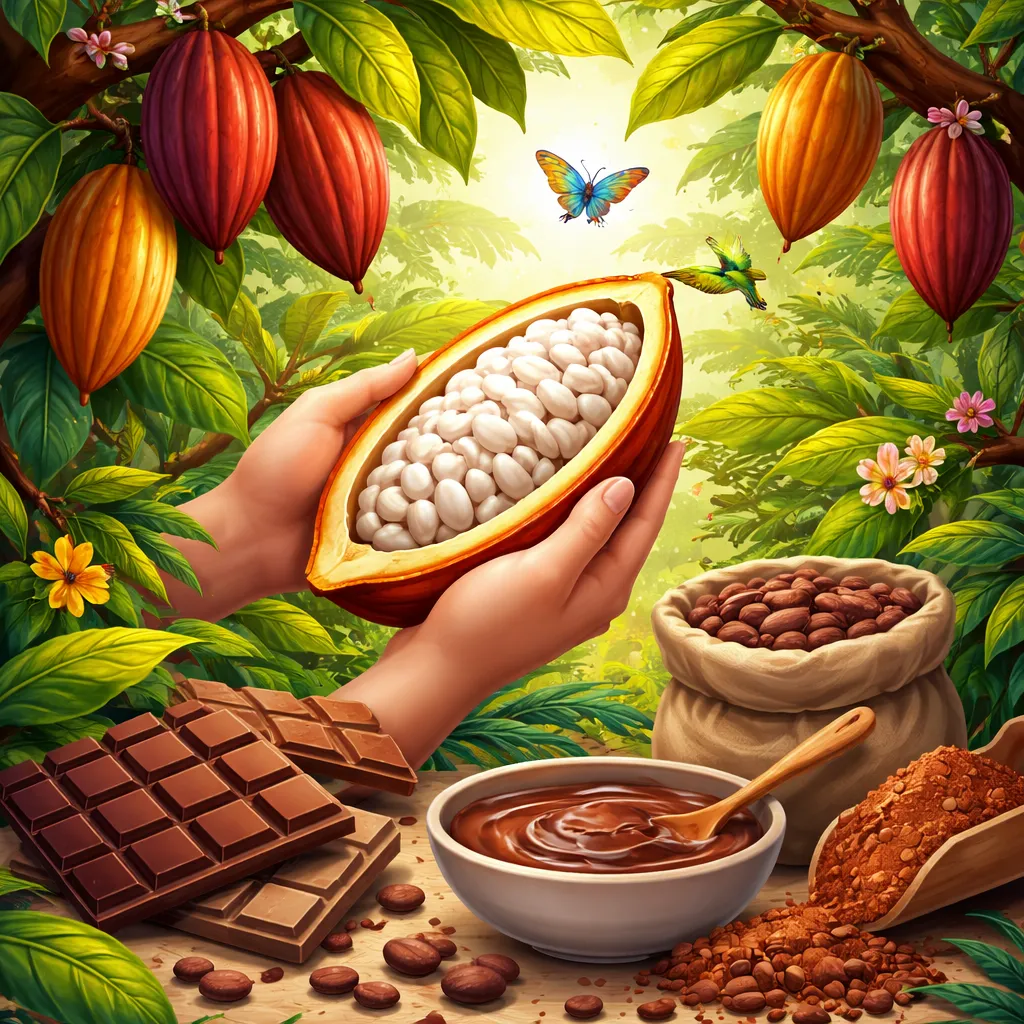

Have you ever taken a bite of smooth, delicious chocolate? It might be a bar, a hot drink, or a cake. That wonderful taste has a magical beginning. It doesn’t start in a factory. It starts in a hot, steamy rainforest, on the trunk of a strange and beautiful tree. This tree grows large, colorful pods that look like lumpy footballs! Inside these pods, surrounded by sweet, white pulp, are the precious beans that become chocolate. Let’s embark on a sweet adventure to learn about the incredible Cocoa plant.
Let’s Learn the Word! – Open the Treasure Box of Language
Formal Name and Pronunciation This magical tree is called the Cocoa plant. It is also called Cacao. Its scientific name is Theobroma cacao. You can say it like this: /ˈkəʊ.kəʊ/ (KOH-koh). The “Co” sounds like “go,” and “coa” is the same. Co-coa. Say it: Cocoa. Its other name, Cacao, sounds like /kəˈkaʊ/ (kuh-KOW).
The Etymology Tale The words are a gift from ancient cultures! “Cacao” comes from the Maya and Aztec word “kakaw.” The Spanish changed it to “cacao.” The English word “cocoa” happened later, maybe by mistake when writing it down! The scientific name is the best: Theobroma means “food of the gods” in Greek. Its name truly is “the food of the gods.”
Nicknames and Friendly Aliases This tree is known by its majestic names. Most often, it is the Cocoa Tree or Cacao Tree. Because of its fruit, it’s called the Chocolate Tree. The bean is the Cocoa Bean or Cacao Bean. The powder is Cocoa Powder. Its scientific name, Theobroma, is a nickname that tells of its delicious gift.
Building Your Word Web: Core Parts Let’s learn the words for a Cocoa tree’s wonderful body. The Pod is the large, colorful fruit growing right from the trunk. The Bean is the almond-shaped seed inside the pod. The Pulp is the sweet, white, sticky fruit around the beans. The Leaf is large, shiny, and evergreen. The Flower is tiny, pink or white, and grows directly on the trunk and branches. The Tree itself is small and shade-loving. A Farm is a cocoa plantation.
Action and State Words Cocoa trees are patient and unique. They grow under the shade of taller trees. The flowers are pollinated by tiny midges. The pods ripen slowly, changing color. Workers harvest the pods with care. The beans are fermented, dried, roasted, and ground. A cocoa plant is tropical, shade-loving, cauliflorous (flowers on trunk), and perennial.
Ecosystem Friends Vocabulary The cocoa farm is a mini-rainforest. It needs tall banana or rubber trees to provide shade. Tiny midges (no-see-um flies) pollinate the flowers. In the wild, animals like monkeys and birds might eat the sweet pulp and spread the seeds. The shade trees are homes for birds and insects. It is a whole ecosystem.
Cultural Imprint in Language Cocoa is rich in history. The ancient Aztecs and Mayas used cocoa beans as money! They made a bitter, spicy drink for kings and warriors. Today, chocolate is a global symbol of love, celebration, and comfort. We say something is “like a box of chocolates” because you never know what you’ll get. Chocolate represents joy, treasure, and ancient wisdom.
Ready for Discovery We know its delicious, godly name. Are you ready to be a rainforest explorer and crack open the secret of the chocolate tree? Let’s discover the world of the Cocoa plant.
Discover the Plant’s Secrets! – A Nature Detective’s Notebook
The Plant Passport The Cocoa plant belongs to the Malvaceae family. Its famous scientific name is Theobroma cacao. It is a small evergreen tree, 15-25 feet tall. The leaves are large, glossy, and dark green. The flowers are tiny and grow in clusters directly on the trunk and older branches—this is called cauliflory. The fruit is a large pod, 6-12 inches long, that can be yellow, orange, red, or purple. It grows only in the hot, humid tropics, 20 degrees north and south of the Equator.
Survival Smarts Cocoa is a child of the rainforest understory. It must grow in the shade of taller “canopy” trees. This protects it from strong sun and wind. Its flowers grow on the trunk so tiny pollinating insects can easily find them in the dark understory. The sweet, juicy pulp around the beans attracts animals. They eat the pulp and spit out or poop out the beans far away, helping the tree spread its seeds to new places.
Its Role and Gifts In a rainforest or a shade farm, cocoa trees are part of a healthy, layered ecosystem that shelters wildlife and protects the soil. Its priceless gift is the bean. After a long process of fermentation, drying, and roasting, the beans are ground. They produce cocoa liquor, which is pressed to separate cocoa butter and cocoa powder. These are the building blocks of all chocolate.
Human History and Cultural Symbol Cacao was first domesticated in Central and South America over 5,000 years ago. For the Maya and Aztec, it was sacred—a drink for royalty and a form of money. Spanish explorers brought it to Europe, where sugar was added, creating modern chocolate. It became a treat for everyone. The cocoa plant represents ancient treasures, global exchange, and the simple happiness found in a shared treat.
Fun “Wow!” Facts Get ready for a flower fact! Thousands of tiny flowers grow on a cocoa tree’s trunk each year, but only about 1 in 200 will get pollinated and grow into a pod! And here’s a number fact: It takes the whole year’s harvest from one cocoa tree to make just about 500 grams (a little over 1 pound) of chocolate!
From Rainforest Pod to Your Home The story of the Cocoa plant is one of tropical mystery. Would you like to grow your own little piece of the rainforest? You can try growing a cocoa plant as a special houseplant! Let’s see how.
Let’s Grow It Together! – A Little Guardian’s Action Guide
Good for Home Growing? Yes, as a challenging and fascinating houseplant project! A cocoa tree will not bear fruit in your home, but it can grow into a beautiful leafy plant. It needs constant warmth, very high humidity, and bright, filtered light—like a warm bathroom with a skylight or a greenhouse. It’s for a dedicated young gardener.
Little Gardener’s Toolkit You will need a fresh cocoa bean (from a specialty garden store) or a small seedling. Get a deep pot with excellent drainage. Use very rich, well-draining, acidic potting soil. Have a watering can, a spray bottle, a clear plastic bag (for humidity), and the warmest, brightest spot in your house ready.
Step-by-Step Growing Guide
Planting Your Chocolate Tree If using a bean, plant it right away—it dries out fast! Plant it about 1 inch deep, with the pointed end down. Water well. Cover the pot with a clear plastic bag to make a mini-greenhouse. Place it in a very warm spot (75-80°F). Keep the soil moist. It can take weeks to sprout, so be patient.
Care Calendar This plant loves moisture. Keep the soil consistently damp but not waterlogged. Mist the leaves several times a day. It needs warm temperatures year-round—never below 60°F. Feed it with a gentle liquid fertilizer every month in spring and summer. It needs very bright, indirect light. A grow light can help.
Watch and Be Friends Watch for the stem to emerge. The first two leaves will be small, then the big, proper leaves will grow. The new leaves are soft and bronze-colored before turning dark green. Feel the thick, leathery leaves. Keep a humidity diary. Your goal is to keep it alive and green, which is a big achievement!
Problem Diagnosis If leaf edges turn brown and crispy, the air is much too dry. Mist more and use a humidity tray. If leaves turn yellow and drop, it might be too cold or overwatered. If you see tiny webs, spider mites might be present; spray the leaves in the shower. The biggest challenges are low humidity and cold drafts.
Your Rewards and Gifts Your gift is growing a living piece of the tropics. You are learning about rainforest ecology, extreme patience, and attentive care. Nurturing a cocoa plant teaches responsibility, observation, and the wonder of tending to a rare and special living thing. You become a steward of a tiny jungle.
Creative Fun Start a Rainforest Gardener’s Log. Draw your plant’s large, beautiful leaves. Research the layers of the rainforest and draw where cocoa lives. Create a “chocolate making” comic strip from pod to bar. Design a wrapper for your own imaginary chocolate bar made from your “homegrown” beans. Build a mini rainforest in a large jar with moss, stones, and a toy cocoa pod. Write a poem from the perspective of a midge pollinating a cocoa flower in the steamy, dark understory.
Growing a Taste of the Tropics By tending a cocoa plant, you are not just growing a tree. You are growing a deep connection to global farmers, a lesson in delicate ecosystems, and a great appreciation for the long, complex journey of chocolate. You are a cultivator of wonder and understanding.
Conclusion and Forever Curiosity What a magical, sweet, and humid journey! You started to learn about the Cocoa plant, you discovered its secrets as the trunk-flowering, shade-craving parent of chocolate, and you took on the challenge of caring for your own tropical sapling. You now know the Cocoa plant is not just a candy ingredient; it is a gift of the rainforest understory, a masterpiece of co-evolution, ancient money, and a symbol of joyful celebration. Remember, its true value is wrapped in a pod, hidden in the shade, and unlocked only with great patience. Your curiosity is the key that unlocks the sweetest stories in nature. Keep exploring the world’s forests, asking about the origins of your food, and savoring the wonders of our planet. Your adventure to learn about the Cocoa plant shows us that the most delightful treasures often require the most care, patience, and a little bit of magical, tropical mystery.