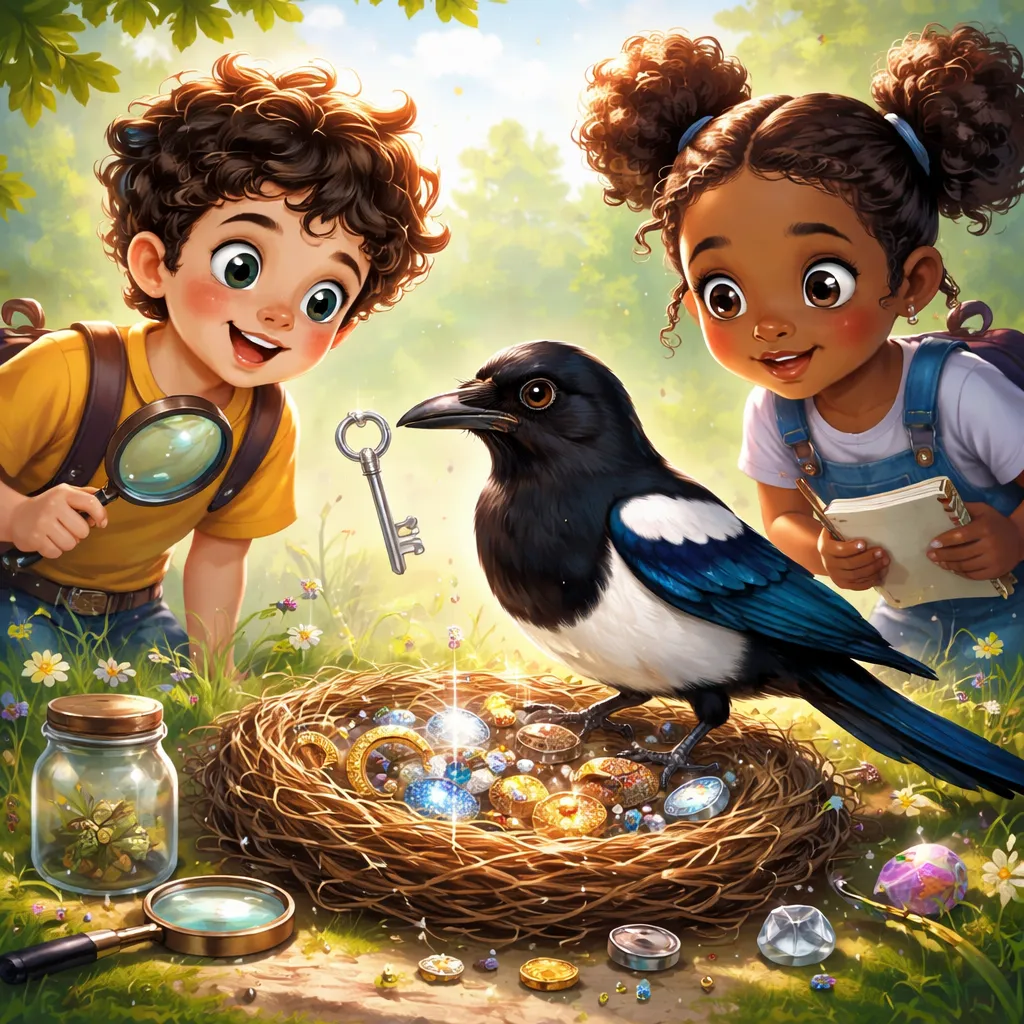

Have you ever seen a bird with bold black and white feathers and a long tail, hopping in your garden or park? It might be a magpie! With their smart eyes and chattering calls, magpies are known for being clever and curious. They are famous in stories and songs. Learning about magpies is a fascinating adventure that takes us to backyards and woodlands. Let’s begin our journey of learning about magpie mysteries and minds.
English Language Learning
Vocabulary and Spelling Our bold, black and white friend is called a magpie. The word "magpie" is a noun. A noun names a person, place, or thing. So, a magpie is a thing—a very smart, living bird. Spelling "magpie" is fun: M-A-G-P-I-E. The 'M' starts the word, the 'A' and 'G' are in the middle, and it ends with 'P-I-E'. M-A-G-P-I-E spells magpie.
Sound and Pronunciation Let’s say the word correctly. It sounds like this: /ˈmæɡ.paɪ/. We can say it in two clear parts. First, say "mag". It rhymes with "bag" or "tag". Next, say "pie". It sounds just like the dessert, a pie! Now, put it together! "Mag" "pie". Magpie! Great! The word "magpie" has two beats, or two syllables. Clap your hands twice: Mag-pie. It’s a catchy, fun word.
Related Words Learning about magpies is more fun with new words! Here are some important ones. Group: A group of magpies is called a tiding, a gulp, or a charm. Baby: A baby magpie is called a chick. Sound: The chattering call of a magpie is a chatter or a chacker.
A Famous Saying There is a well-known rhyme about magpies: "One for sorrow, two for joy..." This is an old counting rhyme that people say when they see magpies. It’s a fun tradition, not science! It reminds us that people have told stories about magpies for a very long time. Say the first line with me: "One for sorrow, two for joy." It’s a piece of cultural fun.
Now you know the word "magpie"! Are you ready to discover their clever ways? Let’s hop from words to wonderful knowledge!
Animal Knowledge
Who Are They? – Family and Group What kind of animal is a magpie? Magpies are birds. They are warm-blooded, have feathers, and lay eggs. They are part of the corvid family. This smart bird family also includes crows, ravens, and jays. Magpies are known for their intelligence and complex social behavior.
What Do They Look Like? – Amazing Bodies Magpies are medium-sized birds with a very long tail. They have striking black and white feathers, with iridescent blue, green, and purple sheen on their black wings and tail. Their most famous features are their long, graduated tail and their bold, contrasting colors. Their tail is almost as long as their body! It helps them balance and maneuver when they fly. Their strong beak and legs are black. They have excellent eyesight and are very aware of their surroundings. Magpies have special adaptations. They are excellent fliers and can perform agile turns. They are also very good at walking and hopping on the ground. Like their corvid cousins, they have large brains and are great problem-solvers.
Where Do They Live and How? – Home and Habits Magpies live in many parts of the world, including Europe, Asia, and North America. Their homes are open woodlands, gardens, parks, and farmlands. They like areas with trees and open spaces. Magpies are omnivores. This means they eat both plants and animals. They eat insects, worms, small animals, seeds, and fruit. They are also scavengers and will eat food scraps. They are known for their curiosity and will investigate shiny objects. Magpies are social and often live in pairs or small family groups. They are active during the day. They spend their time foraging on the ground, chattering in trees, and building large, domed nests. They are territorial and will protect their home area.
A Magpie’s Life Story – Growing Up A baby magpie is called a chick. Magpies are birds, so chicks hatch from eggs. Magpies usually lay about five to eight eggs in a large, domed nest made of sticks and mud, high in a tree. Both parents work together to raise the chicks. They build the nest, incubate the eggs, and bring food to the hungry chicks. The parents are very protective and will chase away predators. Chicks are born naked and blind, with pink skin. They grow quickly and are fed by their parents. They leave the nest after about three to four weeks. The young birds stay with their parents for several months, learning how to find food and survive.
How Do They "Talk"? – Communication Magpies are very vocal birds! They have a wide range of calls, including chatters, rattles, and loud, flute-like notes. Their call is often a rapid, chattering "chacker-chacker-chacker". They also use body language. A magpie might flick its tail or fluff its feathers to communicate with other magpies. They are known to hold "funerals" or gatherings when a magpie dies. Their best senses are their excellent eyesight and hearing. They have very good vision to spot food and danger. Their hearing is sharp, and they can recognize the calls of other magpies and even mimic other sounds.
Are They Okay? – Taking Care of Them Many magpie species are common and not endangered. However, like all wildlife, they face challenges from habitat loss and pollution. The main threats are losing their woodland homes, being hit by cars, and sometimes being persecuted by people who mistakenly think they harm other birds. It’s important to remember they are a natural part of the ecosystem. You can be a magpie friend! You can enjoy watching them from a distance. Keep your trash secure so they don’t eat unhealthy things. If you have a cat, keep it indoors to protect magpies and other birds. Support the protection of natural areas.
Life Connections and Inspiration
How to Be With Them – Safety and Love Magpies are wild birds. They can be defensive during breeding season if they feel their nest is threatened. We must always respect them and keep a safe distance. The rule is: Observe quietly and give them space. Watch magpies from a window or a bench. Never try to touch a magpie or disturb its nest. If a magpie swoops during breeding season, walk away calmly. Wearing a hat can help. Remember, they are just protecting their family. We show our love by letting them be wild. We can plant native trees and shrubs to provide them with natural food and shelter. A garden that welcomes insects will also welcome magpies.
Super Qualities We Learn from Them Magpies teach us wonderful things. One super quality is intelligent curiosity. Magpies are naturally curious and love to explore. They are known to play and investigate new things. They teach us to be curious about the world, to ask questions, and to never stop learning. Another quality is family loyalty and teamwork. Magpie pairs often mate for life and work together to build a home and raise their young. They are loyal to their family group. This reminds us of the importance of working together with our family and being loyal to our friends. Think about it: How can you use your curiosity to learn something new today? How can you be a loyal and helpful member of your own family?
Take Action! – Your "Magpie Treasure" Project Let’s do a curious and creative activity! Your project is to create a magpie’s "treasure" collection. Find a small box. This is your magpie nest. Now, go on a safe hunt (with an adult if needed) for clean, shiny, or interesting natural treasures. You might find a smooth stone, a pretty leaf, a pinecone, or a lost feather. Do not take anything that belongs to someone else. Arrange your treasures in your box. Draw a picture of a magpie next to it. This shows how magpies are curious collectors of interesting things.
Closing Learning about magpie mysteries is a clever and joyful adventure! We learned the word "magpie" and how to say its two-part name. We discovered amazing facts about their long tails, their chattering calls, and their life in loyal pairs. We know that magpies are intelligent, curious birds that are an important part of nature. You can use your new words to share the true story of these striking birds. You can use your knowledge to be a respectful wildlife watcher and a curious learner. The animal world is full of curious and loyal teachers. Always remember to respect wildlife from a safe distance, nurture your own curiosity, and value loyalty in your friendships and family. Keep exploring with wonder, chatter about your discoveries, and be a friend to the wild. Your thoughtful actions and curious mind make you a true friend to the amazing magpie.