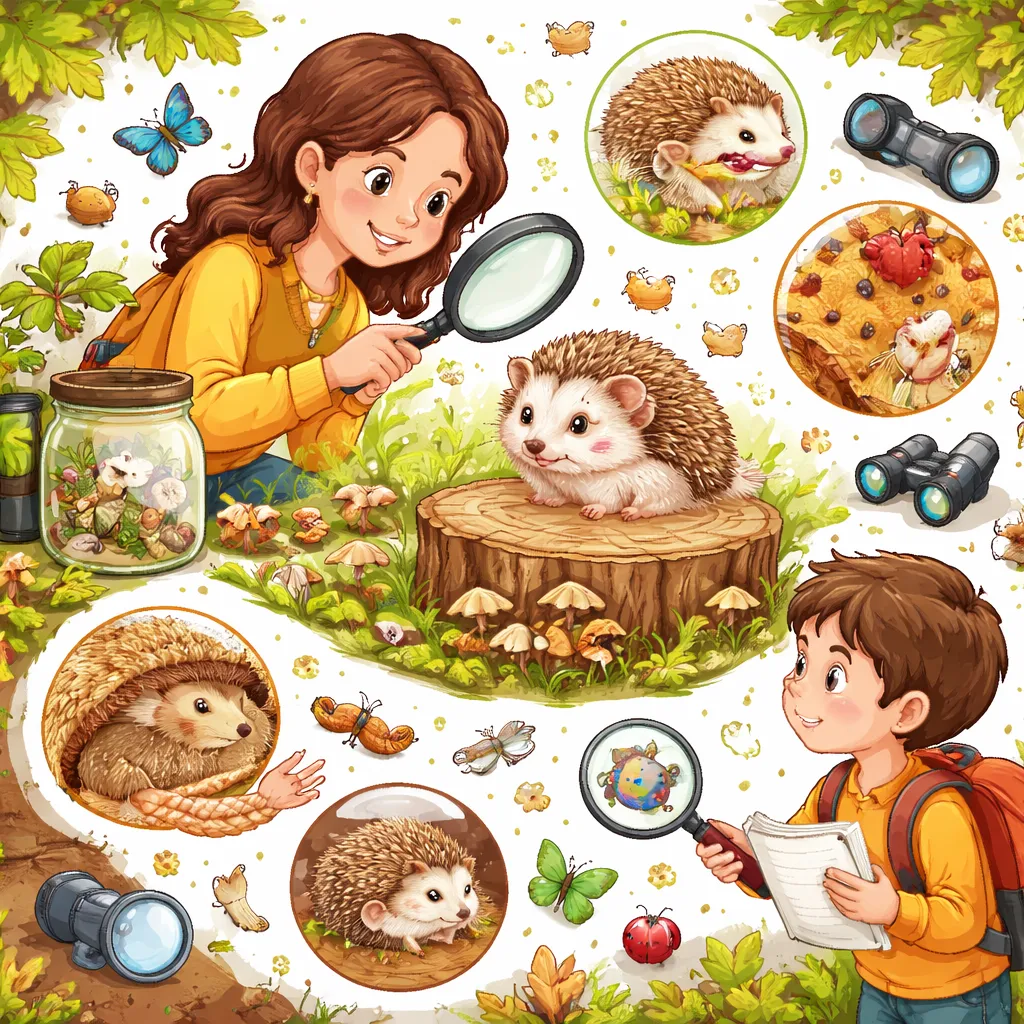

Have you ever seen a picture of a cute, prickly ball with a little snout? That’s a hedgehog! They are shy, quiet animals that come out at night to explore gardens and hedges. In stories, they are often clever and kind. Learning about hedgehogs takes us on a quiet adventure into the nighttime world. Let’s tiptoe softly and start learning about hedgehog mysteries.
English Language Learning
Vocabulary and Spelling Our prickly friend is called a hedgehog. The word "hedgehog" is a noun. A noun is a word for a person, place, or thing. So, a hedgehog is a thing—a small, spiky mammal. Spelling "hedgehog" is two words put together: H-E-D-G-E and H-O-G. The first part, "hedge", is where it likes to live. The second part, "hog", is an old word for a pig, because of its snout! Together, H-E-D-G-E-H-O-G spells hedgehog.
Sound and Pronunciation Let’s say the word just right. It sounds like this: /ˈhɛdʒ.hɑːɡ/. We can say it in two clear parts. First, say "hedge". It rhymes with "edge" or "ledge". Next, say "hog". It rhymes with "dog" or "log". Now, put it together! "Hedge" "hog". Hedgehog! Excellent! The word "hedgehog" has two beats, or two syllables. Clap your hands twice: Hedge-hog. It’s a funny, bumpy-sounding word.
Related Words Learning about hedgehogs is more fun with new words! Here are some important ones. Body Parts: A hedgehog’s sharp spines are called quills. They are stiff hairs that protect it. Its long, pointy nose is called a snout. Action: Hedgehogs love to forage at night, which means to search for food. In cold winters, they go into a deep sleep called hibernation. Sound: A happy hedgehog might make a soft snuffling sound as it sniffs for food.
A Famous Saying There is a fun saying: "As prickly as a hedgehog." This means someone is easily annoyed or hard to get close to, just like it’s hard to pet a hedgehog’s spiky back! It reminds us that everyone has their own way of protecting themselves, and sometimes we need to be gentle and understanding. Say the saying with me: "As prickly as a hedgehog." It’s a fun way to describe someone who is feeling a bit grumpy or defensive.
Now you know the word "hedgehog"! Are you ready to learn about their quiet, nighttime lives? Let’s shuffle from words to wonderful facts!
Animal Knowledge
Who Are They? – Family and Group What kind of animal is a hedgehog? Hedgehogs are mammals. They have hair (quills are a type of hair!), are warm-blooded, and mother hedgehogs feed their babies milk. They are in their own special family called Erinaceidae. Their closest relatives are shrews and moles. They are not related to porcupines at all, even though both have spines!
What Do They Look Like? – Amazing Bodies Hedgehogs are small, about the size of a guinea pig or a large apple. They are covered in about 5,000 to 7,000 sharp quills! Their belly, face, and legs are covered in soft fur. Their most famous feature is their spines or quills. They are not poisonous, but they are sharp. When a hedgehog is scared, it rolls into a tight ball, and the quills point out in all directions to protect its soft belly. Hedgehogs have special body tools. They have a great sense of smell on their long snout. They have small eyes but good night vision. Their ears are also good at hearing tiny sounds in the dark.
Where Do They Live and How? – Home and Habits Hedgehogs live in Europe, Asia, and Africa. They like places with bushes and places to hide, like gardens, hedges, and woodlands. They need leaves and logs to make nests. Hedgehogs are insectivores. This means they mostly eat insects and other tiny creatures. They love to eat beetles, worms, slugs, and caterpillars. They are a gardener’s best friend! They are nocturnal, which means they sleep during the day and are active at night. They are mostly solitary, meaning they like to live alone. They spend their nights snuffling through leaves, looking for food.
A Hedgehog’s Life Story – Growing Up Baby hedgehogs are called hoglets. Hedgehogs are mammals, so hoglets are born live from their mother. A mother usually has three to six tiny babies at a time. The mother hedgehog takes care of the hoglets all by herself. She feeds them milk in a safe nest. The hoglets are born with soft, white spines under their skin, which harden and darken within a few days. Hoglets grow very fast. Their eyes open after about two weeks. They start to leave the nest with their mother to learn how to forage. After about four to six weeks, they are ready to live on their own.
How Do They "Talk"? – Communication Hedgehogs are usually quiet animals. They can make soft grunts, snuffles, and squeaks. If they are very scared or angry, they might hiss or click. They use their sense of smell a lot to talk. They leave scent messages for other hedgehogs. They also use their quills! Rolling into a ball is a very clear message that says, "Leave me alone!" Their best sense is their amazing sense of smell. Their snout is like a super-powered detective tool that can find a worm underground. Their hearing is also very good.
Are They Okay? – Taking Care of Them In many places, hedgehog numbers are going down. They are becoming vulnerable. This means they need our help. The biggest problems are busy roads where they get hit by cars, gardens with fences that trap them, and the use of chemicals that kill the insects they eat. They also lose their homes when fields and hedges are cleared. You can be a hedgehog hero! You can make a small hole in your garden fence so they can pass through. You can avoid using garden poisons. You can leave a shallow dish of water and a bit of cat or dog food (not milk!) in your garden on dry nights. Always check for hedgehogs before mowing or lighting a bonfire.
Life Connections and Inspiration
How to Be With Them – Safety and Love Hedgehogs are wild animals. In some countries, they are also kept as pets, but wild hedgehogs should be left alone. For wild hedgehogs: The rule is look, don’t touch. If you see one in your garden, watch quietly from a distance. Never try to pick up a wild hedgehog unless it is clearly hurt (and then ask an adult to call a wildlife rescue). If you must move one, wear thick gloves and be very gentle. If kept as pets: This is a big responsibility. They need a large cage, a wheel, special food, and a vet. They are not cuddly pets because of their quills, but they can be fun to watch. We show our love by making our gardens safe and friendly for them to visit, and by protecting wild spaces.
Super Qualities We Learn from Them Hedgehogs teach us wonderful things. One super quality is gentle self-protection. Hedgehogs don’t attack. When scared, they simply curl up and protect their soft parts. This teaches us that it’s okay to have boundaries and to protect yourself in a calm, non-aggressive way. Another quality is quiet perseverance. Hedgehogs slowly and steadily shuffle through the night, searching for food. They don’t give up. They remind us to be patient, to keep going steadily, and that slow and steady can win the race. Think about it: How can you protect yourself in a calm way if you feel upset? How can you show quiet perseverance in learning something new, like a hard word or a math problem?
Take Action! – Your "Hedgehog Haven" Project Let’s do a fun and helpful activity! Your project is to design a hedgehog-friendly garden poster. On a large piece of paper, draw a garden. Include a safe log pile for hedgehogs to hide and sleep in. Draw a shallow pond (with a ramp so they can get out). Show a small hole at the bottom of a fence. Draw a little food and water dish. Draw a happy hedgehog snuffling around. Label all the things that make your garden a safe haven. You can hang your poster to remind your family how to help hedgehogs.
Closing Learning about hedgehog wonders is a gentle adventure! We learned the word "hedgehog" and how to say its two-part name. We discovered amazing facts about their protective quills, their snuffling snouts, and their helpful garden habits. We know that hedgehogs are shy, steady animals who need our help to stay safe. You can use your new words to teach others about these spiky friends. You can use your knowledge to make your neighborhood a safer place for wildlife. The animal world is full of quiet, gentle heroes. Always remember to observe wildlife with care, protect yourself gently, and persevere in your goals. Keep exploring with quiet curiosity, be a friend to the creatures in your garden, and walk steadily on your own path. Your thoughtful actions and kind heart make you a true guardian of nature.