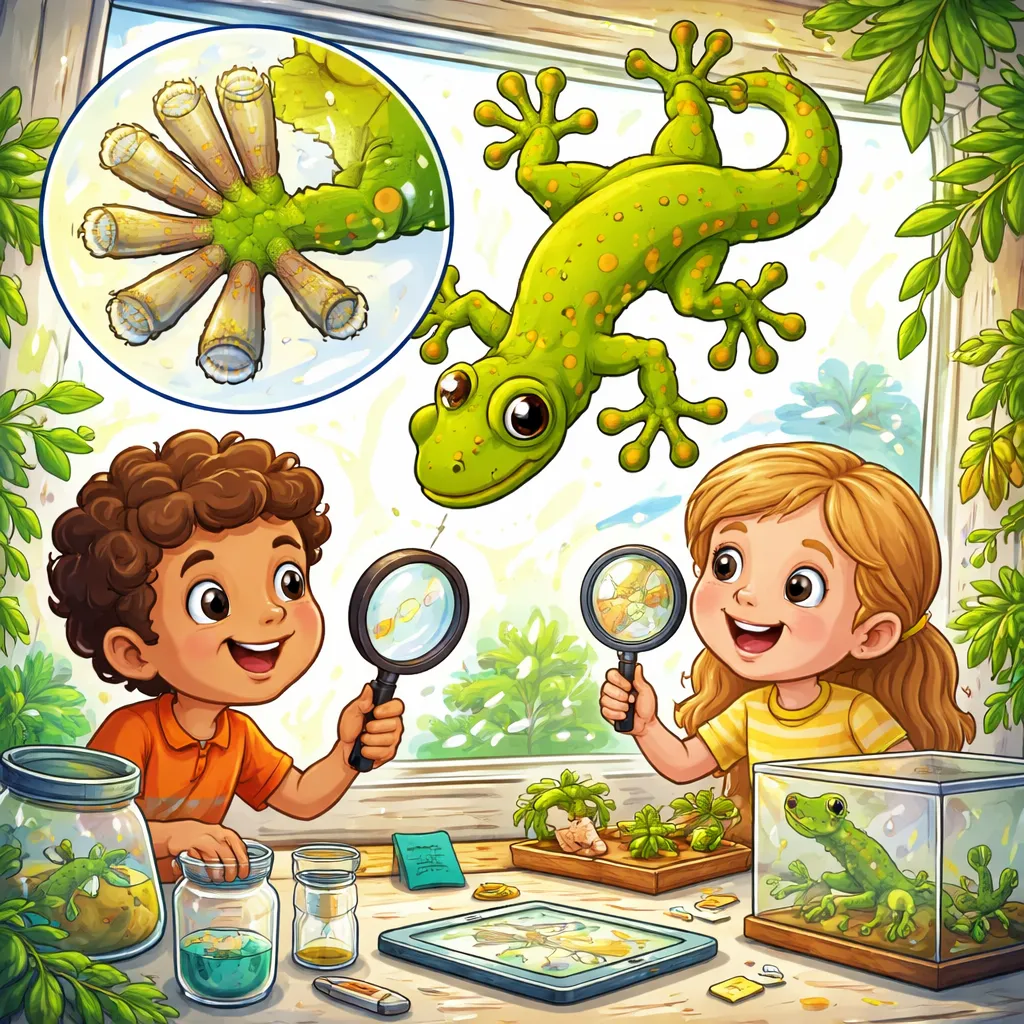

Have you ever been in a warm place and seen a small, flat lizard with big eyes scurrying up a wall or even across the ceiling? It might have even made a chirping sound! That’s a gecko! These amazing little lizards are famous for their incredible ability to walk on walls and windows. Learning about geckos is a sticky adventure that takes us to warm climates and shows us the power of tiny hairs. Let’s begin our journey of learning about gecko grip and their world.
English Language Learning
Vocabulary and Spelling Our sticky-footed friend is called a gecko. The word "gecko" is a noun. A noun names a person, place, or thing. So, a gecko is a thing—a small, living lizard. Spelling "gecko" is simple: G-E-C-K-O. The 'G' starts the word, the 'E' and 'C' are in the middle, and it ends with 'K-O'. G-E-C-K-O spells gecko.
Sound and Pronunciation Let’s say the word correctly. It sounds like this: /ˈɡek.oʊ/. We can say it in two clear parts. First, say "geck". It rhymes with "check". Next, say "oh". It’s a long 'o' sound. Now, put it together! "Geck" "oh". Gecko! Great! The word "gecko" has two beats, or two syllables. Clap your hands twice: Geck-o. It’s a short, fun word.
Related Words Learning about geckos is more fun with new words! Here are some important ones. Action: The way a gecko walks on walls is called climbing or adhesion. A baby gecko is a hatchling. Body Part: The special pads on a gecko’s toes are lamellae or setae. Sound: The chirping or clicking sound a gecko makes is a call or chirp.
A Famous Idea Because of their amazing grip, people sometimes say: "Sticks like a gecko." This means something attaches or holds on very, very well. It comes from the gecko’s ability to stick to surfaces. It reminds us that sometimes, a strong and reliable hold is the best tool. Say the idea with me: "Sticks like a gecko." It’s about being secure and steady.
Now you know the word "gecko"! Are you ready to climb into some amazing facts? Let’s stick from words to wonderful knowledge!
Animal Knowledge
Who Are They? – Family and Group What kind of animal is a gecko? Geckos are reptiles. They are a type of lizard. They are cold-blooded, have scaly skin, and most lay eggs. They belong to the Gekkonidae family. There are over 1,500 different species! Some are as small as your thumb, and some are as long as your hand. They are one of the most common types of lizards in warm parts of the world.
What Do They Look Like? – Amazing Bodies Geckos are usually small and have flat bodies. They come in many colors and patterns. Their most famous features are their large, lidless eyes and their special sticky toe pads. Their body is full of super tools! Their toe pads have millions of tiny hairs called setae. Each hair splits into even tinier ends. These use a special force to stick to surfaces, letting them climb glass, walls, and even walk upside down! Geckos have special adaptations. They cannot blink because they have no eyelids! They lick their eyes to keep them clean. Many geckos can lose their tail to escape a predator, and it will grow back. Some geckos can change color a little to blend in.
Where Do They Live and How? – Home and Habits Geckos live in warm climates all over the world. Their homes are rainforests, deserts, and even people’s houses! They love to live where it is warm and there are insects to eat. Geckos are insectivores. This means they eat insects. They love to eat moths, flies, mosquitoes, and spiders. They are helpful to people because they eat pest insects. They are usually active at night. Geckos are often seen alone. They are nocturnal, which means they are most active at night. They spend their time hiding during the day and coming out at night to hunt for insects. A group of geckos is called a clutch or a colony.
A Gecko’s Life Story – Growing Up A baby gecko is called a hatchling. Most geckos hatch from eggs with a soft, leathery shell. The mother usually lays two eggs at a time and hides them under bark or in a crack. Most gecko parents do not take care of their babies. The mother leaves the eggs, and the hatchlings are completely on their own when they hatch. They must find food and avoid predators right away. Hatchlings are tiny and look like adults. They can use their sticky feet from the very beginning. They grow by shedding their skin. They can live for several years, with some species living over 20 years in captivity.
How Do They "Talk"? – Communication Geckos are famous for their sounds! Many species make chirping, clicking, or barking sounds. This is how they talk to each other, especially to say "This is my space!" or to find a mate. They also use body language. A gecko might wave its tail, bob its head, or change its color a little bit. Dropping their tail is a last-ditch way to say "Leave me alone!" Their best senses are their excellent eyesight and hearing. Their large eyes are great for seeing in the dark. Their hearing is also very good, which helps them communicate with their calls.
Are They Okay? – Taking Care of Them Many gecko species are common, but some are threatened or endangered. Their main threat is the loss of their home habitats, like forests. Other threats are being caught for the pet trade and pollution. In some places, people are afraid of them and hurt them, even though they are harmless and helpful. You can be a gecko friend! You can learn about them and tell others they are helpful. If you live where geckos are native, you can welcome them in your garden as natural pest control. Never take a gecko from the wild to keep as a pet. If you want a pet gecko, make sure it is one that was bred in captivity, like a Leopard Gecko, and learn how to care for it properly.
Life Connections and Inspiration
How to Be With Them – Safety and Love Geckos are wild animals. They are delicate and can be easily stressed. We must respect them and observe them without causing harm. The rule is: Look, don’t touch. If you see a gecko in your house or garden, watch it from a distance. Never try to grab a gecko, as you could hurt it or it might drop its tail. Never use glue traps or poison, as these can hurt or kill geckos. If you have a pet gecko, it is a big responsibility to provide the right home, heat, and food. We show our love by letting wild geckos live their lives and by being responsible, informed pet owners if we choose to have one.
Super Qualities We Learn from Them Geckos teach us wonderful things. One super quality is incredible grip and steady perseverance. A gecko uses millions of tiny hairs to hold on tightly. It teaches us that even a small, steady hold can be incredibly strong. It reminds us to hold on to our goals with determination and to use many small efforts to achieve something big. Another quality is adaptability and helpfulness. Geckos can live in many different environments, from jungles to houses, and they help people by eating insects. This shows us the value of being adaptable and finding ways to be helpful in our own communities. Think about it: What is a goal you want to "hold onto" with the steady grip of a gecko? How can you be adaptable and helpful in your home or school?
Take Action! – Your "Gecko Grip" Project Let’s do a steady and creative activity! Your project is to test what surfaces a pretend "gecko foot" might stick to. Cut a small square of clean, dry rubber (like from a balloon or a rubber glove). Try to stick it to different surfaces: a window, a painted wall, a wooden table, a piece of paper. Does it stick better to some surfaces than others? This is a simple way to explore how friction and surface texture work, just like a gecko’s amazing toes.
Closing Learning about gecko grip is a fascinating and hands-on adventure! We learned the word "gecko" and how to say its two-part name. We discovered amazing facts about their sticky toe hairs, their unblinking eyes, and their life as helpful night hunters. We know that geckos are adaptable, steady reptiles that are important for controlling insects. You can use your new words to share the cool story of these wall-walking lizards. You can use your knowledge to be a respectful observer of wildlife and a responsible pet owner. The animal world is full of steady and helpful teachers. Always remember to respect wildlife from a safe distance, hold onto your goals with steady perseverance, and look for ways to be adaptable and helpful. Keep exploring with curiosity, stick to your tasks with determination, and be a friend to the wild. Your thoughtful actions and steady spirit make you a true friend to the amazing gecko.