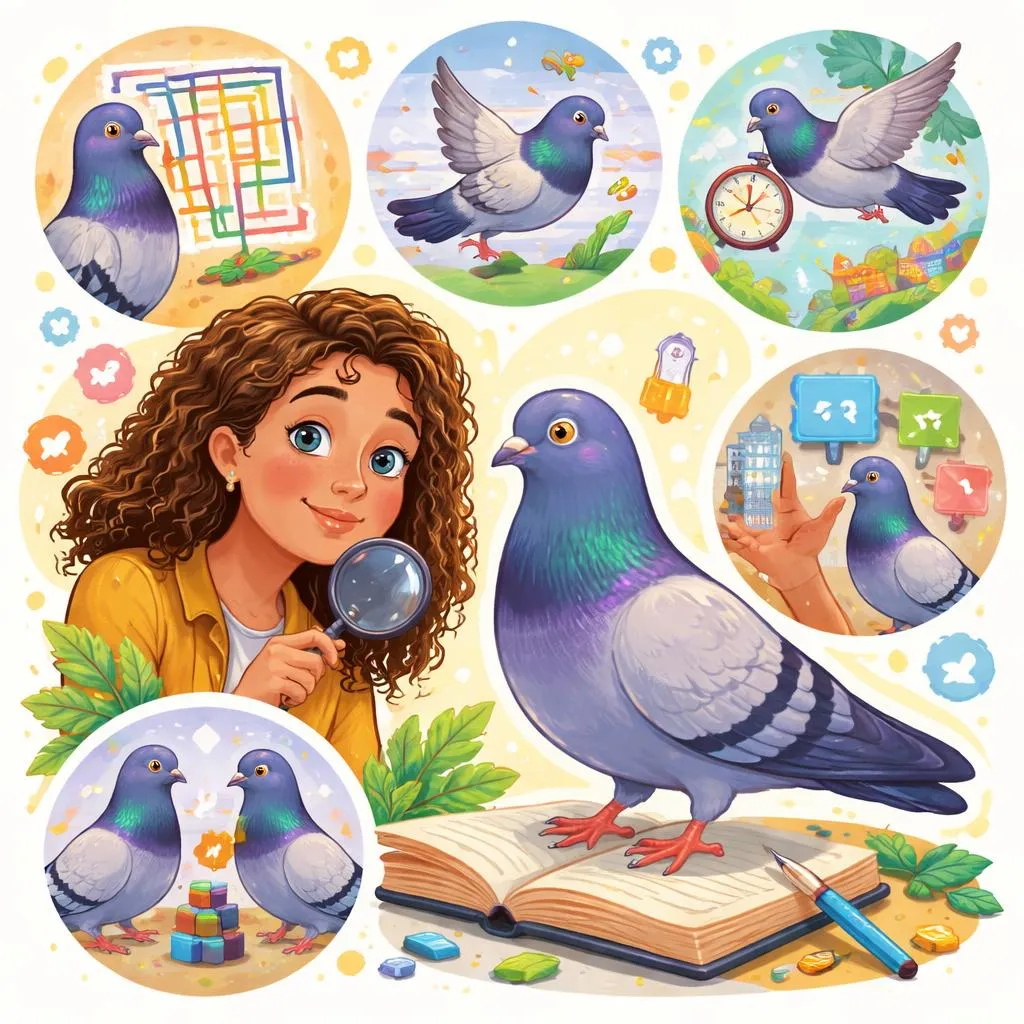

Have you ever seen a pigeon walking in a park, sitting on a statue, or flying in a busy city square? Pigeons are common birds that live all around us. They might seem ordinary, but they have amazing abilities and a long history with people. Learning about pigeons is a surprising adventure that takes us from ancient times to our modern cities. Let’s begin our journey of learning about pigeon secrets and skills.
English Language Learning
Vocabulary and Spelling Our feathered city friend is called a pigeon. The word "pigeon" is a noun. A noun names a person, place, or thing. So, a pigeon is a thing—a living bird. Another common name for it is dove. Spelling "pigeon" is interesting: P-I-G-E-O-N. The 'P' starts the word, the 'I' and 'G' are in the middle, and it ends with 'E-O-N'. P-I-G-E-O-N spells pigeon.
Sound and Pronunciation Let’s say the word correctly. It sounds like this: /ˈpɪdʒ.ən/. We can say it in two clear parts. First, say "pidj". The 'pi' sounds like "pit" and the 'dj' sounds like the 'j' in "jump". Next, say "un". It’s a soft, quick sound, like in "fun". Now, put it together! "Pidj" "un". Pigeon! Great! The word "pigeon" has two beats, or two syllables. Clap your hands twice: Pi-geon. It’s a gentle, soft word.
Related Words Learning about pigeons is more fun with new words! Here are some important ones. Sound: The soft call a pigeon makes is a coo. A group of pigeons is called a flock or a kit. Baby: A baby pigeon is called a squab or a chick. Home: A pigeon’s nest, often on a building ledge, is called a loft or a roost.
A Famous Saying People sometimes say: "As gentle as a dove." This means someone who is very kind, peaceful, and calm. Doves and pigeons are in the same bird family. This saying reminds us of the value of being gentle and peaceful in our actions. Say the saying with me: "As gentle as a dove." It’s a beautiful way to describe someone.
Now you know the word "pigeon"! Are you ready to discover their amazing abilities? Let’s fly from words to wonderful knowledge!
Animal Knowledge
Who Are They? – Family and Group What kind of animal is a pigeon? Pigeons are birds. They are warm-blooded, have feathers, and lay eggs. They are part of the dove family, called Columbidae. The city pigeon’s wild ancestor is the Rock Dove. There are over 300 species of pigeons and doves in the world.
What Do They Look Like? – Amazing Bodies City pigeons are about the size of a small toy. They have plump bodies, small heads, and short legs. Their feathers can be gray, white, brown, or even spotted. Their most famous features are their iridescent neck feathers and their strong wings. Look closely at a pigeon’s neck! In the sun, the feathers shine with green and purple colors, like a rainbow. This is called iridescence. They have excellent eyesight and can see colors, just like us. Pigeons have special adaptations. They are incredible navigators. They can find their way home from hundreds of miles away! Scientists think they use the sun, stars, Earth’s magnetic field, and even smells to navigate. They are also very strong fliers.
Where Do They Live and How? – Home and Habits Pigeons live on every continent except Antarctica. They are masters of adaptation. Their homes are cities, towns, farms, and cliffs. In cities, they live on building ledges, under bridges, and in parks. Pigeons are omnivores, but they mostly eat plants. They eat seeds, grains, fruits, and sometimes insects or leftovers from people. They peck at the ground to find food. They drink water by sucking it up, unlike many birds that must tilt their heads back. Pigeons are very social and live in flocks. They are active during the day. They spend their time foraging for food, preening their feathers, and cooing. They are monogamous, meaning a pair stays together to raise their young.
A Pigeon’s Life Story – Growing Up A baby pigeon is called a squab. Pigeons are birds, so squabs hatch from eggs. Pigeon parents usually lay two white eggs in a simple nest made of twigs and grass. Both parents take care of the squabs. They make a special food called "pigeon milk" in their crops, which is a creamy liquid they feed to the babies. The parents are very dedicated and take turns keeping the squabs warm and feeding them. Squabs are born with yellow down feathers and their eyes closed. They grow very fast. They stay in the nest for about four weeks before they are ready to fly. The parents continue to feed them for a little while after they leave the nest.
How Do They "Talk"? – Communication Pigeons talk with soft, gentle sounds. Their most famous sound is a coo. They have different coos for different messages, like a greeting or a call to a mate. They use body language too. A pigeon might bow, puff up its chest, or strut to attract a mate. They are usually peaceful but can peck if they feel threatened. Their best senses are their incredible eyesight and their amazing sense of direction. They have excellent vision for finding food and navigating. Their hearing is also good.
Are They Okay? – Taking Care of Them Most city pigeon populations are very common, but some wild pigeon species are threatened or endangered. This is because of habitat loss and hunting. The main threats for city pigeons are pollution, cars, and sometimes people who see them as pests. They can get sick from eating unhealthy human food or from dirty environments. You can be a pigeon friend! You can enjoy watching them. If you want to feed them, choose healthy foods like bird seed, peas, or corn, not bread or junk food. You can support groups that protect all birds and their habitats. Remember, pigeons are living creatures that deserve kindness.
Life Connections and Inspiration
How to Be With Them – Safety and Love Pigeons are wild birds, even in the city. They are gentle but can carry germs, so it’s best to admire them without touching. The rule is: Look, don’t touch, and be kind. You can watch pigeons from a few steps away. Never chase or try to grab a pigeon. It’s best not to touch them or their nests. If you find a hurt pigeon, tell an adult who can call a wildlife helper. Wash your hands after being in a place with many pigeons. We show our love by being respectful and not leaving trash that can harm them. We can share our parks and cities peacefully with all creatures.
Super Qualities We Learn from Them Pigeons teach us wonderful things. One super quality is incredible navigation and homing instinct. Pigeons can find their way home over long distances. They teach us to find our way, to remember where we come from, and to stay connected to our home and family. Another quality is adaptability and resilience. Pigeons thrive in busy cities all over the world. They adapt to new challenges. This reminds us to be flexible, to make the best of our surroundings, and to be resilient when things change. Think about it: How can you find your way when you are trying something new, like a pigeon finding its home? How can you adapt to a new situation, like starting a new school year or making a new friend?
Take Action! – Your "Pigeon Post" Project Let’s do a fun and navigating activity! Your project is to create a simple "homing" message. Draw a picture of a pigeon. On the back, write a friendly message or a fun fact about pigeons. Now, give your "pigeon post" to a family member. Can they deliver it to another person in your home, like a real carrier pigeon? This shows how pigeons were once used to carry important messages long ago. You are using your pigeon to share knowledge!
Closing Learning about pigeon wonders is a fascinating and eye-opening adventure! We learned the word "pigeon" and how to say its two-part name. We discovered amazing facts about their rainbow necks, their incredible homing skills, and their life in our cities. We know that pigeons are gentle, adaptable birds with a special place in history and in our world today. You can use your new words to share the surprising story of these common birds. You can use your knowledge to be a kind and observant neighbor to urban wildlife. The animal world is full of adaptable and resilient teachers. Always remember to respect all creatures, find your way with confidence, and adapt to changes with a positive spirit. Keep exploring with curiosity, navigate your own learning journey, and be a friend to the feathered citizens of your city. Your thoughtful actions and kind heart make you a true friend to the amazing pigeon.