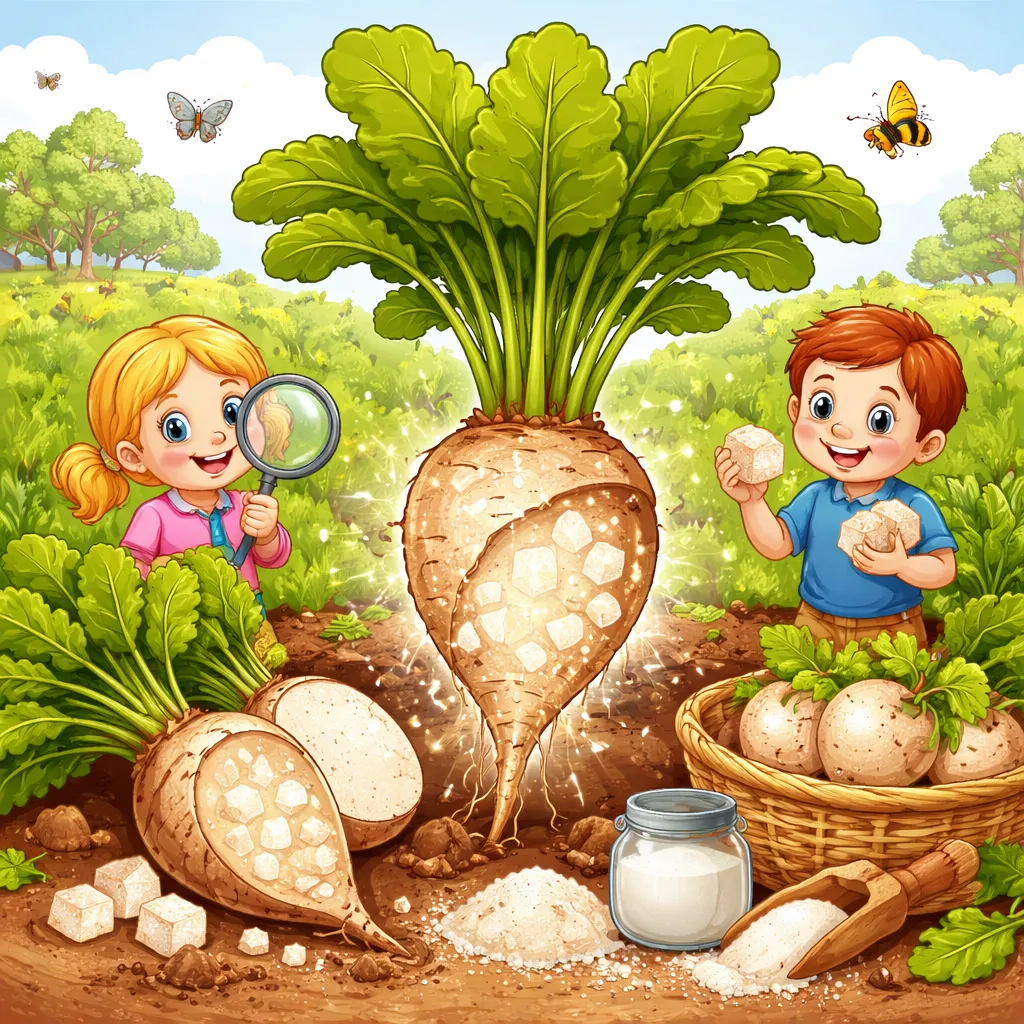

Look at the white sugar in your bowl. It looks just like sugar from sugarcane, doesn’t it? But what if the sugar in your cookie came not from a tall, tropical grass, but from a round, red or white root vegetable that grows in cool, northern soil? It grows under the ground like a beet or a turnip. Its green leaves sprout above, but the sweet treasure is hidden below. This amazing plant changed the way the world makes sugar. Let’s dig in and learn about the surprising Sugar Beet plant.
Let’s Learn the Word! – Open the Treasure Box of Language
Formal Name and Pronunciation This root of sweetness is called the Sugar Beet. Its scientific name is Beta vulgaris. You can say it like this: /ˈʃʊɡ.ə ˌbiːt/ (SHUUG-uh beet). The “Sugar” is the sweet product, and “beet” is the vegetable. Sugar Beet. Say it: Sugar Beet. It’s a simple, honest name.
The Etymology Tale The word “Beet” is very old, coming from the Latin word “beta.” The word “Sugar” has its own ancient journey from Sanskrit. The combination, “Sugar Beet,” is a modern description. It tells you exactly what this plant is: a beet grown for sugar. Before the 1800s, this name didn’t even exist, because people hadn’t yet learned to get much sugar from it!
Nicknames and Friendly Aliases This plant is usually just called the Sugar Beet. The round root is the Beet Root. Because it stores sugar, it’s an Industrial Beet or a Root Crop. The white variety bred for maximum sugar is often called the White Silesian Beet. Sometimes it’s simply called the Sugar Root.
Building Your Word Web: Core Parts Let’s learn the words for a Sugar Beet’s clever body. The Root is the fat, sweet storage part that grows underground. The Crown is the top of the root where the leaves attach. The Leaf is large, green, and grows in a rosette from the crown. The Taproot is the main, thick root we harvest. The Sugar (sucrose) is the sweet crystal stored in the root’s cells. The Field where it grows is a beet field. The Pulp is the plant material left after the sugar is extracted.
Action and State Words Sugar Beets are busy underground. They grow in cool weather. The plant stores sunlight energy as sugar in its root. Farmers harvest the big roots in autumn. The beets are washed, sliced, and soaked in hot water to extract the sugar juice. The juice is then purified and crystallized. A sugar beet plant is biennial (takes two years, but harvested in one), cold-tolerant, and productive.
Ecosystem Friends Vocabulary A beet field is a home for soil life. Earthworms aerate the soil the beets grow in. Birds may eat insects around the plants. After harvest, leftover leaves and small roots break down and feed the soil microbes. The plant itself doesn’t feed many animals above ground, but its cultivation supports farmland ecosystems in cooler climates.
Cultural Imprint in Language The Sugar Beet is a hero of self-sufficiency. During the Napoleonic Wars in Europe, the British blocked sugarcane imports. Scientists and farmers worked fast to develop the sugar beet to make sugar at home. This made countries in cooler places less dependent on tropical sugarcane. It represents ingenuity, science, and adapting to your environment to solve a problem.
Ready for Discovery We know its cool-climate, rooty name. Are you ready to be a soil detective and uncover how this round vegetable competes with tall sugarcane? Let’s explore the hidden world of the Sugar Beet plant.
Discover the Plant’s Secrets! – A Nature Detective’s Notebook
The Plant Passport The Sugar Beet belongs to the Amaranth family, Amaranthaceae. Its scientific name is Beta vulgaris, the same species as garden beets and Swiss chard! It is a biennial plant, but farmers harvest it in its first year. In the first year, it makes a large, conical root and a bunch of leaves. The root is usually white or pale yellow. The leaves are broad and green. It grows best in temperate climates with deep, fertile soil—places like northern Europe, the northern US, and Canada.
Survival Smarts The sugar beet’s genius is in its root. It is a storage superstar. During the sunny growing season, its leaves collect energy from the sun. Instead of using all this energy right away to grow taller, the plant sends it down to be stored as sucrose (sugar) in the root. This stored energy is meant to fuel the plant’s growth of a flower stalk in its second year. But farmers harvest the root at the end of the first year, just when it’s packed with sweet, stored energy.
Its Role and Gifts Sugar beet fields cover and protect the soil. Their greatest gift is the root, which is about 15-20% sugar by weight. In big factories, the sugar is extracted and refined to make the pure white sugar we use. The leftover pulp is dried and becomes a highly nutritious feed for farm animals like cows. Nothing is wasted. It allows countries with cool winters to produce their own sugar.
Human History and Cultural Symbol In the 1740s, a German chemist discovered that the juice of certain beets contained sugar identical to cane sugar. But it took another 50-60 years and the leadership of Napoleon Bonaparte to seriously develop it as a crop to break a sugar shortage. Today, it provides about 20% of the world’s sugar. It symbolizes scientific discovery, agricultural innovation, and resilience.
Fun “Wow!” Facts Get ready for a size fact! A single sugar beet root can weigh 2 to 5 pounds—as much as a big bag of flour! And here’s a family fact: Your red garden beet and your Swiss chard are very, very close cousins to the sugar beet. They are all the same species, just bred for different jobs—color, leaves, or sugar!
From Cool Field to Your Garden The story of the Sugar Beet is one of hidden sweetness. Would you like to try growing your own sugar-storing root? You can grow a sugar beet in a garden or a deep container! Let’s see how.
Let’s Grow It Together! – A Little Guardian’s Action Guide
Good for Home Growing? Yes, it’s a great garden project! Sugar beets need deep, loose soil for their big roots to grow. You can grow them in a deep garden bed. For containers, you need a very deep pot (at least 12-18 inches deep). You won’t extract sugar, but you can harvest the root, taste its sweetness, and even try cooking the greens.
Little Gardener’s Toolkit You will need a packet of sugar beet seeds (look for varieties like ‘Sugar Beet’ or ‘Albina’). Get a very deep, wide pot or prepare a sunny garden spot. Use loose, rich, stone-free potting soil. Have a watering can, some compost, and a sunny spot ready.
Step-by-Step Growing Guide
Planting Your Sweet Root Plant seeds in early spring, as soon as the soil can be worked. They like cool weather to start. Plant seeds about half an inch deep and 3-4 inches apart. Water the soil well. Once the seedlings are a few inches tall, thin them to stand 6-8 inches apart so each root has space to get fat.
Care Calendar Keep the soil evenly moist. Beets need consistent water for the roots to grow nicely and not get woody. They love full sun. You can give them a little balanced fertilizer when they are young. The most important thing is to keep the soil loose and weeded so the roots can expand easily downward.
Watch and Be Friends Watch for the first pair of leaves, then the rosette of big leaves. The magic is happening unseen! After a couple of months, you can gently brush away soil from the top of a root to see how big it’s getting. Don’t pull it yet! The leaves will tell you a story—if they are big and green, the root is growing. Harvest in the fall after a frost, which can make the root even sweeter.
Problem Diagnosis If leaves have holes, look for small beetles; pick them off. If leaves are small and pale, the plant might need fertilizer. The most common problem is overcrowding—you must thin the seedlings! If the root is small and misshapen, the soil might be too hard or rocky.
Your Rewards and Gifts Your gift is unearthing your own sweet treasure. You are learning about root crops, plant energy storage, and patience. Caring for sugar beets teaches observation, responsibility, and the thrill of harvesting something you’ve only seen the “hair” (leaves) of for months. You become a grower of underground mysteries.
Creative Fun Start a Underground Sugar Journal. Draw the plant above ground, then draw what you imagine the root looks like below. When you harvest, weigh and measure your beet. Grate a small piece of the raw root and taste its sweetness. Research how a sugar factory works and draw a simple diagram. Use natural dye from a red garden beet (its cousin!) to paint a picture. Write a “Diary of a Sugar Beet” from seed to harvest.
Growing a Lesson in Storage By planting sugar beets, you are not just growing a vegetable. You are growing a living lesson in botany and history, a connection to global food systems, and an appreciation for the clever ways plants store the sun’s energy. You are a cultivator of curiosity.
Conclusion and Forever Curiosity What a cool, clever, and surprising journey from a northern field to your sugar bowl! You started to learn about the Sugar Beet plant, you discovered its secrets as the round, sugar-storing hero of temperate farms, and you learned how to grow your own hidden sweet root. You now know the Sugar Beet plant is not just a type of beet; it is a marvel of plant science, a historical problem-solver, a lesson in self-reliance,