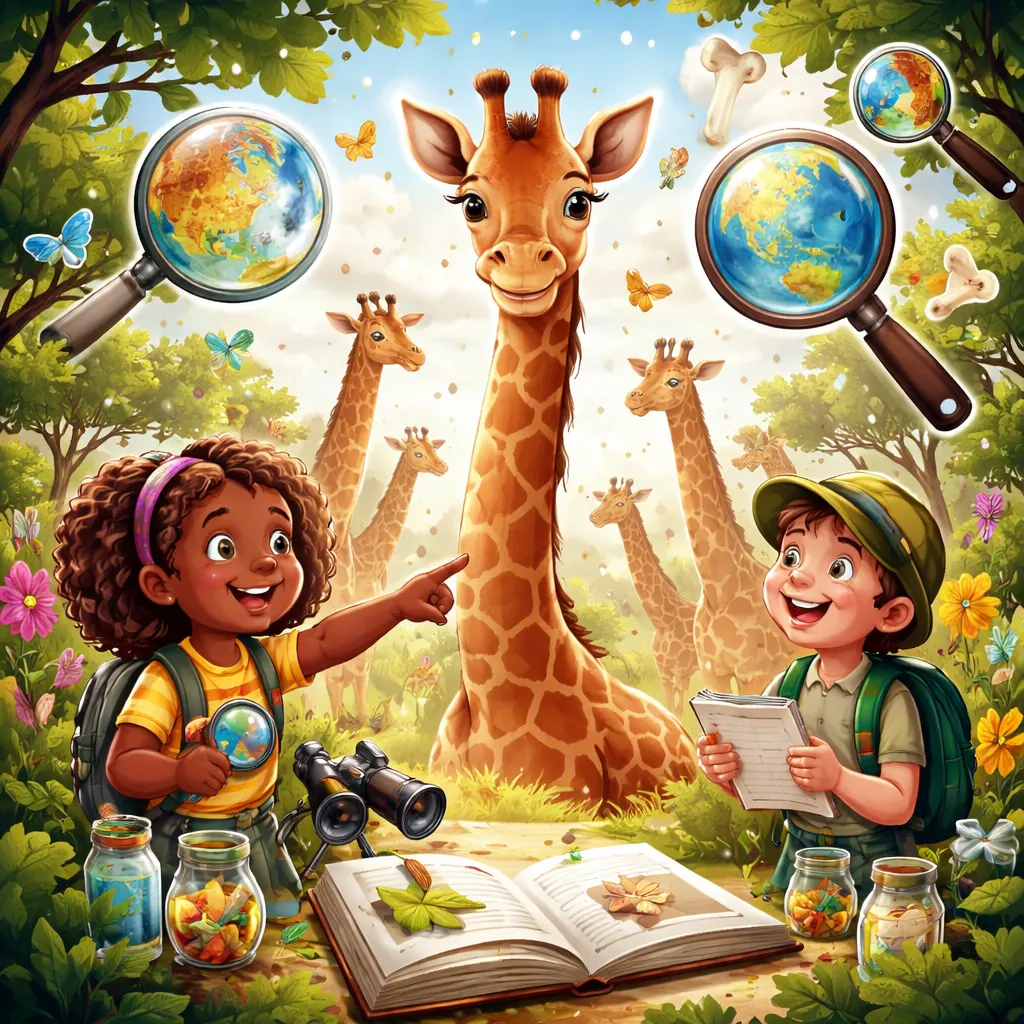

Have you ever looked up, up, up at a giraffe in a picture book or at the zoo? It’s the tallest animal in the world! With its incredibly long neck, beautiful spotted coat, and gentle eyes, a giraffe is like a living skyscraper. Learning about giraffes takes us on a journey to the sunny, open plains of Africa. Let’s stretch our minds and our imaginations to learn about these gentle giants.
English Language Learning
Vocabulary and Spelling The word for this sky-high animal is giraffe. The word "giraffe" is a noun. A noun is a word for a person, place, or thing. So, a giraffe is a thing—a very tall and wonderful thing! Spelling "giraffe" is interesting: G-I-R-A-F-F-E. It’s a long word, just like a giraffe’s neck! Notice the two 'F's in the middle, like two long legs standing strong. The 'G' at the beginning stands tall. The 'E' at the end is silent, like a giraffe walking quietly. G-I-R-A-F-F-E spells giraffe.
Sound and Pronunciation Let’s say the word the right way. It sounds like this: /dʒəˈræf/. We can break it into easy sounds. First, say "juh". It’s a soft sound, like the start of "jump". Next, say "raf". It rhymes with "laugh" but with an 'r' at the start. Now, say it all together fast! "Juh" "raf". Giraffe! Excellent! The word "giraffe" has two beats, or two syllables. Clap your hands twice: Gi-raffe. It’s a graceful, stretchy-sounding word.
Related Words Learning about giraffes is more fun with new words! Here are some important ones. Body Parts: A giraffe’s most famous part is its long neck. The beautiful brown patches on its coat are called spots. Every giraffe’s spot pattern is unique, like a snowflake! Action/Habit: Giraffes love to browse. This means they eat leaves, buds, and twigs from high up in trees. Home: The wide, grassy land where giraffes live is called the savanna.
A Famous Saying There is a fun and positive saying: "Stick your neck out." This means to be brave, to take a risk, or to stand up for something. Imagine a giraffe sticking its neck out high above the trees to see far and wide. It reminds us to be brave and to try new things, even if it feels a little scary at first. Say it with me: "Stick your neck out." When was a time you had to "stick your neck out" and be brave?
Now you know the word "giraffe"! Are you ready to reach for some amazing facts? Let’s stretch from words to wonderful knowledge!
Animal Knowledge
Who Are They? – Family and Group What kind of animal is a giraffe? Giraffes are mammals. They have hair, are warm-blooded, and mother giraffes feed their babies milk. They are in their own very special family called Giraffidae. Their only living relative in this family is the okapi, a shy forest animal that looks a bit like a mix between a giraffe and a zebra!
What Do They Look Like? – Amazing Bodies Giraffes are the tallest animals on Earth! They can be as tall as a two-story house. Their coats are a beautiful patchwork of brown spots on a lighter background, which helps them hide in the shadows of trees. Their most incredible feature is their long neck. It has the same number of bones as your neck—seven—but each bone is much, much longer! They use it to reach the tastiest leaves at the tops of trees. Giraffes have special body tools. Their long, dark tongue can be up to 20 inches long! They use it to wrap around leaves and pull them off branches. Their long legs are perfect for running fast, and they have hard hooves to protect their feet.
Where Do They Live and How? – Home and Habits Giraffes live in Africa. Their home is the open savanna, which is a huge grassy plain with scattered trees. They need space to walk and lots of trees to eat from. Giraffes are herbivores. This means they only eat plants. They are browsers, so they eat leaves, especially from acacia trees. They can eat hundreds of pounds of leaves each week! They are social animals and often live in loose groups called towers. A tower of giraffes can have males, females, and young ones. They spend their days walking, eating, and keeping watch for danger.
A Giraffe’s Life Story – Growing Up A baby giraffe is called a calf. Giraffes are mammals, so calves are born live from their mother. The mother gives birth standing up, so the calf has a big drop to the ground! The mother giraffe takes care of her calf all by herself. She feeds it milk and protects it fiercely. Other females in the tower may also help guard the calves. A newborn calf is already about six feet tall! It can stand and even run within just a few hours of being born. It grows quickly, but it will take about four years to become a full-sized adult.
How Do They "Talk"? – Communication Giraffes are mostly quiet animals, but they do communicate. They can make low humming sounds at night that are hard for humans to hear. They mostly "talk" with their bodies. They swing their necks gently or nudge each other. If a giraffe is angry or warning another, it might give a hard stare or swing its neck forcefully. Their best sense is their excellent eyesight. Their high-up eyes let them see for miles across the savanna, watching for lions or other dangers. They have a great view!
Are They Okay? – Taking Care of Them Giraffe numbers are going down. Some kinds of giraffes are endangered or vulnerable. This means they need our help. The main problems are people taking their land for farms and cities. Sometimes, giraffes are also hunted. They can get hurt when they try to move across roads that cut through their home. You can be a giraffe guardian! You can learn and tell others about them. You can support zoos and groups that work to protect giraffes in Africa. Choosing products that are good for the planet helps save wild places for all animals.
Life Connections and Inspiration
How to Be With Them – Safety and Love Giraffes are wild animals. We must show our love by admiring them from a safe and respectful distance. The rule is: Look, don’t touch, and give them space. We can see them at good zoos with large, natural habitats. We never try to touch, feed, or get close to a wild giraffe. They are gentle but very large and powerful. We show we care by protecting the wide-open savannas where they live. We can be friends to giraffes by being friends to the whole Earth.
Super Qualities We Learn from Them Giraffes teach us wonderful things. One super quality is seeing the big picture. Because they are so tall, they can see far ahead. This reminds us to look at problems from a high view, to think ahead, and to be aware of what’s around us. Another quality is gentle strength and uniqueness. Giraffes are incredibly strong and tall, but they are also calm and graceful. Their unique spots remind us that it’s wonderful to be different and to stand tall in our own special way. Think about it: How can you "see the big picture" when you have a problem? How can you be strong and gentle, and proud of what makes you unique, just like a giraffe?
Take Action! – Your "Giraffe Spot" Project Let’s do a fun activity! Your project is to become a pattern scientist and design your own giraffe. Get a piece of paper and some brown and yellow crayons or paints. Draw the outline of a tall giraffe. Now, look at pictures of real giraffes. See how their spots are like big puzzle pieces? Use your brown crayon to draw your own unique spot pattern all over your giraffe. No two giraffes have the same spots, so make yours special! Give your giraffe a name and write a sentence about what it sees from way up high with its excellent eyesight.
Closing Learning about giraffe giants is a soaring adventure! We learned the word "giraffe" and how to say its two-part, graceful name. We discovered amazing facts about their long necks, their spotty coats, and their life on the savanna. We know that giraffes are gentle, tall watchers who need our help to keep their homes safe. You can use your new words to share stories about these towering animals. You can use your knowledge to understand why protecting wild spaces is so important. The animal world is full of gentle giants that teach us to look ahead and stand tall. Always remember to respect wildlife and be a kind friend to our planet. Keep exploring, keep looking at the big picture, and walk with your own gentle strength. Your curiosity and care help make sure these magnificent creatures are here for everyone to enjoy.