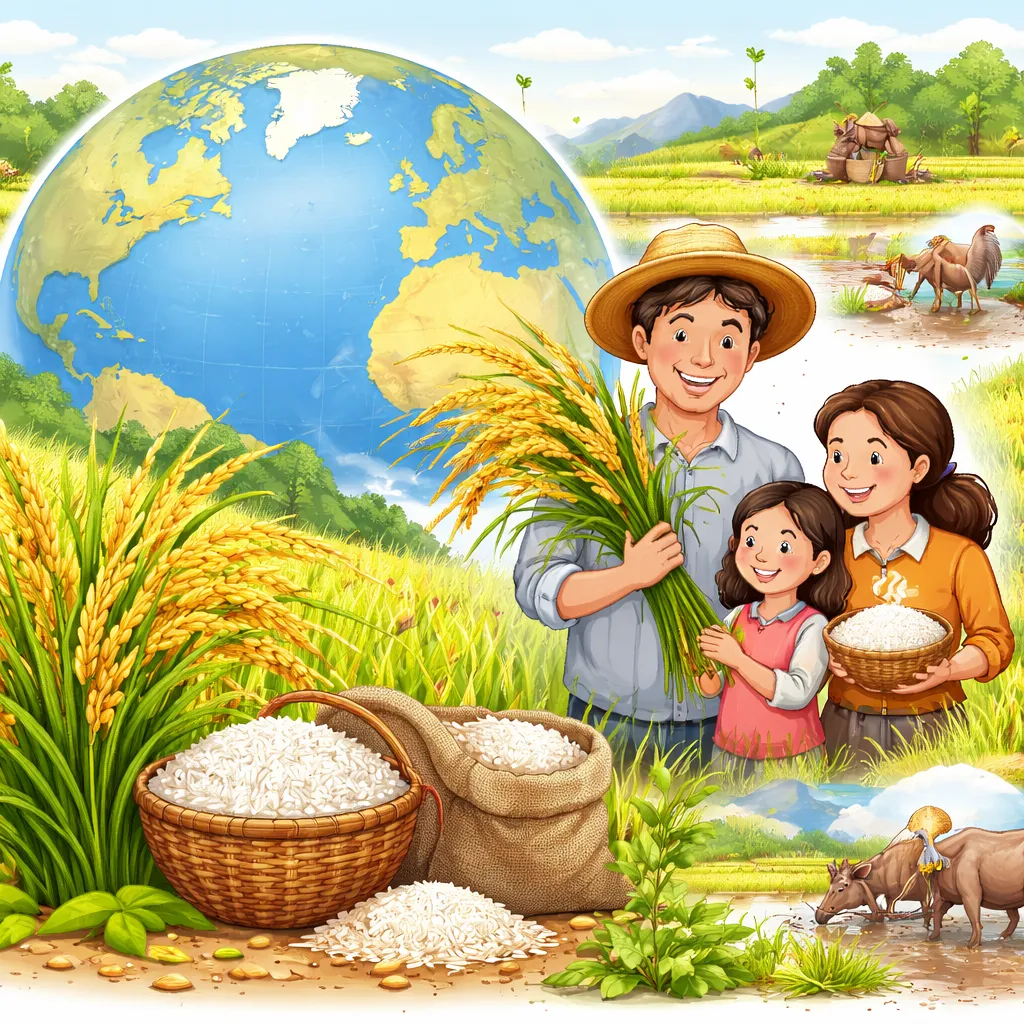

Do you know what food is eaten by more people in the world than any other? It’s a small, white grain that is fluffy and delicious when cooked. It’s in your sushi, your rice pudding, and maybe even in your cereal! It doesn’t grow on a tree or a bush. It grows in special flooded fields that look like giant, green mirrors reflecting the sky. This amazing plant feeds billions of people and is at the heart of many cultures. Let’s wade into the fascinating world of the Rice plant.
Let’s Learn the Word! – Open the Treasure Box of Language
Formal Name and Pronunciation This essential grain is called Rice. Its scientific name is Oryza sativa. You can say it like this: /raɪs/ (rye-ss). It rhymes with “nice” and “ice.” Rice. Say it: Rice. It’s a short, simple, and powerful word.
The Etymology Tale The word “Rice” has traveled a long way! It comes from the Old French word “ris,” which came from the Italian “riso.” That word came from the Latin “oryza,” which was borrowed from the Greek “óryza.” The Greek word likely came from an ancient language in South or West Asia, where rice was first grown. Its name is a passport stamped by traders and travelers throughout history.
Nicknames and Friendly Aliases Rice is known by names that describe its form and home. The plant growing in the field is called Paddy Rice or simply Paddy. The harvested grain is Brown Rice with its bran, or White Rice when polished. Wild Rice is a different plant from North America. Because it’s so important, it’s often called the Staple Grain or the Bread of Asia.
Building Your Word Web: Core Parts Let’s learn the words for a Rice plant’s body. The Plant is a type of grass, with a main stem called a Culm. The Leaf is long, flat, and pointed, growing from the stem. The Panicle is the beautiful, arching flower head where the grains form. A Grain is a single seed of rice, growing on the panicle. The Hull or Husk is the tough, inedible outer shell of the grain. The Paddy is the flooded field where the rice grows. A Seedling is a very young rice plant, often grown in a nursery first.
Action and State Words Rice has a special way of growing. Farmers transplant seedlings into flooded fields. The plant grows tall in the water. The field is flooded and then drained before harvest. Farmers harvest the golden panicles. The grain is threshed to separate it, then milled to remove the hull. Rice is nutritious, aquatic, cultivated, and essential.
Ecosystem Friends Vocabulary The rice paddy is a temporary wetland ecosystem. Frogs and toads move in to eat insects. Fish are sometimes raised in the water, a practice called rice-fish farming. Water birds visit the fields. Ducks can be let into the paddies to eat weeds and pests. Even earthworms and microbes in the soil and water help create a healthy environment for the rice to grow.
Cultural Imprint in Language Rice is deeply woven into the language of many cultures. A common Chinese blessing is, “May your rice never burn,” meaning may you always have enough to eat. In Japan, there is a saying, “Rice is the heart of a meal.” A beautiful haiku by the poet Matsuo Basho simply describes the quiet sound of a rice-planting song, showing how rice is part of the rhythm of life. In English, to “know your oats” (or rice) means to be knowledgeable and capable.
Ready for Discovery We know its global, life-giving name. Are you ready to get your hands muddy and discover how this little grain grows in water? Let’s explore the secrets of the Rice plant.
Discover the Plant’s Secrets! – A Nature Detective’s Notebook
The Plant Passport Rice belongs to the grass family, Poaceae, just like wheat and bamboo. Its genus is Oryza. A rice plant is an annual grass that grows about 3 to 6 feet tall. It has long, slender leaves and a hollow stem. Its flowers are tiny and grow on a branched panicle. Each fertilized flower becomes a single grain of rice, encased in a protective hull. It grows in warm climates and needs a long growing season, often from spring to fall.
Survival Smarts Rice’s superpower is growing in water! Most weeds can’t survive in flooded fields, but rice can. It has special air channels in its stems and roots, called aerenchyma, that act like snorkels, carrying air from the leaves down to the roots underwater. This lets the roots breathe even when they are submerged. The water also provides a steady supply of moisture, controls the soil temperature, and helps deliver nutrients to the plant.
Its Role and Gifts The rice paddy is a human-made wetland that provides food for people and habitat for wildlife. Its most famous gift is, of course, the grain—a primary source of calories for over half the world’s population. Rice is also used to make flour, noodles, vinegar, syrup, and even milk. The straw is used for animal feed, roofing, and making paper. It is a plant of zero waste.
Human History and Cultural Symbol Rice was first domesticated in China around 8,000 to 13,000 years ago. From there, it spread across Asia and eventually the world. It shaped civilizations, cultures, and landscapes. In many Asian cultures, rice is a symbol of life, fertility, and prosperity. Throwing rice at weddings is an old tradition for wishing the couple abundance. The hard work of planting and harvesting rice is celebrated in countless festivals, dances, and songs.
Fun “Wow!” Facts Get ready for a numbers fact! There are over 40,000 varieties of rice in the world! They can be short, medium, or long-grained; sticky or fluffy; and even colors like white, brown, red, black, or purple. And here’s a water fact: It takes about 2,500 liters of water to produce one kilogram of rice. That’s why it’s so important to grow it wisely.
From Global Field to Your Container The story of the Rice plant is one of human ingenuity and nature’s magic. Would you like to try growing this vital grain yourself? You can grow a little rice paddy in a container! Let’s see how.
Let’s Grow It Together! – A Little Guardian’s Action Guide
Good for Home Growing? Yes, as a fantastic educational project! You won’t grow enough for many meals, but you can see the entire life cycle. You need a warm, sunny spot (like a patio) for at least 3-5 months. Rice is best grown in a large, water-holding container without drainage holes, like a plastic storage tub or a bucket. It is a fun, hands-on way to learn about this crucial crop.
Little Gardener’s Toolkit You will need a handful of unhulled rice seeds (often called “paddy rice” or “seed rice” from a garden store). Get a large, water-tight container (at least 6-8 inches deep). Use garden soil or potting mix. Have a watering can and a sunny spot ready. A little organic fertilizer is helpful.
Step-by-Step Growing Guide
Planting Your Mini Paddy Fill your container with 4-6 inches of moist soil. Scatter the rice seeds evenly over the soil. Gently press them into the surface, but don’t bury them deeply. Water the soil until it is thoroughly wet and muddy. Now, carefully add 1-2 inches of water on top, so the seeds are submerged. Place your container in the warmest, sunniest spot you have.
Care Calendar Keep the water level at 1-2 inches above the soil for the first few weeks. Once the seedlings are about 5-7 inches tall, you can let the water level drop so the soil is just soggy, but not flooded. Rice loves full sun. You can add a little liquid fertilizer once a month. In about 3-4 months, the panicles will form and turn from green to golden yellow. When they are golden and the grains are hard, it’s harvest time.
Watch and Be Friends Watch for the first green shoots coming out of the water. Notice how the plants grow tall and form stems. Watch for the delicate panicles to appear and flower. Keep a calendar of the growth stages. The most exciting part is seeing the green grains slowly turn golden. Listen to the sound of the leaves rustling.
Problem Diagnosis If the water smells bad, it might be stagnant. Change it gently for fresh water. If leaves turn yellow, the plants might need fertilizer. The most common pests are birds who love the grains; you can cover the panicles with a net or cloth bag. Algae might grow on the water surface; you can skim it off.
Your Rewards and Gifts Your gift is the deep understanding of where food comes from. You are growing a plant that teaches patience, care, and the global importance of agriculture. Caring for rice connects you to farmers and cultures around the world. You learn the value of water, sun, and soil in feeding our planet.
Creative Fun Start a Rice Farmer’s Almanac. Draw the different stages of growth. Make a map of the world showing the top rice-growing countries. Try weaving a small mat from dried grass, imagining it’s rice straw. With an adult, cook a simple dish from a different culture that uses rice, and write about it. Create a pie chart showing how much of the world eats rice compared to other grains. Write a thank-you poem to the sun and rain for helping your rice grow.
Growing a Grain of Knowledge By planting rice, you are not just growing a grass. You are growing empathy for farmers, a lesson in global interdependence, and a deep appreciation for the tiny grains on your plate. You are a grower of global citizenship.
Conclusion and Forever Curiosity What a meaningful journey from a flooded field to your fork! You started by learning the word “Rice,” you discovered its secrets as the water-loving grass that feeds the world, and you learned how to nurture a few stalks yourself. You now know the Rice plant is not just a side dish; it is a pillar of civilization, a masterpiece of agricultural science, a hub of biodiversity, and a symbol of life itself. Remember, its power is in its ability to turn water, earth, and sun into food for billions. Your curiosity helps you appreciate the incredible story behind every single grain. Keep asking where your food comes from, wondering about the plants that sustain us, and tasting the world with gratitude. Your adventure to learn about the Rice plant shows us that the smallest seeds can hold the greatest stories and the most important lessons for our shared future.