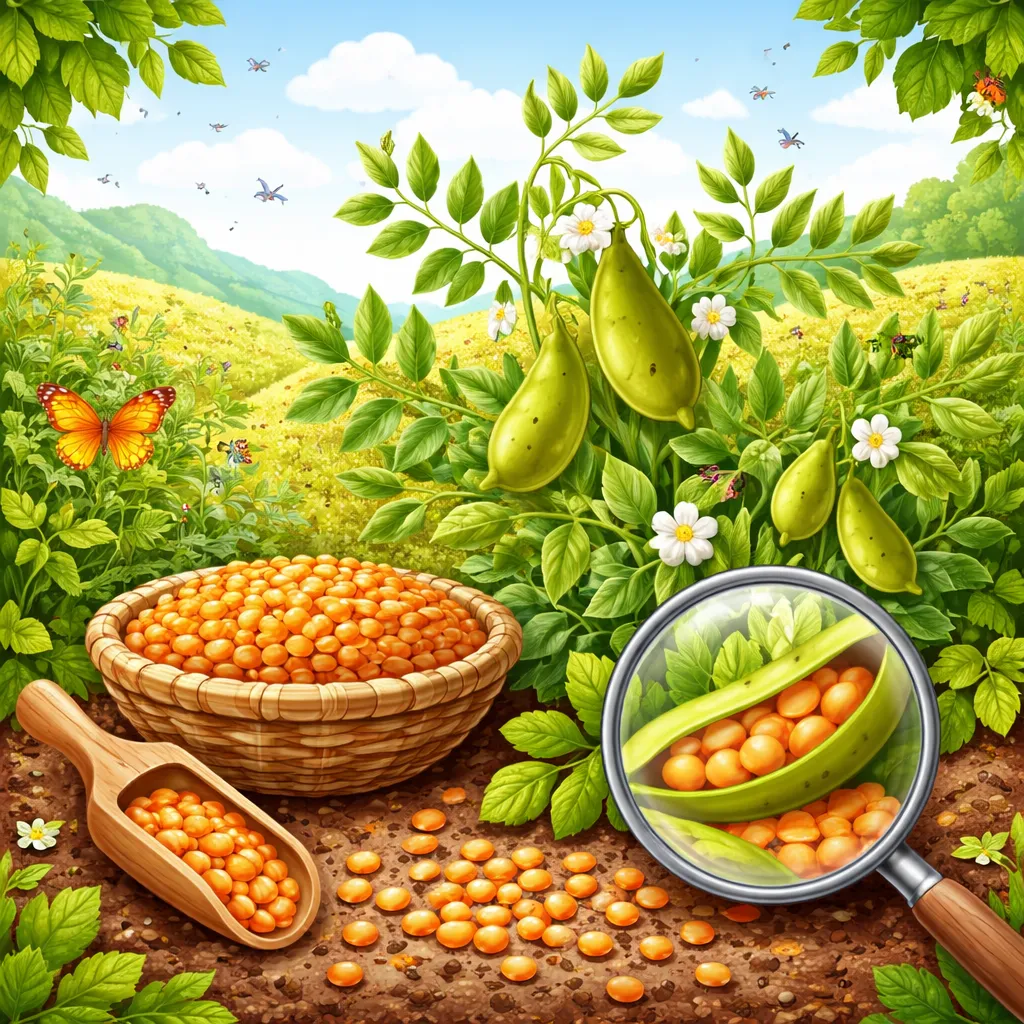

Have you ever eaten a warm, hearty bowl of soup with lots of tiny, lens-shaped seeds in it? Maybe it was a red lentil soup or a yellow lentil stew. Those little seeds are packed with protein and have been feeding people for thousands of years. The plant they come from is not tall and showy. It is a small, humble, bushy plant that doesn’t need much water. Let’s discover the mighty power of the tiny Lentil plant.
Let’s Learn the Word! – Open the Treasure Box of Language
Formal Name and Pronunciation
This mighty little seed is called a Lentil. Its scientific name is Lens culinaris. You can say it like this: /ˈlen.təl/ (LEN-tul). It rhymes with “gentle.” Len-til. Say it: Lentil. It’s a soft, gentle-sounding word.
The Etymology Tale
The word “Lentil” is very old. It comes from the Latin word “lens,” which means… a lens! Why? Because the shape of a lentil seed looks just like a tiny, curved, double-convex lens—the kind used in magnifying glasses and eyeglasses! The scientific name keeps this word: Lens. Its name is a picture of its shape.
Nicknames and Friendly Aliases
Lentils are known by their colors and where they are used. There is Brown Lentil, Green Lentil, Red Lentil, Black Lentil, and Yellow Lentil. In India, split lentils are called Dal or Dhal. Because they are so small, they are sometimes called Poor Man’s Meat for their protein. The French green type is Puy Lentil.
Building Your Word Web: Core Parts
Let’s learn the words for a Lentil plant’s modest body. The Plant is a low, bushy annual, about 1 to 2 feet tall. The Leaf is made of many small leaflets arranged like a feather (pinnate). The Pod is very small, flat, and contains one or two seeds. A single Seed is the lentil itself, shaped like a tiny lens. The Flower is small, white, or pale blue. The Root has nodules that hold nitrogen-fixing bacteria. A Field of lentils is a lentil field.
Action and State Words
Lentil plants are efficient and tough. They grow quickly in cool weather. They tolerate drought. The plant flowers and produces many small pods. The pods are harvested and threshed to get the seeds. The seeds are split or cooked whole. A lentil plant is low-growing, drought-tolerant, nutritious, and soil-enriching.
Ecosystem Friends Vocabulary
The lentil field is a quiet helper. Like other beans, its roots host Rhizobia bacteria in nodules. These invisible friends take nitrogen from the air, feeding the plant and improving the soil. The low plants provide some ground cover for small insects and help prevent soil erosion. They are a quiet partner in the farm ecosystem.
Cultural Imprint in Language
Lentils are a global symbol of humble sustenance and nourishment. A famous story is the biblical tale of Esau selling his birthright for a bowl of lentil stew (“a mess of pottage”), showing its value as a basic, filling food. In many cultures, eating lentils on New Year’s Day symbolizes good luck and prosperity for the coming year. They represent simplicity, resilience, and shared meals.
Ready for Discovery
We know its lens-shaped, protein-packed name. Are you ready to be a history detective and discover how this small seed became a global food hero? Let’s explore the secrets of the Lentil plant.
Discover the Plant’s Secrets! – A Nature Detective’s Notebook
The Plant Passport
Lentils belong to the legume family, Fabaceae. Their genus is Lens. The plant is a low, spreading annual bush. The stems are slender. The leaves are compound, with many small leaflets. The flowers are tiny and not very showy. The fruit is a small, flat pod that holds one or two lens-shaped seeds. The seeds can be many colors. It grows in cool, dry climates and is harvested in early summer. It is one of the most drought-tolerant pulses.
Survival Smarts
The lentil plant is a master of doing more with less. It has a deep taproot that can find water far underground, helping it survive in dry areas. Its small size means it doesn’t need a lot of nutrients or water to produce its seeds. Its most important trick is, of course, the root nodules. The bacteria inside make nitrogen fertilizer from the air, so the plant can grow in poor soil. It completes its life cycle quickly before the summer heat gets too harsh.
Its Role and Gifts
Lentils are environmental champions. They add nitrogen to farm soil, reducing the need for chemical fertilizers. Their greatest gift is the seed. Lentils are a nutritional powerhouse: high in protein, fiber, and iron. They cook quickly without needing to be soaked. They are used worldwide in soups, stews, curries (dal), salads, and even as a meat substitute in burgers. They are a vital, affordable source of protein for millions.
Human History and Cultural Symbol
Lentils are one of the world’s first domesticated crops, grown over 8,000 years ago in the Middle East. They spread along ancient trade routes to Asia, Europe, and the Americas. In ancient Egypt, Greece, and Rome, they were a common food. Today, they remain a staple in South Asian, Middle Eastern, and Mediterranean cuisines. The lentil symbolizes ancient agriculture, food security, and the ability to thrive in challenging conditions.
Fun “Wow!” Facts
Get ready for a history fact! Archaeologists have found lentil seeds in ancient sites that are over 8,000 years old! And here’s a color fact: Red and yellow lentils are usually just brown or green lentils that have had their seed coat removed and are split in half. That’s why they cook so fast and turn mushy, perfect for soups and dals!
From Ancient Field to Your Pot
The story of the Lentil plant is one of humble abundance. Would you like to grow your own patch of this historic food? You can grow lentils in a pot or garden! Let’s see how.
Let’s Grow It Together! – A Little Guardian’s Action Guide
Good for Home Growing?
Yes, you can! Lentils are easy to grow in a sunny spot. They are perfect for a container garden because they stay small and bushy. You won’t get a huge harvest from a few plants, but you will get to see the whole life cycle and harvest your own handful of homegrown lentils. It’s a wonderful, educational project.
Little Gardener’s Toolkit
You will need a packet of lentil seeds (from a garden store or online; do NOT use split lentils from the grocery store). Get a wide, medium-deep pot with drainage holes. Use well-draining potting soil. Have a watering can and a very sunny spot ready.
Step-by-Step Growing Guide
Planting Your Protein Patches
Lentils like cool weather. Plant them in early spring, as soon as the soil can be worked. Plant the seeds about 1 inch deep and 2-3 inches apart. If in a pot, you can plant several seeds in it. Water the soil well. Place the pot in the sunniest spot you have.
Care Calendar
Keep the soil moist until the seedlings appear. Once growing, lentils are quite drought-tolerant. Water them when the top inch of soil is dry. They love full sun. You do not need to add nitrogen fertilizer because they make their own. Just let them grow!
Watch and Be Friends
Watch for the first delicate seedlings. They will grow into a small, airy bush. Look for the tiny, pretty flowers. Then, watch for the tiny, flat pods to form. They will start green and then turn tan or brown as they dry. The most exciting part is opening a dry pod to find one or two perfect little lentils inside! You can measure your plant and count how many pods it makes.
Problem Diagnosis
If the plant gets tall and floppy, it might need more sun. Aphids might visit; spray them off with a jet of water. The most common problem is overwatering, which can cause root rot. Let the soil dry out a bit between waterings. Also, don’t plant them in the heat of summer.
Your Rewards and Gifts
Your gift is growing one of humanity’s oldest foods. You are learning about drought-tolerant plants, nitrogen cycles, and patience. Caring for lentils teaches responsibility, observation, and the deep satisfaction of harvesting your own protein, even just a spoonful. You become a grower of history and health.
Creative Fun
Start a Global Food Journal. Draw your lentil plant. Create a “lentil lens” by gluing a single lentil onto a paper circle and pretending it’s a magnifying glass. Sort different colored lentils (from the store) and make a picture with them. With an adult, cook a simple lentil soup and write the recipe in your journal. Research a country where lentils are a staple food and make a mini poster about it. Write a short story about an ancient farmer discovering lentil plants.
Growing a Spoonful of History
By planting lentils, you are not just growing a plant. You are growing a living link to our past, a lesson in sustainable eating, and an appreciation for the small, mighty foods that feed the world. You are a cultivator of connection.
Conclusion and Forever Curiosity
What a humble, powerful, and ancient journey! You started to learn about the Lentil plant, you discovered its secrets as the drought-tolerant, lens-shaped protein seed, and you learned how to grow your own little patch of this global staple. You now know the Lentil plant is not just for soup; it is a soil scientist, a nutritional giant, a chapter in human history, and a symbol of resilient nourishment. Remember, its power is in its simplicity and efficiency. Your curiosity helps you see the incredible stories in the smallest seeds. Keep exploring the foods of the world, asking about their origins, and planting seeds of understanding. Your adventure to learn about the Lentil plant shows us that the most important things sometimes come in the smallest, most lens-shaped packages.