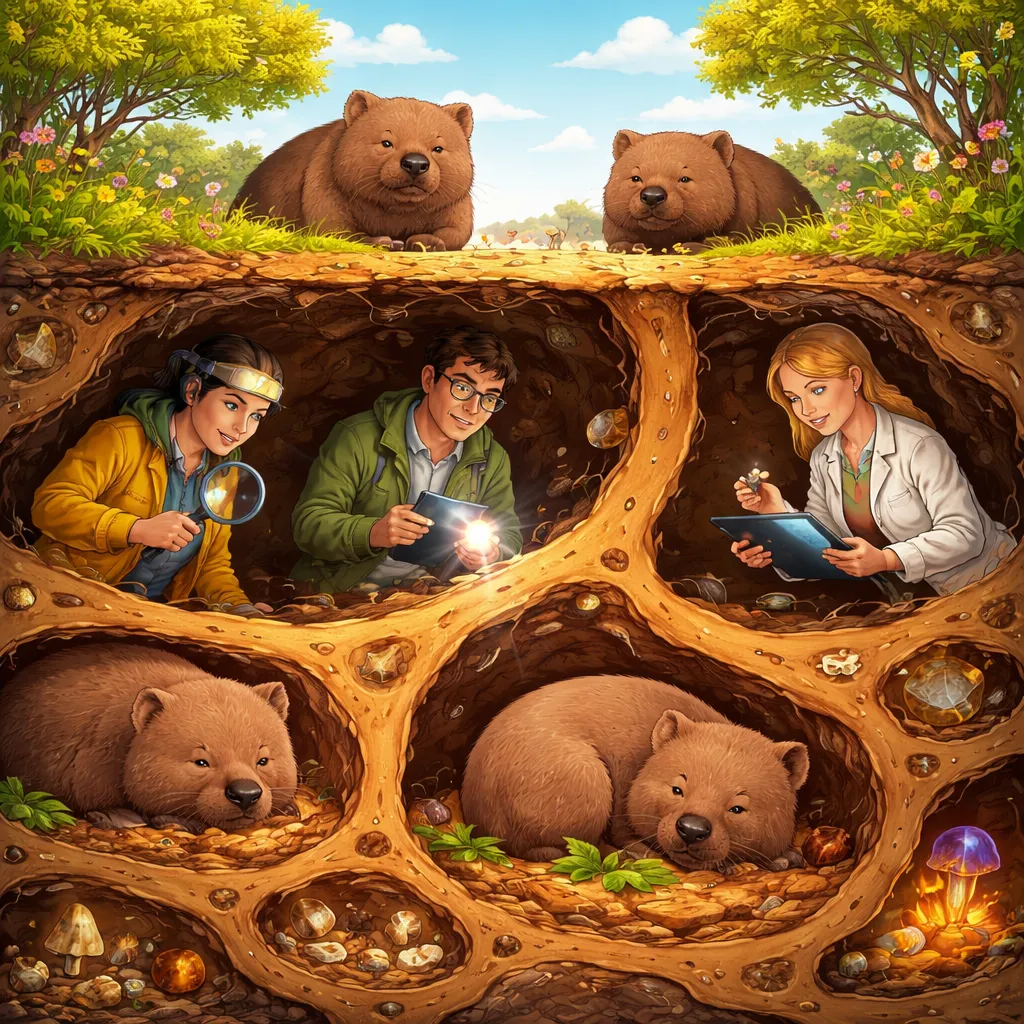

Have you ever seen a round, furry animal that looks like a small, cuddly bear with short legs? That might be a wombat! Wombats are amazing diggers from Australia. They are not bears, but sturdy marsupials with incredible skills. Learning about wombats takes us on a journey underground, to burrows and bushlands. Let’s grab our shovels of curiosity and start learning about wombat wonders!
English Language Learning
Vocabulary and Spelling Our digging friend is called a wombat. The word "wombat" is a noun. A noun names a person, place, or thing. So, a wombat is a thing—a strong, burrowing animal. Spelling "wombat" is interesting: W-O-M-B-A-T. The 'W' starts the word, like a wombat starting to walk. The 'O' and 'M' are in the middle, and it ends with 'B-A-T'. W-O-M-B-A-T spells wombat.
Sound and Pronunciation Let’s say the word correctly. It sounds like this: /ˈwɒm.bæt/. We can say it in two clear parts. First, say "wom". It rhymes with "bomb" or "Tom". Next, say "bat". It sounds just like the flying animal, "bat". Now, put it together! "Wom" "bat". Wombat! Excellent! The word "wombat" has two beats, or two syllables. Clap your hands twice: Wom-bat. It’s a sturdy, solid-sounding word.
Related Words Learning about wombats is more fun with new words! Here are some important ones. Home: A wombat’s long, underground tunnel home is called a burrow. A group of burrows is called a warren. Action: Wombats love to dig and graze. Grazing means eating grass. Unique Fact: Wombats are famous for their cube-shaped droppings (poop)! It’s a very special trait.
A Famous Saying While there isn’t a famous old saying, there is a fun modern phrase: "Built like a wombat." This means someone or something is very sturdy, strong, and low to the ground. It’s a playful way to describe a solid, tough build, just like a wombat’s body. Say the phrase with me: "Built like a wombat." It’s a compliment for being strong and steady!
Now you know the word "wombat"! Are you ready to dig into some amazing facts? Let’s tunnel from words to wonderful knowledge!
Animal Knowledge
Who Are They? – Family and Group What kind of animal is a wombat? Wombats are mammals. They have fur, are warm-blooded, and mother wombats feed their babies milk. They are a special kind of mammal called a marsupial. Marsupials have a pouch for their babies. Their closest living relatives are koalas! They share a common ancestor.
What Do They Look Like? – Amazing Bodies Wombats are about the size of a small dog, but much heavier and sturdier. They have thick, coarse fur in colors like brown, gray, or black. They have a large, rounded body, a big head, and very short, powerful legs. Their most famous feature is their strong, clawed feet. Their front paws have long, sharp claws perfect for digging. Their back is tough and their rear end is mostly made of cartilage, which is very hard. Wombats have special adaptations for a burrowing life. Their pouch opens backward! This is so dirt does not get on the baby while the mother digs. Their teeth never stop growing, so chewing grass wears them down.
Where Do They Live and How? – Home and Habits Wombats live only in Australia. Their homes are forests, grassy plains, and mountain areas. They need soil that is good for digging. Wombats are herbivores. This means they only eat plants. They are grazers, so they eat grasses, roots, and bark. They have a very slow metabolism, so they don’t need to eat a lot. Wombats are mostly solitary and nocturnal. This means they sleep during the day in their burrows and come out at night to eat. They are very good at digging and can create huge, complex burrow systems.
A Wombat’s Life Story – Growing Up A baby wombat is called a joey. Wombats are marsupials, so the joey is born very tiny and underdeveloped. It crawls into its mother’s backward-opening pouch. The joey stays in the mother’s pouch for about five months, drinking milk. After that, it will follow the mother and may ride on her back. It will stay with her for up to two years. The joey learns everything from its mother, especially how to dig and what to eat. It grows slowly and becomes independent after 18 to 20 months. Wombats can live for over 20 years.
How Do They "Talk"? – Communication Wombats are generally quiet animals. They can make grunts, growls, and squeaks. They also make a "huh-huh" sound when they are annoyed. They communicate a lot through scent. They have scent glands and leave droppings on rocks and logs to mark their territory. Their cube-shaped droppings don’t roll away, so the message stays! Their best sense is their sense of smell. Their nose is excellent for finding food and for understanding the scent messages from other wombats. Their hearing is also good.
Are They Okay? – Taking Care of Them Some wombat species, like the Northern Hairy-nosed Wombat, are critically endangered. This means there are very few left. Other species are doing better but still face problems. The main threats are habitat loss, diseases like mange, and being hit by cars. They also can have trouble finding food during droughts. You can be a wombat helper! You can learn and tell others about these unique animals. You can support wildlife groups in Australia that rescue sick wombats and protect their habitats. Being mindful of how we use land helps all burrowing animals.
Life Connections and Inspiration
How to Be With Them – Safety and Love Wombats are wild animals. We must respect their space and never try to interfere with their wild life. The most important rule is: Observe from afar and never disturb a burrow. In the wild, we watch them from a distance, especially at dusk. We never try to touch or feed a wombat. If you see one crossing a road, you can tell an adult so they can drive carefully. We must never block or damage a burrow entrance. We show our love by protecting the wide, open lands they need to dig and graze. We can be a voice for conservation.
Super Qualities We Learn from Them Wombats teach us wonderful things. One super quality is steady determination. Wombats are not fast, but they are incredibly determined and strong. They dig long, complex homes with patience and power. This teaches us to be steady, determined, and to work hard on our projects, even if they take time. Another quality is being grounded and sturdy. Wombats are built low to the ground and are very solid. They remind us to be strong, reliable, and to have a solid foundation in our own lives—like knowing our values and being a good friend. Think about it: How can you show steady determination when learning something difficult? How can you be a sturdy, reliable friend or family member?
Take Action! – Your "Wombat Warren" Project Let’s do a fun and steady activity! Your project is to design a wombat warren diorama. Find a shoebox and turn it on its side. Use brown paint or paper to create the dirt walls. Now, use paper towel tubes or molded clay to create tunnels branching off in different directions. These are the burrows. Make a little nest chamber with shredded paper. Draw or create a little wombat out of clay or paper and place it in the warren. Label the different parts of the burrow system. What do you think a wombat does in each chamber? Sleep, eat, store food? Use your imagination!
Closing Learning about wombat life is a grounding adventure! We learned the word "wombat" and how to say its two-part, sturdy name. We discovered amazing facts about their digging claws, their backward pouches, and their cube-shaped poop. We know that wombats are determined, sturdy animals who need our help to protect their homes. You can use your new words to share the story of these incredible diggers. You can use your knowledge to appreciate the importance of every creature’s role in nature. The animal world is full of steady, hardworking teachers. Always remember to respect wildlife from a safe distance, be determined in your goals, and stand on solid ground. Keep exploring with curiosity, work steadily on your dreams, and be a protector of the earth. Your patient care and strong will make you a true friend to animals everywhere, even those digging deep underground.