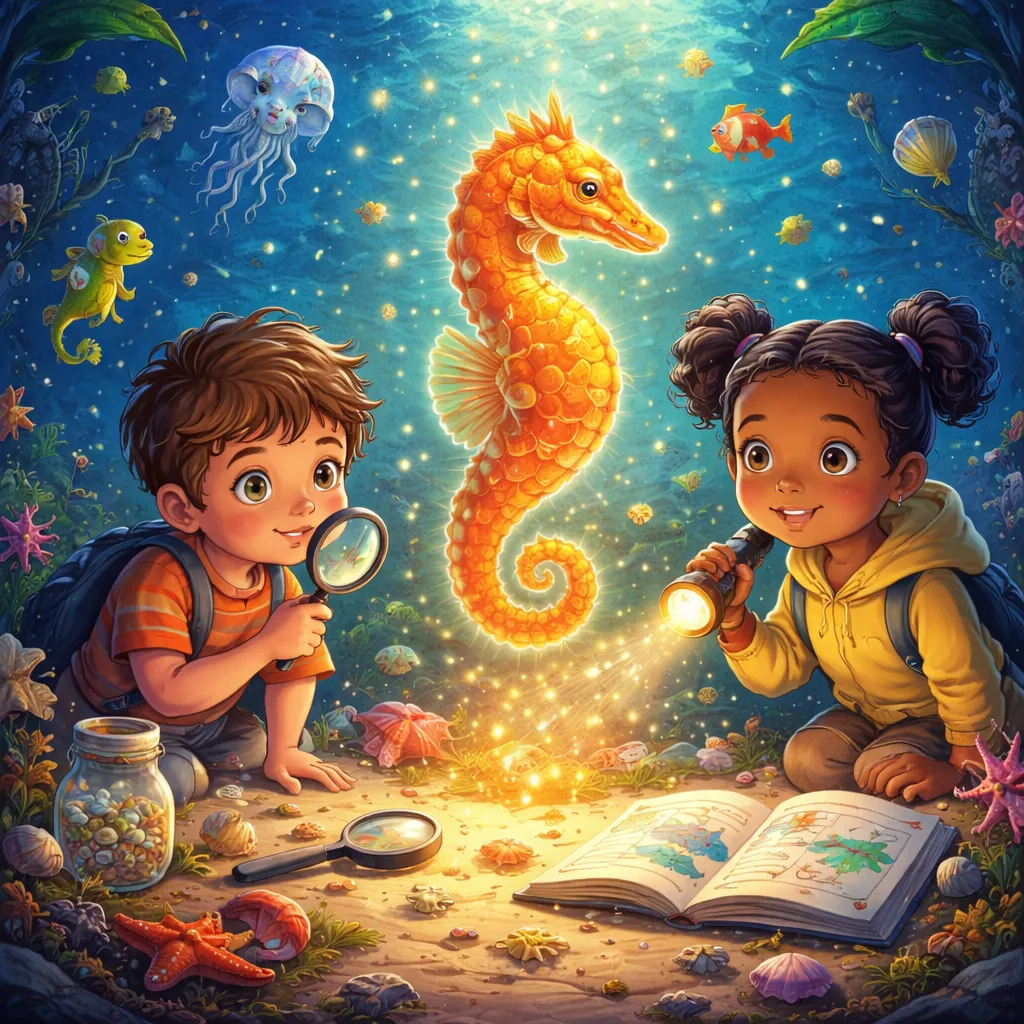

Imagine you’re exploring a calm, shallow sea and you see a tiny creature that looks like a horse’s head on a dragon’s body, holding onto a piece of seaweed with its curly tail. That’s a seahorse! These amazing little animals are fish, but they look like nothing else in the ocean. Learning about seahorses is a magical adventure that shows us how wonderfully different life under the sea can be. Let’s begin our journey of learning about seahorse mysteries.
English Language Learning
Vocabulary and Spelling
Our tiny, horse-headed friend is called a seahorse.
The word "seahorse" is a noun. A noun names a person, place, or thing. So, a seahorse is a thing—a very unusual, living fish.
Spelling "seahorse" is two words together: S-E-A and H-O-R-S-E. S-E-A-H-O-R-S-E spells seahorse.
Sound and Pronunciation
Let’s say the word correctly. It sounds like this: /ˈsiː.hɔːrs/.
We can say it in two clear parts. First, say "sea". It’s just like the big ocean, the sea! Next, say "horse". It’s the same as the animal, a horse.
Now, put it together! "Sea" "horse". Seahorse! Great!
The word "seahorse" has two beats, or two syllables. Clap your hands twice: Sea-horse. It’s a fun, descriptive word.
Related Words
Learning about seahorses is more fun with new words! Here are some important ones.
Body Part: The long, curling tail a seahorse uses to hold on is called a prehensile tail. A baby seahorse is called a fry.
Action: The way a seahorse moves through the water, standing up, is swimming upright.
Home: The seahorse’s home in the ocean, like a coral reef or seagrass bed, is its habitat.
A Famous Idea
Because seahorses are so unique, people sometimes say: "As unique as a seahorse."
This means something is one-of-a-kind, special, and unlike anything else. It reminds us that it’s wonderful to be different and to have our own special qualities.
Say the idea with me: "As unique as a seahorse." It’s a celebration of being different.
Now you know the word "seahorse"! Are you ready to discover their amazing world? Let’s swim from words to wonderful knowledge!
Animal Knowledge
Who Are They? – Family and Group
What kind of animal is a seahorse? Seahorses are fish. They are cold-blooded, have gills, and have a backbone. But they are a very special type of fish!
They are part of the Syngnathidae family. Their close cousins are pipefish and sea dragons. Their scientific name is Hippocampus, which means "horse caterpillar" in Greek! There are over 40 different species of seahorse.
What Do They Look Like? – Amazing Bodies
Seahorses are small, usually just a few inches long. They have a horse-like head, a pouch like a kangaroo, and a long, curling tail. Their most famous features are their unique shape and their ability to change color.
Their body is a masterpiece of camouflage! They can change their skin color to match the seaweed or coral they are holding onto. This helps them hide from predators. They have a bony armor of plates under their skin for protection, not scales.
Seahorses have special adaptations. They are poor swimmers. They swim upright and use a tiny fin on their back to flutter along. They use their tail to anchor themselves to plants so they aren’t swept away by currents. They have excellent eyesight, and their eyes can move independently, like a chameleon’s!
Where Do They Live and How? – Home and Habits
Seahorses live in warm, shallow seas all around the world. Their homes are coral reefs, seagrass beds, and mangrove forests. They need calm water and something to hold onto, like seagrass or coral.
Seahorses are carnivores. This means they are meat-eaters. They eat tiny shrimp, plankton, and other small creatures. They are ambush predators. They stay very still, camouflaged, and when a tiny shrimp swims by, they suck it up through their long, tube-like snout in a quick snap!
Seahorses are often seen in pairs or alone. They are active during the day. They spend their time holding onto plants with their tails, waiting for food, and gently swimming with their mate. A group of seahorses is sometimes called a herd.
A Seahorse’s Life Story – Growing Up
A baby seahorse is called a fry. Seahorses are fish, so they hatch from eggs. But here is the most amazing fact: the father seahorse has the babies!
The female lays her eggs in a special pouch on the father’s belly. He then carries the eggs for several weeks, keeping them safe and feeding them. When the eggs are ready, the father goes through a kind of "birth," releasing hundreds of tiny, fully-formed seahorse fry into the water.
The father does not take care of the fry after they are born. The tiny fry must survive on their own, which is very hard. They are so small they can be eaten by almost anything. Only a few will grow up to be adults. They grow quickly and are ready to have their own babies in a few months.
How Do They "Talk"? – Communication
Seahorses are quiet creatures. They do not make sounds we can hear. They communicate through behavior and color changes.
When a male and female seahorse are a pair, they do a beautiful daily dance. They meet every morning, change colors, and swim together holding tails. This dance strengthens their bond. Changing color can also show they are scared or upset.
Their best senses are their incredible eyesight and their sense of touch. Their moving eyes help them watch for food and danger. Their tail is very sensitive and helps them feel their surroundings.
Are They Okay? – Taking Care of Them
Many seahorse species are in trouble. They are vulnerable or endangered. Their special homes are disappearing, and they are caught for souvenirs and traditional medicine.
The main threats are loss of their coral reef and seagrass homes, pollution, and being caught too often for the pet trade or for drying and selling. They are also sometimes caught by accident in fishing nets.
You can be a seahorse saver! You can learn and tell others about them. You can never buy a dried seahorse as a souvenir. If you have a saltwater aquarium, make sure any seahorse you get was bred in a tank, not taken from the wild. Support groups that protect coral reefs, mangroves, and seagrass beds.
Life Connections and Inspiration
How to Be With Them – Safety and Love
Seahorses are delicate, wild ocean animals. We must admire them with great care and without disturbing their fragile homes.
The rule is: Look with your eyes, not with your hands. If you are snorkeling or diving, look at seahorses from a distance. Never try to touch one or pick it up. Never take a seahorse from the ocean. If you have a boat, be careful not to damage seagrass beds with your anchor.
We show our love by protecting the clean, healthy ocean gardens they need to survive. We can be gentle guardians of the sea.
Super Qualities We Learn from Them
Seahorses teach us beautiful lessons. One super quality is quiet patience and camouflage. A seahorse can stay perfectly still for a long time, waiting and blending in. It teaches us the value of patience, of sometimes being still and observant, and of adapting to our surroundings in a peaceful way.
Another quality is unique roles and dedicated fatherhood. The seahorse breaks the rules—the dad carries the babies! This shows us that families can work in many different, wonderful ways. It teaches us that it’s okay to be different and that dedication and care in a family can come from anyone.
Think about it: When is a time you need to be patient and still, like a seahorse waiting for food? What is something that makes you or your family unique and special?
Take Action! – Your "Seahorse Dance" Project
Let’s do a patient and creative activity! Your project is to create a seahorse and its habitat from modeling clay or recycled materials.
Use clay, pipe cleaners, or clean trash to shape a seahorse with a curly tail. Then, create its home: a piece of cardboard can be the ocean floor. Add green yarn for seagrass or painted paper for coral. Place your seahorse in its home, holding on with its tail. This shows the seahorse’s unique shape and its need for a safe place to live.
Closing
Learning about seahorse wonders is a gentle and fascinating adventure! We learned the word "seahorse" and how to say its two-part name. We discovered amazing facts about their color-changing skin, their upright swimming, and the father’s incredible role in having babies. We know that seahorses are patient, unique fish that are in danger and need us to protect their ocean homes. You can use your new words to share the extraordinary story of these magical creatures. You can use your knowledge to make choices that help our oceans and celebrate the beauty of being different. The animal world is full of patient and unique teachers. Always remember to respect wildlife from a safe distance, value patience and stillness, and celebrate the unique qualities in yourself and others. Keep exploring with wonder, hold onto your curiosity, and be a friend to the wild. Your caring actions and gentle spirit make you a true friend to the amazing seahorse.