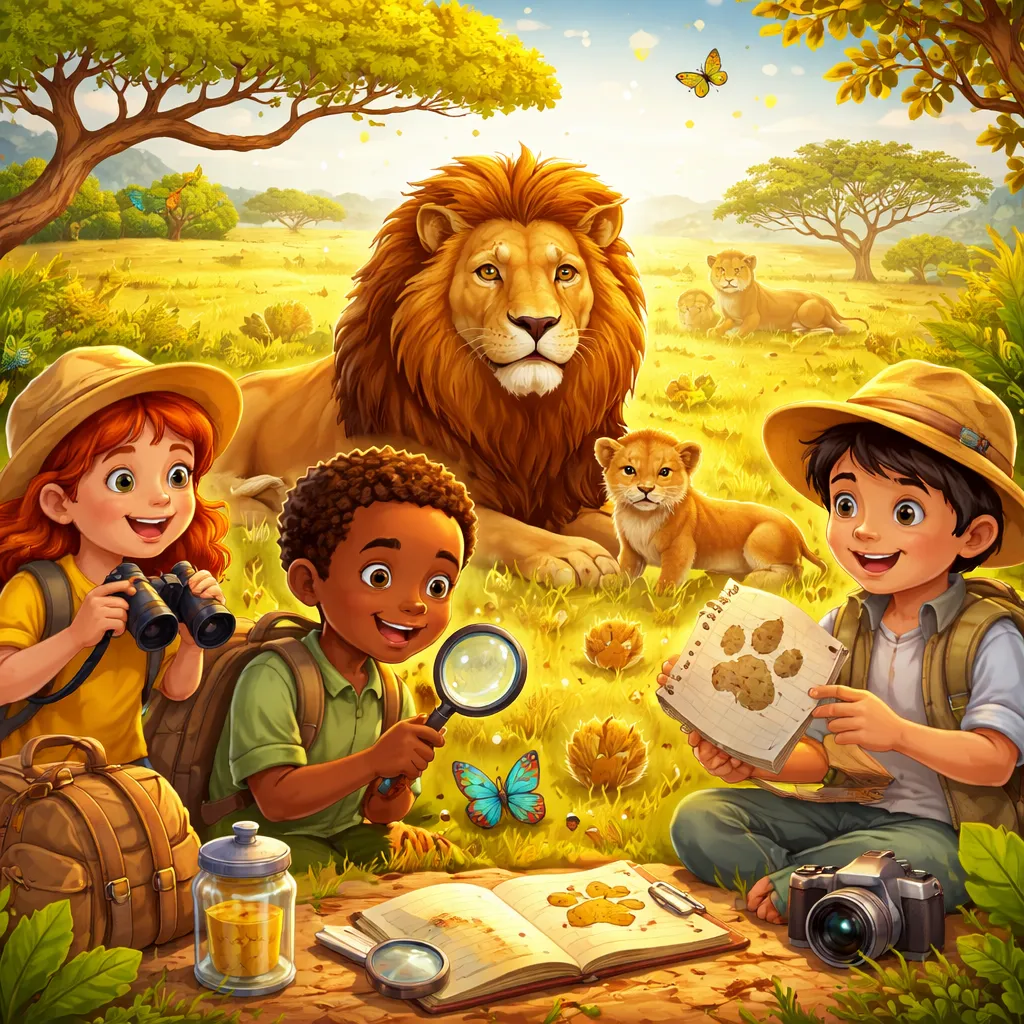

Have you ever seen a lion in a storybook or a movie? It often sits tall, with a big, fluffy mane, looking like the king of all animals. Lions are powerful, beautiful, and live in families. Learning about lions takes us on a safari adventure to the wild grasslands. Let’s discover the world of this magnificent big cat together.
English Language Learning
Vocabulary and Spelling The word for this majestic animal is lion. The word "lion" is a noun. A noun names a person, place, or thing. So, a lion is a thing—a strong and wonderful animal. Spelling "lion" is fun. It goes L-I-O-N. The 'L' stands tall like a lion’s head. The 'I' is straight like its strong body. The 'O' is round like its face, and the 'N' stands strong at the end, like its tail. L-I-O-N spells lion!
Sound and Pronunciation Let’s say the word right. It sounds like this: /ˈlaɪ.ən/. We can say it in two easy parts. First, say "lie". It sounds like the word "lie" or the "li" in "light". Next, say "uhn". It’s a soft sound, like the end of "button". Now, put the parts together fast! "Lie" "uhn". Lion! Perfect! The word "lion" has two beats, or two syllables. Clap two times: Li-on. It’s a strong, proud-sounding word.
Related Words Learning about lions is more exciting with new words! Here are some great ones. Body Parts: The long, thick hair around a male lion’s head and neck is called a mane. It makes him look big and protects his neck. Sound: The loud, deep call a lion makes is a roar. You can hear it from very far away! Home: A lion family group is called a pride. It is a home and a team all in one.
A Famous Saying There is a famous phrase about lions: "The lion’s share." This means the biggest or the best part of something. Imagine a lion taking the biggest piece of the meal. It’s a fun way to talk about getting the largest portion. It reminds us that lions are seen as strong and important. Say it with me: "The lion’s share." Can you think of something you’d like the lion’s share of? Maybe a big piece of cake?
Now you know how to say and spell "lion"! These words are your tools. Are you ready to explore the lion’s kingdom? Let’s go from words to the wild!
Animal Knowledge
Who Are They? – Family and Group What kind of animal is a lion? Lions are mammals. They have fur, are warm-blooded, and mother lions feed their babies milk. They are part of the big cat family! Their cousins are tigers, leopards, and jaguars. Lions are the only big cats that live in big family groups. Cool, right?
What Do They Look Like? – Amazing Bodies Lions are huge and strong! A male lion can be heavier than ten big children. They have golden-yellow fur that helps them hide in the dry grass. Their most famous feature is the male’s mane. This fluffy ring of hair makes him look bigger and protects his neck during fights. Both males and females have strong jaws and sharp teeth for eating meat. Lions have special adaptations for hunting. They have powerful legs for running fast in short bursts. Their rough tongues are like combs to help them lick meat off bones and groom their fur.
Where Do They Live and How? – Home and Habits Lions live in hot places in Africa. Their home is the savanna, which is a huge grassy plain with some trees. They need open space to hunt and rest. Lions are carnivores. This means they are meat-eaters. They hunt animals like zebras and wildebeests. The female lions, called lionesses, do most of the hunting for the pride. Lions are very social. They live in family groups called a pride. A pride has related lionesses, their cubs, and a few males. They spend their time resting, playing, and protecting their home.
A Lion’s Life Story – Growing Up A baby lion is called a cub. Lions are mammals, so cubs are born live from their mother. A lioness can have two to four tiny, spotted cubs at a time. All the lionesses in the pride help take care of all the cubs. They feed them, protect them, and teach them how to hunt. The cubs play-fight a lot to practice for when they grow up. Cubs have soft, spotted fur when they are born. The spots help them hide. As they grow, the spots fade, and male cubs start to grow their manes when they are a few years old.
How Do They "Talk"? – Communication Lions talk to each other in many ways. They are famous for their loud roars. A roar can tell another lion "This is my home!" from miles away. They also grunt, growl, and purr! They rub heads and lick each other to say "Hello, friend." Their best senses are sight and hearing. They have excellent night vision to help them hunt in the dark. Their ears can turn to catch the smallest sound of prey.
Are They Okay? – Taking Care of Them Lions are in trouble. They are vulnerable. This means there are fewer and fewer lions left in the wild. People are taking their land for farms and cities. Sometimes, lions are hunted. They can also have trouble finding enough food. You can be a lion hero! You can learn all about them and tell your friends. You can support groups that protect wild lands in Africa. Remember, all living things are connected, and protecting nature helps protect amazing animals like lions.
Life Connections and Inspiration
How to Be With Them – Safety and Love Lions are powerful wild animals. We must admire them from a very safe distance. The most important rule is to look, never touch. We see lions in zoos, behind strong glass or fences, or in nature documentaries. We never, ever try to get close to a wild lion. They are not pets; they are strong predators. We show our love by respecting their wild nature and helping protect the places where they live. We can be brave voices for their protection.
Super Qualities We Learn from Them Lions teach us amazing things. One super quality is courage. Lions are known as the "king of beasts" for their bravery. They face big challenges to protect their pride. They teach us to be brave in our own lives. Another quality is teamwork and leadership. A lion pride works together. The lionesses hunt as a team to feed everyone. They show us that working together and looking out for your family and friends makes everyone stronger. Think about it: When do you need to be brave like a lion? How can you be a good team player or a kind leader in your own "pride" at home or school?
Take Action! – Your "Lion Pride" Project Let’s do a fun activity! Your project is to make a lion’s mane headband and act out a pride. Find some paper, yellow and orange crayons or paper strips, scissors, and tape. Cut a long strip of paper to fit around your head. Draw a lion’s face in the middle or color it yellow. Glue or tape lots of strips of yellow and orange paper all around it to make a big, fluffy mane. Now you are a lion! Gather your friends or toys as your pride. Who will be the lionesses on the hunt? Who will watch the cubs? Act out a day in the life of a lion pride on the savanna.
Closing Learning about lion kings is a roaring good adventure! We learned the word "lion" and how to say its proud, two-part name. We discovered cool facts about their loud roars, their family prides, and their amazing manes. We know that lions are brave, social animals who need wide-open spaces to live. You can use your new words to share stories about these big cats. You can use your knowledge to understand why we must protect wild animals. The animal kingdom is full of powerful and beautiful teachers. Always remember to respect wildlife and be a voice for those who cannot speak. Keep exploring, stay brave, and work together with your own pride. Your curiosity and care can help the wild world stay wonderful.