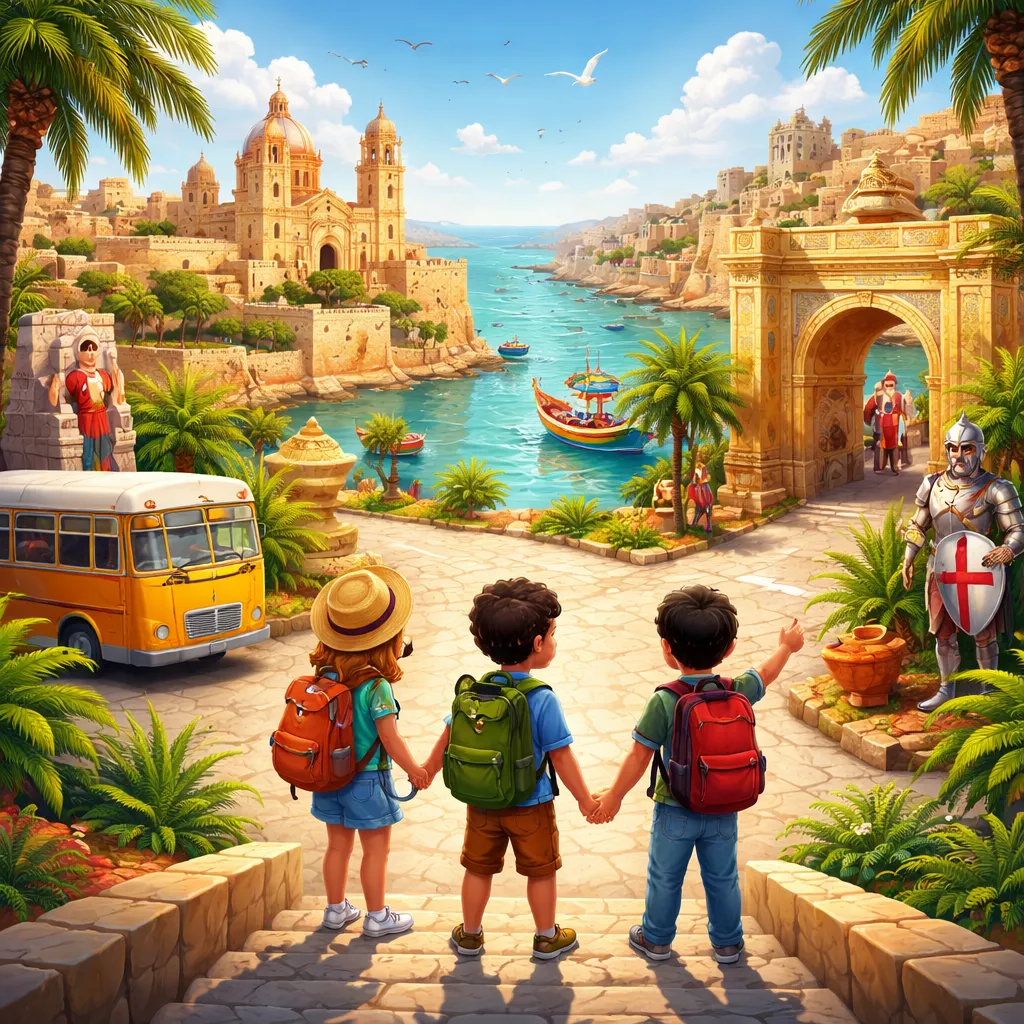

Introduction to Malta
Language learning carries us to islands where history whispers from ancient stones. Today we explore a small archipelago in the heart of the Mediterranean Sea. This nation holds temples older than the Egyptian pyramids. Children will discover a land shaped by knights, sailors, and ancient builders. They will learn about stone structures built over five thousand years ago. Exploring Malta builds reading skills while revealing layers of human history. Every fact uncovers a new civilization. Every word invites them to walk where Phoenicians, Romans, and Knights once stood.
Where Is Malta?
Malta lies in the Mediterranean Sea south of Sicily, Italy. This small archipelago consists of three main islands. Malta, Gozo, and Comino form the nation. The country sits between Europe and North Africa. Its location made it a prized possession for many empires. The capital city is Valletta. Valletta stands on a peninsula with grand buildings and fortress walls. The city overlooks the sea on both sides. The islands cover just over one hundred twenty square miles. That makes Malta one of the smallest countries in the world. Finding Malta on a map shows a tiny dot between Italy and Tunisia. This central location explains why so many cultures left their mark here.
Interesting Facts About Malta
Malta offers extraordinary facts for young learners. It holds some of the oldest freestanding structures on Earth. The Ħaġar Qim and Mnajdra temples date back over five thousand years. They were built before Stonehenge and the pyramids of Egypt. Another interesting fact involves the Knights of St. John. These warrior monks ruled Malta for over two hundred years. They built cities, forts, and churches. The knights turned Malta into a fortress that withstood massive attacks.
Malta also has a unique language. Maltese is the only Semitic language written in the Latin alphabet. It contains words from Arabic, Italian, and English. Another fun fact involves the blue waters. The Blue Lagoon on Comino island shines with turquoise water so clear you can see the bottom. Malta also has underground wonders. The Hypogeum is a subterranean temple complex carved from rock. It served as a sanctuary and burial place thousands of years ago.
The country also features stunning cliffs. The Dingli Cliffs drop straight into the Mediterranean. On clear days, you can see Sicily across the water. These facts show children a country where nature and human history combine in remarkable ways.
Key Vocabulary About Malta
Let us build vocabulary for this island nation. These words help children describe what they learn.
Archipelago: a group or chain of islands.
Temple: a building used for religious worship.
Knights: warriors who served a ruler or followed a religious order.
Fortress: a strong building built for defense.
Megalithic: made of very large stones.
Hypogeum: an underground ancient structure.
Peninsula: a piece of land surrounded by water on three sides. Introduce these words with pictures and stories. Show the megalithic temples with their giant stones. Show the knights' armor and forts. Let children say each word aloud. These vocabulary words give children the language to explore Malta's deep history.
Simple Sentences for Reading Practice
Short sentences help new readers build confidence. Use these sentences about Malta for practice.
Malta is a small island country in the Mediterranean Sea.
The capital city is Valletta.
Ancient temples stand on the islands.
These temples are over five thousand years old.
Knights once ruled Malta.
The Blue Lagoon has clear turquoise water.
People speak Maltese and English. Read each sentence together. Let children point to the words. Encourage them to repeat after you. Use pictures to show each fact. These simple sentences prepare young readers for longer passages.
Short Reading Passage About Malta
Here is a short passage for children to read together.
“Malta sits in the middle of the Mediterranean Sea. This small archipelago includes the islands of Malta, Gozo, and Comino. The capital, Valletta, stands on a rocky peninsula. Fortress walls surround the city. Long ago, knights built these walls to protect the island. Before the knights, other people lived here. The ancient builders created temples from massive stones. The Ħaġar Qim temple stands on a hill overlooking the sea. People built it over five thousand years ago. Underground, the Hypogeum tunnels deep into the rock. This hidden place served as a temple and burial site. The islands also hold natural wonders. The Blue Lagoon shimmers with bright blue water. Fish swim in the clear shallows. The Dingli Cliffs drop straight to the sea. From the top, you can see forever. Today, people speak Maltese, a language with Arabic and Italian roots. English is also spoken everywhere. Malta brings together ancient stones, knightly forts, and sparkling seas.”
Read this passage slowly together. Pause to talk about each idea. Ask children to find vocabulary words in the text. This activity builds reading fluency and deepens understanding.
Fun Questions About Malta
Questions make reading interactive and engaging. Use these to start conversations with young learners.
What sea surrounds Malta?
What is the capital city of Malta?
How old are the ancient temples in Malta?
Who were the knights that ruled Malta?
What is the Blue Lagoon known for?
What languages do people speak in Malta? Let children answer in complete sentences. Encourage them to use new vocabulary. Ask them to imagine visiting the ancient temples. What would they wonder about the people who built them? Creative questions make the topic personal and exciting.
Tips for Learning English with This Topic
Use Malta to create rich English learning experiences. Start with a map activity. Let children find Malta between Sicily and North Africa. Discuss why so many cultures wanted to control this small island. Point out how location influences history. This connects geography to historical understanding in a meaningful way.
Next, introduce the vocabulary through a building activity. Let children build their own megalithic structures using blocks or stones. Talk about how ancient builders moved giant stones without machines. Use the words "megalithic" and "temple" during the activity. Hands-on learning makes ancient history tangible.
Read the passage aloud with a sense of wonder. Let your voice reflect amazement at the five-thousand-year-old temples. After reading, let children draw a scene from Malta. One child might draw the Ħaġar Qim temple with its massive stones. Another might draw knights in armor by the fortress walls. Let them label their drawings with vocabulary words.
Incorporate a history connection. Talk about how different groups left their mark on Malta. Mention the ancient temple builders, the Romans, the knights, and modern Maltese people. This shows children that language learning reading connects to the layers of human history.
Use music and movement to enhance the experience. Listen to traditional Maltese music or sounds of the sea. Let children pretend to be knights guarding the fortress. Pretend to be ancient builders moving giant stones. Physical activity reinforces learning in joyful ways.
Encourage children to share their knowledge. Let them tell a family member about the temples older than the pyramids. They can explain why Malta's location made it so important. Teaching others builds confidence and deepens understanding.
Connect Malta to your child's world. Ask, “What are the oldest buildings near our home?” Talk about how people built structures long ago. Compare them to Malta's megalithic temples. Ask about languages spoken in your community. Compare that to Malta's multilingual culture. These connections help children see that language learning reading is about understanding people across time and place. By exploring Malta together, you give children a rich experience. They learn new words, discover an island of ancient wonders, and grow their love for reading. This Mediterranean gem becomes a cherished part of their learning journey.