
What Is This Plant?
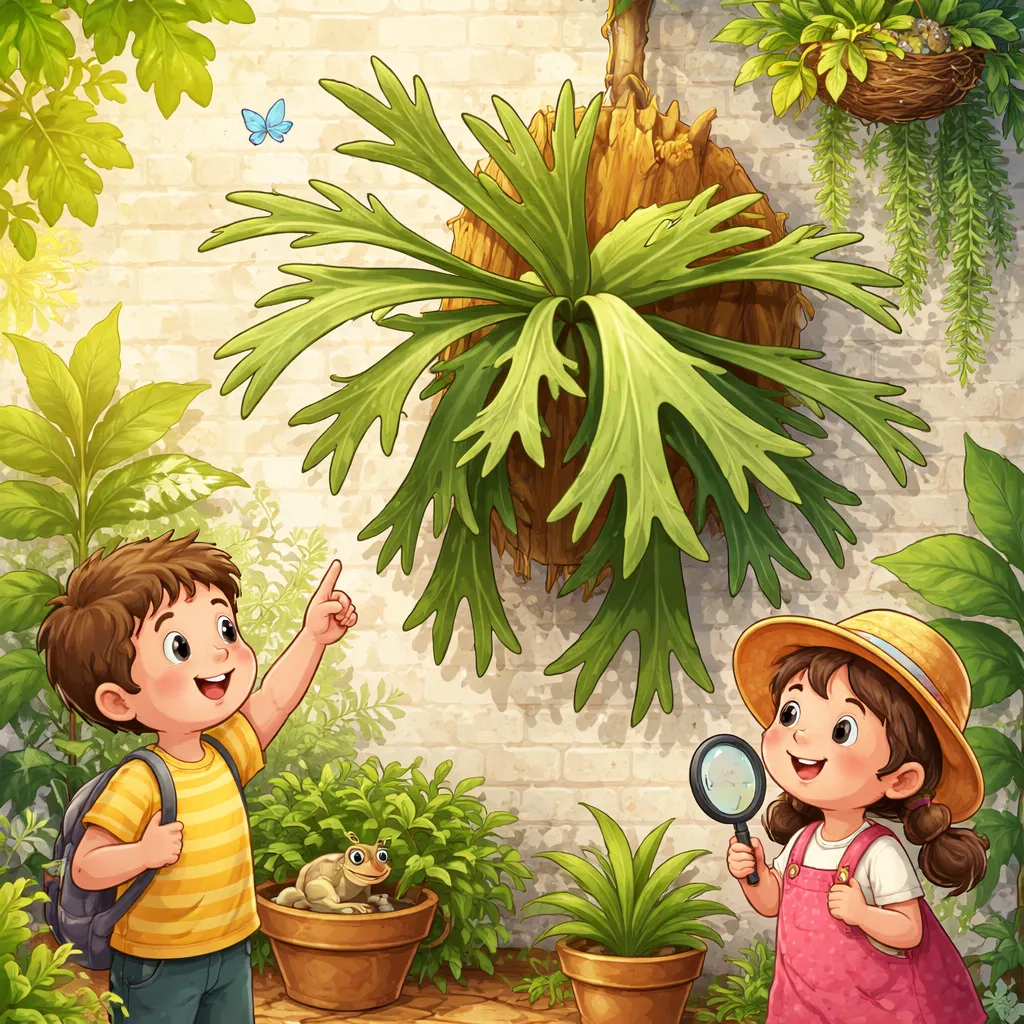
The staghorn fern plant is a unique, antler-shaped fern that grows on trees, walls, or mounted on boards. It does not grow in soil. It is an epiphyte. It attaches to surfaces with special fronds. The plant has two types of fronds. The basal fronds are flat and round. They look like shields. They attach to the surface and collect water and nutrients. The fertile fronds are long and forked. They look like deer antlers or stag horns. That is how the plant got its name. The fertile fronds are green and can grow several feet long. The plant has no roots. It absorbs water through its fronds. For children, the staghorn fern is like a plant from another world. It grows on walls. The fronds look like antlers. Parents can mount staghorn ferns on boards or hang them in baskets. Children love the antler shape and the way the plant grows without soil. This plant teaches children about epiphytes, adaptation, and unique plant forms.
English Learning About This Plant
The English name “staghorn fern” comes from the antler-shaped fronds. The pronunciation is “stag-horn fern.” The International Phonetic Alphabet (IPA) is /ˈstæɡhɔːrn fɜːrn/. Children can say it: stag-horn fern. When we learn about staghorn fern plant, we learn words for its parts. The basal frond is the flat, round, shield-shaped part that attaches to the surface. The fertile frond is the long, forked, antler-shaped part. The epiphyte is a plant that grows on another plant without taking nutrients. The spore is the tiny, dust-like part that ferns use to reproduce. The mount is the board or surface the fern is attached to. These words help children describe this unique fern.
There is a famous saying about staghorn ferns. They are called “antler ferns” in some places. Another saying goes, “A staghorn fern turns a wall into a living sculpture.” Parents can share these words with their child. They become gentle lessons about adaptation and the beauty of unique forms. Staghorn ferns are native to tropical regions around the world.
Plant Facts and Scientific Knowledge
The staghorn fern plant belongs to the genus Platycerium. There are about 18 species. Staghorn ferns are members of the polypody family, Polypodiaceae. They are native to tropical regions of Africa, Asia, Australia, and South America. They are epiphytes. They grow on trees in the wild.
Staghorn ferns have two types of fronds. Basal fronds are sterile. They are flat, round, and brownish. They attach to the surface. They collect water and fallen leaves. They also protect the plant’s roots. As new basal fronds grow, they cover the old ones. The plant becomes larger.
Fertile fronds are the antler-shaped ones. They are green and forked. They can grow several feet long. They produce spores on their undersides. The spores are brown and dust-like.
Staghorn ferns have no true roots. They absorb water and nutrients through their fronds. They are very slow-growing. They can live for decades. Large specimens can weigh over 100 pounds.
Staghorn ferns have symbolic meaning. They represent strength, uniqueness, and adaptation. The antler shape represents the beauty of nature. They are living sculptures.
How to Grow and Care for This Plant
Growing a staghorn fern plant is a unique project. It does not grow in soil. It needs to be mounted. Use a wooden board, cork bark, or wire basket. Place sphagnum moss on the mount. Place the fern on the moss. Attach it with fishing line or wire. Children can help by holding the fern while you attach it.
Hang the mount in a spot with bright, indirect light. It needs light but not direct sun. It needs high humidity. Mist the fronds regularly. In dry climates, soak the entire mount in water once a week.
Water staghorn fern by soaking the mount. Submerge it in water for 10 to 15 minutes. Let it drain. Do this when the moss feels dry. In winter, water less. The basal fronds will turn brown. This is normal. Do not remove them. They protect the plant.
Fertilize staghorn fern once a month in spring and summer. Use diluted fertilizer. Place a banana peel in the basal fronds. This provides potassium. Children can help by placing the peel.
The plant grows slowly. Be patient. It will reward you with antler-shaped fronds.
Benefits of Growing This Plant
Growing a staghorn fern plant brings many gifts to a family. First, the antler shape is unique. Children love the way it looks like deer antlers. Second, the plant grows on a wall. It is like living art.
Staghorn ferns teach about epiphytes. Children learn that some plants grow on other plants. They learn about adaptation.
The plant is long-lived. It can become a family treasure. Children can watch it grow over many years.
Staghorn ferns also teach about patience. They grow slowly. Children learn that good things take time.
What Can We Learn From This Plant
A staghorn fern plant teaches children about adaptation. The plant grows on trees without soil. It has special fronds to collect water. Children learn that adaptation is key to survival. They can adapt to their environment.
Staghorn ferns also teach about uniqueness. The antler shape is unlike other plants. Children learn that being different is beautiful. They can embrace what makes them unique.
Another lesson is about protection. The basal fronds protect the plant. Children learn that they can protect themselves. They can have layers of protection.
Staghorn ferns also teach about slow growth. They take years to grow large. Children learn that growth takes time. They can be patient.
Fun Learning Activities
There are many simple activities to help children learn about staghorn fern plant. One activity is a frond study. Look at the two types of fronds. Find the flat, round basal fronds. Find the long, forked fertile fronds. Compare them. This builds observation.
Another activity is a mounting activity. Help your child mount a small staghorn fern on a board. Use moss and wire. Hang it on the wall. This teaches about epiphytes and care.
A nature journal works well for staghorn ferns. Draw the basal fronds that look like shields. Draw the fertile fronds that look like antlers. Label the parts: basal frond, fertile frond, mount. Write the date when you mounted the plant.
For art, try painting staghorn ferns. Use green paint for the antler-shaped fronds. Use brown for the basal fronds. Paint the mount. This creates a living sculpture picture.
Vocabulary games are fun too. Write the words staghorn fern, basal frond, fertile frond, epiphyte, mount, and antler on cards. Say each word. Ask your child to point to the part on the plant. Practice saying staghorn fern together. Clap the syllables: stag-horn fern.
Finally, try a patience activity. Mount a staghorn fern. Take a photo each year. See how it grows. This teaches about slow growth and patience.
Through these activities, children build a deep connection with a unique fern that grows like antlers on a wall. They learn new words, mount plants, and discover the joy of adaptation. The staghorn fern plant becomes a symbol of uniqueness and patience. Each time they see the antler-shaped fronds, children remember that being different is beautiful. They remember that growth takes time. This living sculpture opens a world of epiphyte wonder, patient observation, and the lasting lesson that the most unusual plants often teach us the most about adaptation and uniqueness.