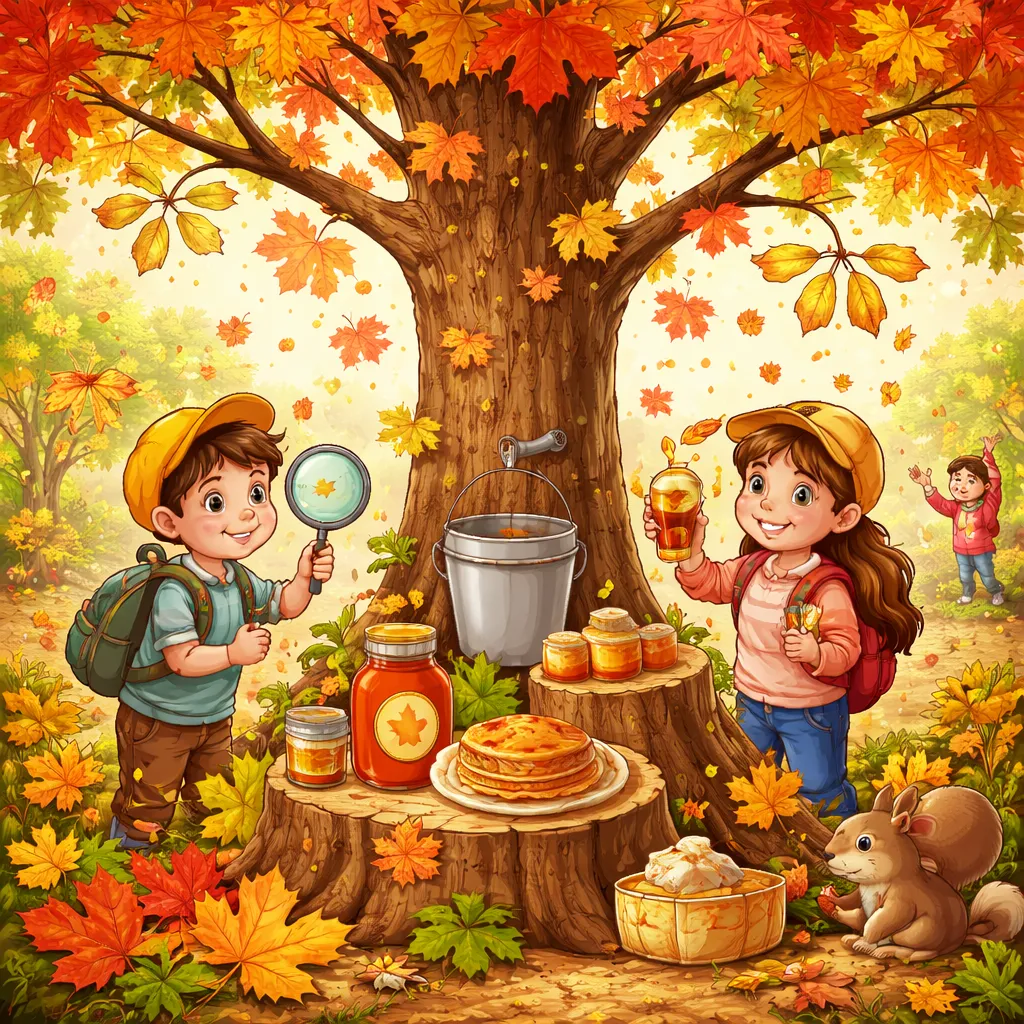

In the fall, have you ever seen a tree that looks like it’s on fire? Its leaves blaze in bright red, orange, and yellow, creating a breathtaking show. And have you ever eaten delicious, golden syrup on your pancakes? That sweet, sticky treat comes straight from a tree! Believe it or not, these two amazing things come from the same family of wonderful, generous trees. Their most famous feature is a leaf shaped like a hand with pointy fingers. Let’s begin a colorful and tasty adventure to learn about the marvelous Maple plant.
Let’s Learn the Word! – Open the Treasure Box of Language
Formal Name and Pronunciation This generous tree is called a Maple. You can say it like this: /ˈmeɪ.pəl/ (MAY-pul). The “May” sounds like the month, and “pull” rhymes with “full.” Ma-ple. Say it with a smile! It’s a happy, friendly-sounding word.
The Etymology Tale The word “Maple” is very old. It comes from the Old English word “mapulder,” which itself might have come from an older word meaning “spotted wood” or “wood that looks marked.” Long ago, people noticed that the wood of the maple tree had beautiful, sometimes speckled patterns. The name has been used for this special wood for over a thousand years.
Nicknames and Friendly Aliases Maples have many nicknames based on their superpowers. The famous syrup-makers are often called “Sugar Maple” or “Rock Maple.” The tree with bright red seeds is the “Red Maple.” The giant tree with big leaves is the “Bigleaf Maple” or “Oregon Maple.” The most famous tiny garden maple is the “Japanese Maple.” In the fall, people just call them the “Autumn Blaze” for their incredible colors.
Building Your Word Web: Core Parts Let’s learn the words for a Maple’s body. The Leaf is the superstar! It is palmate, meaning it’s shaped like an open hand with 3, 5, or 7 pointed lobes (the “fingers”). The Samara is the amazing, winged seed. It looks like a little, spinning helicopter propeller. The Trunk is strong, with bark that is often gray and furrowed. The Bark on young trees is smooth; on old trees, it gets shaggy and full of long ridges. Buds are the small, pointy, red or green tips on the branches in winter, like little wrapped-up presents. The Sap is the clear, slightly sweet water that flows inside the tree. A Tap is the spout people put in the trunk to collect the sap. The Canopy is the tree’s wide, shady crown of leaves.
Action and State Words Maples are famous for changing! In autumn, their leaves turn brilliant colors and then fall. In late winter, the sap begins to flow or run. The winged seeds spin and helicopter down from the branches. A maple tree provides deep shade in summer. It is colorful, sweet, and generous.
Ecosystem Friends Vocabulary The maple is a busy animal diner and hotel. Squirrels and chipmunks eat the seeds. Songbirds like finches and grosbeaks also love the seeds. Deer nibble on the tender twigs and leaves. Butterflies and moths lay eggs on the leaves; their caterpillars eat them. Bees visit the small, early spring flowers for pollen. Woodpeckers sometimes look for insects in the bark.
Cultural Imprint in Language The maple leaf is a famous symbol. In Canada, it stands on the national flag, representing the country’s natural beauty and strength. The poet Helen Hunt Jackson wrote: “October’s bright blue weather… O suns and skies and clouds of June… Count all your boasts together, I love the gentle maple.” The poem loves the maple’s gentle beauty more than the boastful sun of summer. In English, to be “sappy” can mean being very sweet and sentimental, just like maple sap!
Ready for Discovery We know its sweet and colorful name. Are you ready to become a detective and discover the Maple plant’s juicy secrets? Let’s explore!
Discover the Plant’s Secrets! – A Nature Detective’s Notebook
The Plant Passport Maples belong to the Sapindaceae family. Their group name is Acer. A maple tree can look like a giant, friendly umbrella, creating a huge circle of shade. The leaves are its signature: shaped like a hand, with veins spreading out like the lines on your palm. In spring, it grows small, delicate flowers that are often red, yellow, or green. The fruit is the amazing samara—two seeds joined together, each with a papery wing. In autumn, the leaves put on a breathtaking show of crimson, gold, and orange. It is a deciduous tree, sleeping bare in winter, with its next year’s leaves waiting inside the pointy buds.
Survival Smarts The maple’s flying seed is genius! The wing makes the seed spin like a helicopter. This carries it far away from the parent tree on the wind, so the baby tree doesn’t have to fight its parent for sunlight and water. The most famous trick is the sweet sap. In late winter, warm days and freezing nights create pressure inside the tree. This pushes the watery sap, stored in the roots, up the trunk. The tree uses this sap as energy to make its new leaves. People tap this sap to make syrup.
Its Role and Gifts The maple is a cornerstone of the forest. Its seeds are a vital food source for many mammals and birds. Its dense canopy provides crucial shelter and nesting sites. It is a superstar environmental engineer. Its wide roots help prevent soil erosion. Its huge leafy canopy cleans the air, provides cooling shade that lowers temperatures, and its falling leaves create rich compost for the forest floor.
Stories and Symbols The maple leaf, especially the sugar maple leaf, is a global symbol of strength, endurance, and sweet generosity. In Canada, it is the national emblem. For many Native American tribes, the maple was the “Tree of Sweet Water,” and they had legends about how the sap was discovered. They developed the first methods for collecting sap and making syrup, a gift they shared with European settlers. People use the hard, beautiful wood for furniture, floors, musical instruments, and even bowling pins!
Fun “Wow!” Facts Get ready for a sweet surprise! It takes about 40 gallons of clear, watery maple sap to make just ONE gallon of the thick, delicious maple syrup you eat. That’s a lot of work for the tree and the syrup maker! And here’s another: a sugar maple tree can live and produce sap for over 300 years. Some trees being tapped today are older than the United States!
From Forest to Your Future The Maple plant is full of gifts. How can you grow a friendship with one? You can plant a piece of this colorful, generous future. Let’s see how.
Let’s Grow It Together! – A Little Guardian’s Action Guide
Good for Home Growing? You must choose wisely! A giant sugar maple needs a huge backyard. But you can grow a smaller variety like a Japanese Maple in a large pot on a patio for many years, or plant an Amur Maple in a small garden. Dwarf maples are perfect for containers. They love a spot with morning sun and afternoon shade.
Little Gardener’s Toolkit You will need a young maple sapling from a garden center. You can also try growing from a samara seed! Get a large pot with excellent drainage holes. Use good-quality, well-draining potting soil. Have a watering can, some mulch (like bark chips), and a small stick for support ready.
Step-by-Step Growing Guide
Planting Your Colorful Friend The best time to plant is in early fall or spring. For a sapling, dig a hole in your pot twice as wide as the root ball. Place the tree in, fill with soil, and pat gently. Water it deeply. For a seed, in the fall, plant a samara about half an inch deep in a small pot of soil. Leave it outside for the winter cold—it needs this to wake up in spring!
Care Calendar Your maple likes even moisture. Water it when the top inch of soil feels dry. It dislikes very wet, soggy feet. Most maples enjoy full sun to part shade. Feed it in early spring with a slow-release, balanced fertilizer. A little compost mixed in the soil each spring is wonderful too.
Watch and Be Friends This is a four-season show! In spring, watch the tiny leaves unfold from the red buds. In summer, enjoy the deep shade. In fall, have a front-row seat to the color explosion. In winter, admire the beautiful shape of the bare branches. Measure its height each season. Watch the samaras spin down in spring or summer.
Problem Diagnosis If leaf edges look scorched and brown in summer, it might be getting too much hot afternoon sun or not enough water. Move the pot or water more deeply. A common issue is aphids (tiny bugs) that make leaves sticky. Spray them off with a strong jet of water. Japanese maples can get sunburned leaves, so dappled shade is best.
Your Rewards and Gifts Your gift is a living calendar of beauty. You are growing a tree that will teach you about the seasons in the most colorful way. Caring for a maple teaches patience, observation, and the joy of nurturing something that gives so much back—shade, beauty, and maybe one day, seeds for the next generation. You become a steward of sweetness and color.
Creative Fun Start a Four-Seasons Maple Journal. Draw or paint your tree in spring green, summer shadow, autumn fire, and winter silhouette. Make amazing leaf art with crayon rubbings to see every vein. Press colorful autumn leaves in a big book. Try writing a haiku (a short Japanese poem) about your maple tree. Build a tiny fairy house at its base.
Growing Generosity By planting a maple, you are not just planting a tree. You are planting future shade, a kaleidoscope of color, a bird restaurant, and a legacy of natural wonder. You are a planter of joy.
Conclusion and Forever Curiosity What a deliciously colorful journey! You started by learning the word “Maple,” you discovered its secrets as nature’s sweetest artist and helicopter pilot, and you learned how to help one take root in your world. You now know the Maple is not just a pretty leaf; it is a symbol of generosity, a master of flight, a creator of sweet magic, and a friend to all seasons. Remember, its gifts are in its shade, its color, and its sweetness. Your curiosity is the key that unlocks these gifts. Keep looking for the spinning seeds, tasting the sweet syrup, and marveling at the autumn fire. Your adventure to learn about the Maple plant is a gift that grows sweeter and brighter every year.