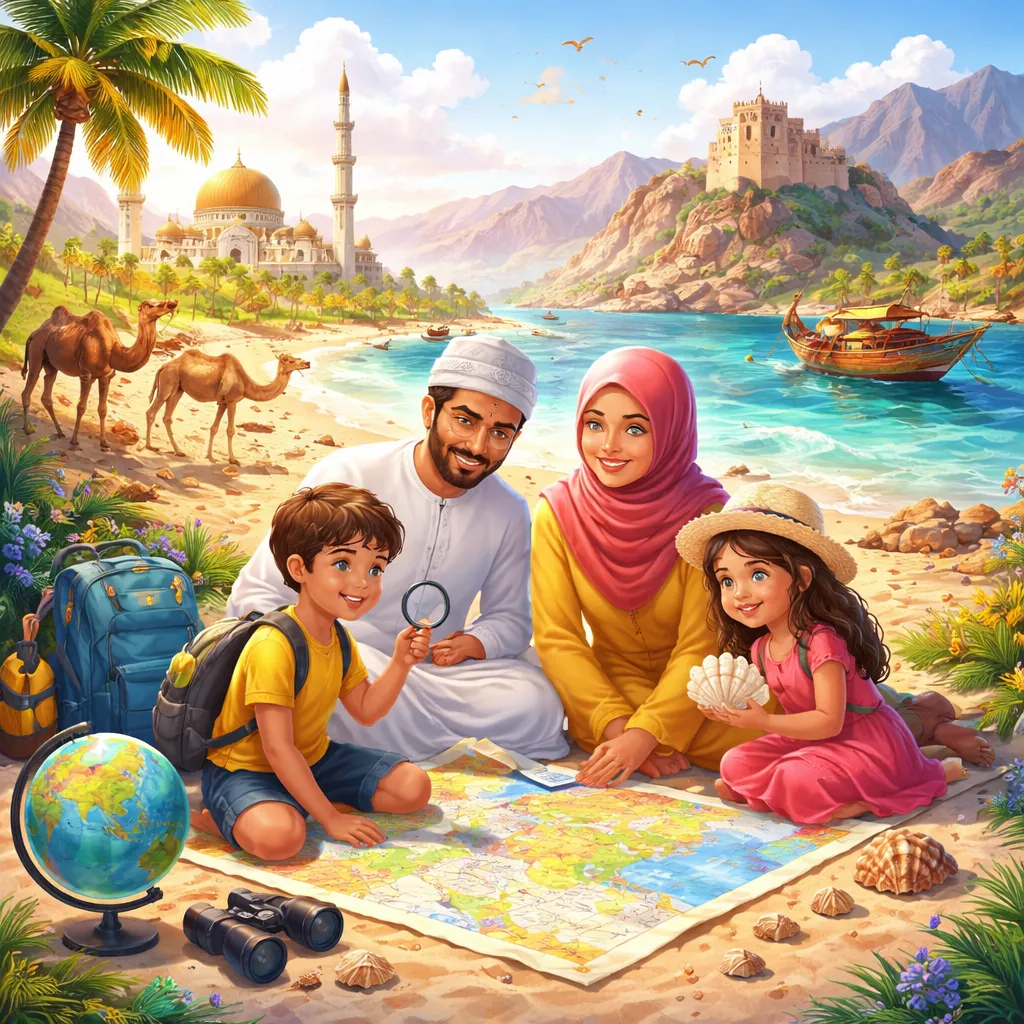

Introduction to Oman
Language learning transports us to a land of ancient trade routes and dramatic coastlines. Today we explore a sultanate on the southeastern edge of the Arabian Peninsula. This nation holds deserts, mountains, and a coastline stretching for over one thousand miles. Children will discover the history of frankincense, a fragrant resin traded for thousands of years. They will learn about traditional dhows that still sail the Indian Ocean. Exploring Oman builds reading skills while revealing a country of hospitality and natural beauty. Every fact uncovers a new treasure. Every word invites young readers to imagine this Arabian gem.
Where Is Oman?
Oman lies on the southeastern coast of the Arabian Peninsula. It shares borders with the United Arab Emirates to the northwest, Saudi Arabia to the west, and Yemen to the southwest. The Arabian Sea and the Gulf of Oman form its eastern and northern coastlines. The capital city is Muscat. Muscat sits on the Gulf of Oman with mountains rising behind it. The country covers over one hundred nineteen thousand square miles. It ranks as the third largest country on the Arabian Peninsula. The landscape varies dramatically. Mountains run along the northern coast. Deserts stretch across the interior. Finding Oman on a map shows a country at the entrance to the Persian Gulf. Its location made it a center of maritime trade for centuries.
Interesting Facts About Oman
Oman offers many remarkable facts for young learners. It was once the heart of the frankincense trade. Frankincense comes from trees that grow in southern Oman. Ancient traders carried this valuable resin across the desert to the Mediterranean. Another interesting fact involves the Sultan Qaboos. He ruled Oman for nearly fifty years and transformed the country. Omanis remember him as the father of modern Oman.
Oman also has a unique animal. The Arabian oryx, a type of antelope, once faced extinction. Conservation efforts in Oman helped bring this animal back to the wild. Another fun fact involves traditional ships. Oman still builds dhows, wooden sailing vessels, using centuries-old methods. These boats continue to fish and trade along the coast.
The country also holds a remarkable mountain range. The Hajar Mountains run along the northern coast. Jebel Shams, the highest peak, is known as the Mountain of the Sun. It offers stunning views over a deep canyon. Another interesting fact involves forts. Oman has over one thousand forts and watchtowers. They once protected the country from invaders. Many remain well preserved today. Oman also has a unique dress code. Men wear a cap called a kumma and a long robe called a dishdasha. Women wear colorful embroidered dresses. These facts show children a country of ancient trade, conservation success, and architectural heritage.
Key Vocabulary About Oman
Let us build vocabulary for this Arabian nation. These words help children describe what they learn.
Frankincense: a fragrant resin from trees, used in incense and perfumes.
Dhow: a traditional wooden sailing vessel.
Sultan: a ruler in some Muslim countries.
Oryx: a type of antelope with long, straight horns.
Wadi: a dry riverbed that fills with water after rain.
Fort: a strong building used for defense.
Incense: a substance burned for its pleasant smell. Introduce these words with pictures and stories. Show a dhow sailing on the sea. Show frankincense resin and explain its ancient trade. Let children say each word aloud. These vocabulary words give children the language to explore Oman's culture and history.
Simple Sentences for Reading Practice
Short sentences help new readers build confidence. Use these sentences about Oman for practice.
Oman is a country on the Arabian Peninsula.
The capital city is Muscat.
The Arabian Sea borders Oman to the east.
Frankincense trees grow in southern Oman.
Traditional dhows sail the coastal waters.
The Hajar Mountains run along the north.
Over one thousand forts stand across the country. Read each sentence together. Let children point to the words. Encourage them to repeat after you. Use pictures to show each fact. These simple sentences prepare young readers for longer passages.
Short Reading Passage About Oman
Here is a short passage for children to read together.
“Oman sits at the southeastern corner of the Arabian Peninsula. The Gulf of Oman and the Arabian Sea lap its shores. The capital, Muscat, spreads between the sea and the mountains. White buildings with domes and arches line the waterfront. A grand mosque with a massive carpet and chandelier welcomes visitors. In the south, frankincense trees grow in dry riverbeds. For thousands of years, traders carried this fragrant resin across the desert. People still use frankincense in homes today. Along the coast, shipbuilders construct dhows by hand. These wooden vessels carry fish and goods as they have for centuries. In the desert, the Arabian oryx walks across the sand. Conservation brought this animal back from the edge of extinction. Forts and watchtowers dot the landscape. They once guarded trading routes and mountain passes. Oman blends sea, desert, and mountain into one welcoming land.”
Read this passage slowly together. Pause to talk about each idea. Ask children to find vocabulary words in the text. This activity builds reading fluency and deepens understanding.
Fun Questions About Oman
Questions make reading interactive and engaging. Use these to start conversations with young learners.
What is the capital city of Oman?
What seas border Oman?
What fragrant resin comes from trees in southern Oman?
What traditional wooden boats still sail Oman's waters?
What animal was brought back from near extinction?
How many forts and watchtowers does Oman have? Let children answer in complete sentences. Encourage them to use new vocabulary. Ask them to imagine sailing on a dhow. What would they see from the boat? Creative questions make the topic personal and exciting.
Tips for Learning English with This Topic
Use Oman to create rich English learning experiences. Start with a map activity. Let children find Oman on the Arabian Peninsula. Point out its long coastline and location at the entrance to the Persian Gulf. Discuss how its position made it a center of trade.
Next, introduce the vocabulary through a hands-on activity. Create a simple dhow model using paper or craft sticks. Let children decorate it. For frankincense, use a small piece of incense or a pleasant-smelling resin. Talk about how traders carried it across the desert. Use the words "dhow," "frankincense," and "wadi" during the activity.
Read the passage aloud with a sense of ancient trade and desert beauty. Let your voice reflect the long history of Oman. After reading, let children draw a scene from Oman. One child might draw a dhow sailing on the sea with mountains behind. Another might draw a frankincense tree with resin dripping from its bark. Let them label their drawings with vocabulary words. Add blue for the sea and gold for the desert.
Incorporate a history and geography connection. Talk about the ancient frankincense trade routes. Discuss why forts were built across the country. This shows children that language learning reading connects to understanding trade and defense in history.
Use music and movement to enhance the experience. Listen to traditional Omani music with drums and string instruments. Let children move like dhows rocking on the waves. Pretend to climb a watchtower. Physical activity reinforces learning in joyful ways.
Encourage children to share their knowledge. Let them tell a family member about frankincense and its importance. They can explain what a dhow is and how it was used. Teaching others builds confidence and deepens understanding.
Connect Oman to your child's world. Ask, “What boats have we seen?” Compare them to dhows. Ask about fragrant things in your home. Compare to frankincense. These connections help children see that language learning reading is about understanding different cultures and histories. By exploring Oman together, you give children a rich experience. They learn new words, discover a land of trade and tradition, and grow their love for reading. This Arabian nation becomes a meaningful part of their learning journey.