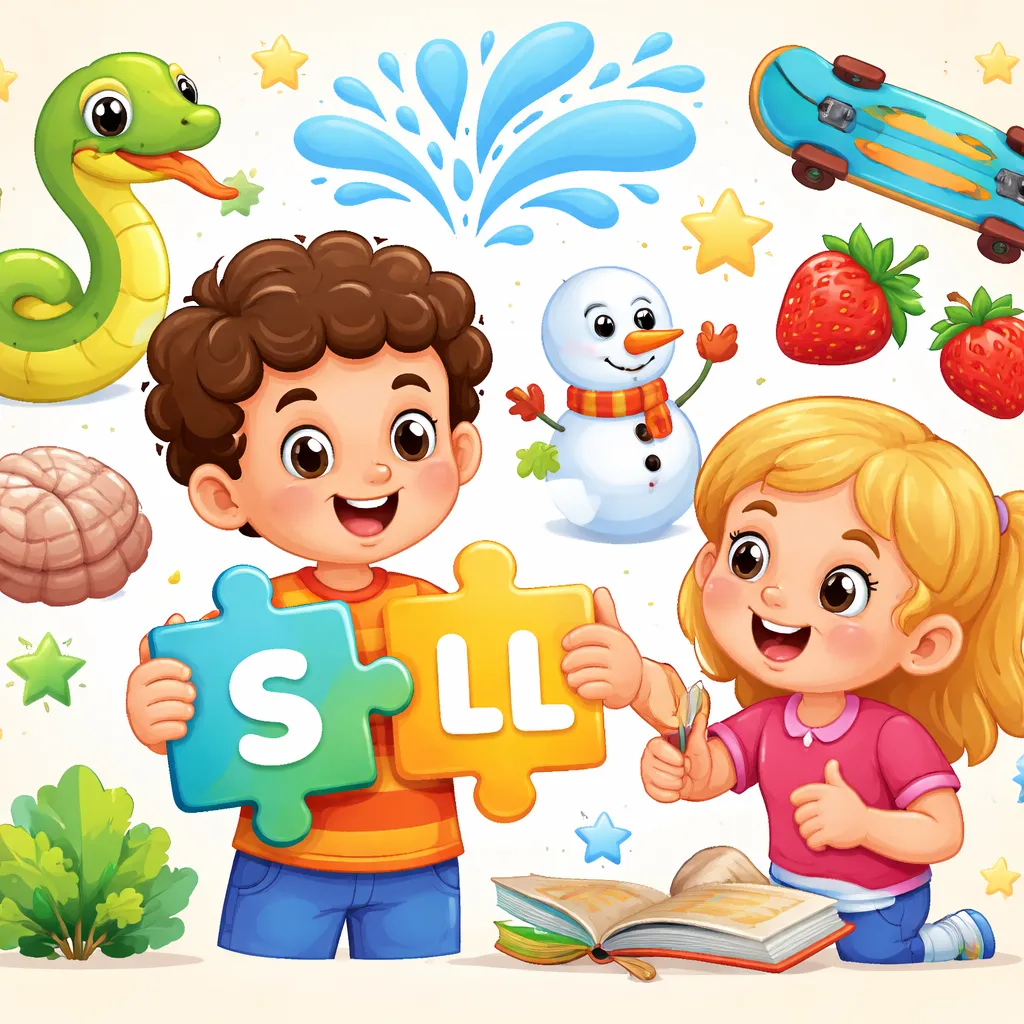

What Is This Situation? Sometimes two consonants come together at the beginning of a word. They blend their sounds. You hear both, but they flow together. S blends are common: sc, sk, sl, sm, sn, sp, st, sw. Each blend has its own sound.
A blends starting with S words list gives children practice with these important sound combinations. Words like scooter, skip, slide, smile, snake, spoon, stop, and swing help children learn to say and read these blends.
This situation happens during reading time, during speech practice, when learning new words. S blends appear in many common words. Learning them helps children read more fluently and speak more clearly.
These blends are best learned through playful practice. Games, songs, and word lists make the patterns stick. With S blends, your child learns that letters can work together.
Key English Phrases for This Situation Use phrases for introducing the blend. "S and c together make the 'sc' sound. Like in scooter." "S and l make 'sl.' Like in slide."
Use phrases for sounding out. "Let us say the sounds together. Sss-lll-ide. Slide." "The s and l blend together. Listen: sl."
Use phrases for comparing. "Scooter starts with sc. Can you hear the two sounds? Sss-cch." "Slide starts with sl. Sss-lll."
Use phrases for finding blends. "Can you find a word that starts with sn?" "Snake starts with sn. Good." "What about sp? Spoon starts with sp."
Use phrases for reading. "You read a word with an s blend. Good job." "Let us practice our s blends. Sc, sk, sl, sm, sn, sp, st, sw."
Simple Conversations for Kids Dialogue 1: Introducing Sc Parent: "Let us learn a new sound. S and c together make 'sc.' Can you say sc?" Child: "Sc." Parent: "Good. Sc like in scooter. Scooter. What word starts with sc?" Child: "Scarf." Parent: "Yes, scarf starts with sc. Good job."
This conversation introduces one blend. The parent models. The child repeats. The child thinks of another word. The learning is active.
Dialogue 2: Practicing Sl Parent: "What sound does slide start with?" Child: "S... l... slide." Parent: "Yes, sl. S and l blend together. Say sl." Child: "Sl." Parent: "Good. Can you think of another word that starts with sl?" Child: "Sleep." Parent: "Yes, sleep starts with sl. Sl-ee-p."
This conversation practices the blend. The child identifies the blend. The child gives another example. The parent confirms. The blend becomes familiar.
Dialogue 3: Reading S Blends Parent: "Let us read these words. Scarf, skip, slide, smile, snake, spoon, stop, swing." Child: "Scarf. Skip. Slide. Smile. Snake. Spoon. Stop. Swing." Parent: "You read all the s blend words. Good job. You said the blends clearly."
This conversation practices reading. The child reads a list. The parent praises. The child hears the blends. The practice builds fluency.
Vocabulary You Should Know Scooter is a two-wheeled ride. It starts with sc. You can say "I ride my scooter." This is a fun word.
Skip means to hop or not do something. It starts with sk. You can say "Let us skip down the sidewalk." This word has two meanings.
Slide is a playground ride or to move smoothly. It starts with sl. You can say "Go down the slide." Children love this word.
Smile is what you do when you are happy. It starts with sm. You can say "Give me a big smile." This word is positive.
Snake is a long animal with no legs. It starts with sn. You can say "The snake is long." This word is common in stories.
Spoon is what you eat soup with. It starts with sp. You can say "Use your spoon." This is a daily word.
Stop means to not go. It starts with st. You can say "The car will stop." This word is important for safety.
Swing is what you do on a playground. It starts with sw. You can say "Push me on the swing." This word is fun.
How to Use These Phrases Naturally Use a clear and patient tone. Blends can be tricky. Your child needs to hear the two sounds clearly. Say them slowly at first. "Sss-lll-ide." Then speed up.
Say the phrases during play. "Let us slide down the slide. Slide starts with sl." Playtime is a natural time for words.
Practice one blend at a time. Sc one day. Sl another. Master one before adding another. Too many blends at once is overwhelming.
Let your child hear the blends in your speech. When you say "stop," emphasize the st. "Sss-tttop." Your child learns by hearing.
Praise the effort. "You said the sn in snake. Good job." Specific praise reinforces the learning.
Common Mistakes to Avoid One mistake is adding a vowel between the sounds. "Suh-lide" instead of "slide." Model the pure blend. "Sss-lll-ide." No vowel in between.
Another mistake is rushing. Blends take time to master. Be patient. Let your child practice at their own pace. Speed comes with practice.
Some children confuse blends. They may say "sc" for "sk." Gently correct. "That word starts with sk. Listen: sk-ip. Skip." Model the correct sound.
Avoid using only worksheets. Worksheets have a place. But children need to hear blends, say blends, and see blends in real words. Use books, games, and conversation.
Tips for Parents and Practice Ideas Use a mirror. Watch your mouth when you say blends. Let your child watch. Then let them watch themselves. Seeing the mouth helps pronunciation.
Make a blend book. Each page is one blend. "Sc words: scooter, scarf, school." Your child draws pictures. The book is a reference.
Play blend bingo. Make cards with blend words. Call out a word. Your child finds it. Bingo makes practice fun.
Sing blend songs. "Sc, sc, scooter. Sc, sc, scarf. Sl, sl, slide. Sl, sl, sleep." Music makes the blends stick.
Go on a blend hunt. Walk around the house. Find things that start with s blends. "Spoon starts with sp. Slide starts with sl." The hunt builds awareness.
Fun Practice Activities Play blend matching. Write blend cards: sc, sk, sl, sm, sn, sp, st, sw. Write word cards: scooter, skip, slide, smile, snake, spoon, stop, swing. Your child matches the blend to the word.
Make blend dice. Write a blend on each side of a cube. Roll the die. Your child says a word that starts with that blend. The game builds quick thinking.
Create a blend train. Draw train cars. Each car is a blend. Your child puts picture cards in the cars. "Sc car gets scooter and scarf."
Use play dough. Roll play dough into letters. Make sc, sk, sl. Your child forms the blends. Hands-on learning engages the body.
Play I Spy with blends. "I spy something that starts with sl." Your child looks. "Slide!" The game builds blend awareness.
A blends starting with S words list gives your child the building blocks for reading and speaking many common words. Sc, sk, sl, sm, sn, sp, st, sw. Each blend is a key. With that key, your child can unlock words like scooter, skip, slide, smile, snake, spoon, stop, and swing. These words are everywhere. They are in books, in conversation, in the world. When your child masters S blends, they read more smoothly. They speak more clearly. They have more words to share. And that is the power of blends. Two sounds working together to make a world of words.