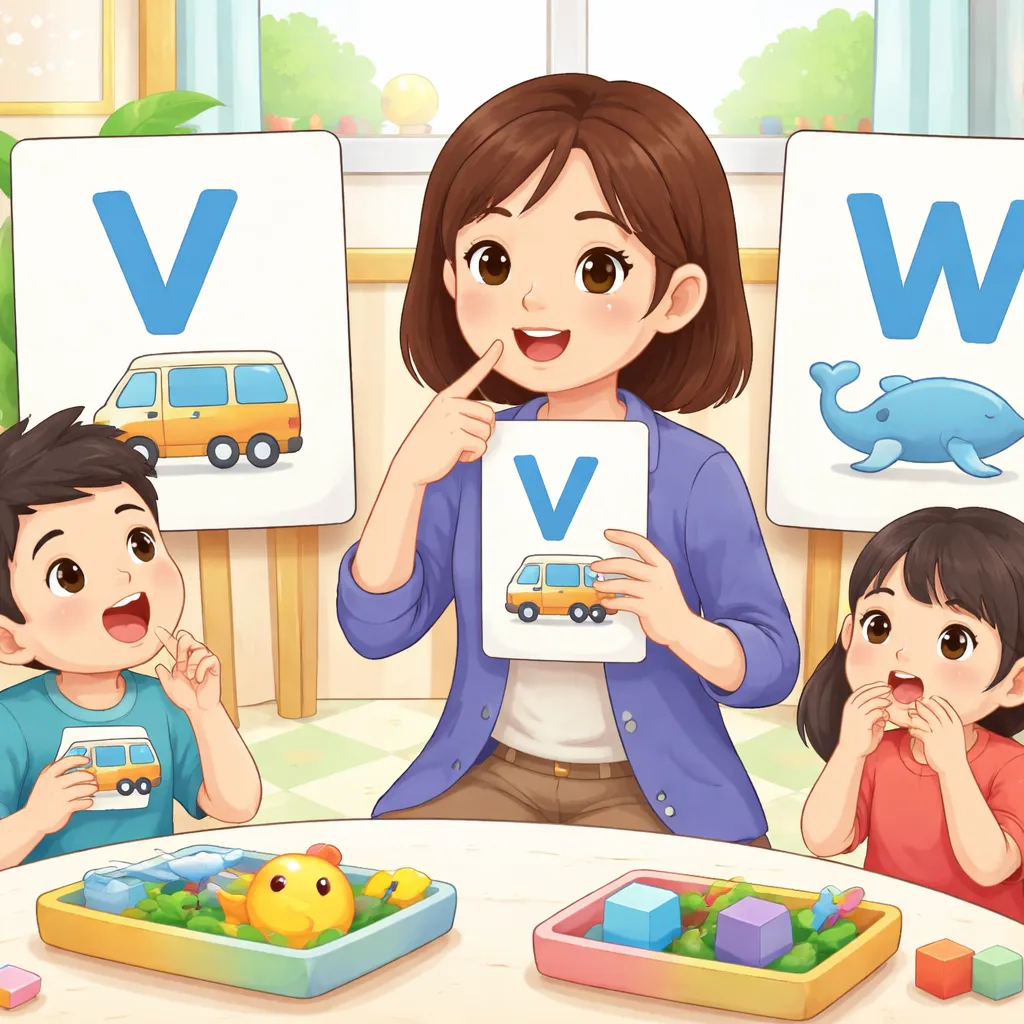

What Is This Situation? V and W can be hard to tell apart. They sound similar, but they are different. V uses your teeth and lip. W uses your lips only. For many Asian language speakers, this difference is new. Learning it takes practice.
How to pronounce V vs W for Asian kids gives children the tools to hear and say these two sounds clearly. V is like biting your lip. V-v-van. W is like a small circle with your lips. W-w-wagon. With practice, the difference becomes clear.
This situation happens during speech practice, during reading time, during everyday conversation. Words like very and well, van and wagon, vine and wine are used often. Saying them clearly helps children be understood.
These tips are gentle and playful. They use mirrors, hand movements, and silly sounds. With patience and practice, your child will learn to hear and say the difference between V and W.
Key English Phrases for This Situation Use phrases for showing the mouth position. "For V, put your top teeth on your bottom lip. Like you are going to bite your lip. Now blow air. V-v-van." "For W, make your lips into a small circle. No teeth. Just lips. W-w-wagon."
Use phrases for comparing. "Listen: V. Teeth on lip. W. Lips in a circle. Can you hear the difference?" "Van has V. Wagon has W. V-v-van. W-w-wagon."
Use phrases for practicing. "Let us practice together. Put your teeth on your lip. V-v-van." "Now make a circle with your lips. W-w-wagon."
Use phrases for feeling the difference. "Put your hand on your throat. For V, you feel a buzz. For W, no buzz." "V uses your voice. W uses only air."
Use phrases for celebrating. "You made the V sound! Good job." "You made the W sound! That was tricky, and you did it."
Simple Conversations for Kids Dialogue 1: Learning the Positions Parent: "Let us learn the V sound. Put your top teeth on your bottom lip. Like this." Parent models. Child tries. Parent: "Good. Now blow air. V-v-van. Can you say van?" Child: "Van." Parent: "Yes! Now the W sound. Make your lips into a small circle. Like you are going to blow out a candle." Child makes circle with lips. Parent: "Now say W-w-wagon." Child: "Wagon." Parent: "Good. V and W. Two different sounds."
This conversation teaches the mouth positions. The parent models. The child practices. The two sounds become clear.
Dialogue 2: Feeling the Difference Parent: "Put your hand on your throat. Say V. V-v-van. Do you feel the buzz?" Child: "Yes." Parent: "Now say W. W-w-wagon. Do you feel the buzz?" Child: "No." Parent: "Good. V uses your voice. W uses only air. That is how you know the difference."
This conversation uses touch to teach. The child feels the vibration. The difference becomes physical.
Dialogue 3: Practicing with Words Parent: "Let us practice some V and W words. Very. V-v-very." Child: "Very." Parent: "Well. W-w-well." Child: "Well." Parent: "Van. Wagon. Can you say them both?" Child: "Van. Wagon." Parent: "Good. You are getting it."
This conversation practices the sounds in real words. The child repeats. The parent praises. The skill builds.
Vocabulary You Should Know Van is a vehicle. It has V. You can say "The van is blue." Practice the V sound.
Very means a lot. It has V. You can say "I am very happy." This word is common.
Vine is a plant that climbs. It has V. You can say "The vine grows up the wall."
Wagon is something you pull. It has W. You can say "The wagon has toys." Practice the W sound.
Well means good or a hole in the ground. It has W. You can say "I am well." This word is common.
Wine is a drink from grapes. It has W. You can say "Grape juice becomes wine."
How to Use These Phrases Naturally Use a patient and playful tone. V and W are hard. Your child may need many tries. Your patience says "You can do this."
Say the phrases with a mirror. Stand in front of a mirror. Show your child your mouth. Let them watch themselves. Seeing helps.
Use hand signals. For V, touch your teeth to your lip. For W, make a circle with your fingers. The gestures help the memory.
Practice in short sessions. Two minutes is enough. Let your child's interest guide the length. Short, frequent practice works best.
Celebrate every try. "You tried the V sound. That was brave." Celebrating the effort encourages more tries.
Common Mistakes to Avoid One mistake is making V sound like W. "Very" sounds like "wery." Show the teeth on lip. Practice the buzz.
Another mistake is making W sound like V. "Well" sounds like "vell." Show the circle lips. No teeth. Practice the air.
Some children get frustrated. If your child is frustrated, stop. Try again later. Learning should feel good.
Avoid pressure. Do not make it a test. Gentle practice works better than pressure.
Tips for Parents and Practice Ideas Use a mirror. Watch your mouth. Let your child watch. Then let them watch themselves. Seeing the mouth helps.
Make it a game. "Let us make the V sound. V-v-van. Now the W sound. W-w-wagon." Games make practice fun.
Use a feather. Put a feather in front of your mouth. Say V. The feather moves a little. Say W. The feather moves more. The feather shows the difference.
Read books with V and W words. Point them out. "This word starts with V. Van." "This word starts with W. Wagon."
Practice during everyday moments. "Let us go in the van. Van starts with V." Real words are the best practice.
Fun Practice Activities Play the V and W game. You say a word. Your child tells you if it starts with V or W. "Van." "V." "Wagon." "W." The game builds listening.
Make V and W cards. Write V on one card, W on another. Show a picture. Your child holds up the correct card. The game builds recognition.
Use a V and W puppet. Make a puppet that loves V words. Another puppet loves W words. Your child helps the puppets talk.
Create a V and W book. Draw pictures of V words and W words. "Van, vine, very. Wagon, well, wine." Your child draws and says the words.
Sing the V and W song. "V says v, teeth on lip. W says w, lips in a circle. V and W are not the same. Now you know the game." Music makes the sounds stick.
How to pronounce V vs W for Asian kids is about learning two new mouth positions. V uses teeth on lip and a buzz. W uses lips in a circle and air. With a mirror, with hand signals, with playful practice, your child will learn to hear the difference and say the difference. They will say "very" instead of "wery." They will say "well" instead of "vell." They will be understood. And they will feel proud. That clarity is a gift. It helps them speak clearly. It helps them connect. And with your patient guidance, they will master these two tricky sounds, one gentle try at a time.