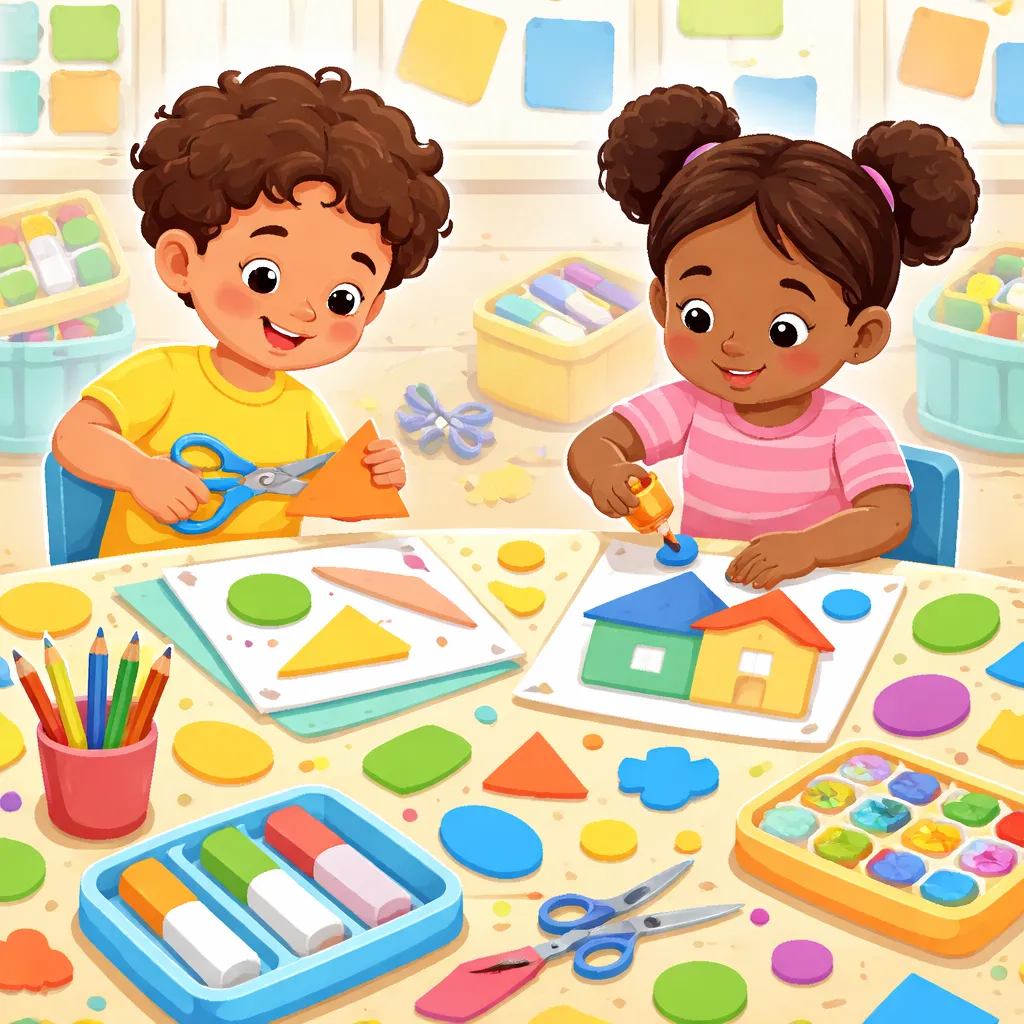

What Is This Situation? Cutting and pasting are important skills for young children. They build hand strength. They build coordination. And they are fun. Adding shapes makes it learning. Children cut out shapes. They paste them in the right place. They learn shape names while they work.
Cut and paste activities for shapes give children a hands-on way to learn. Circle, square, triangle, rectangle. They cut them out. They match them to the outline. They paste them down. The learning is active. The learning is fun.
This situation happens during craft time, during quiet time, during moments when children need a calm activity. Cut and paste is portable. You can do it at the kitchen table, on a rainy afternoon, anywhere.
These activities are best used with conversation. Talk about the shapes. Talk about the colors. The learning happens while working.
Key English Phrases for This Situation Use phrases for introducing the activity. "Let us do a cut and paste activity. We are learning shapes. Cut out the shapes. Then paste them in the right place."
Use phrases for cutting. "Be careful with the scissors. Cut along the lines." "You cut out the circle. Good job."
Use phrases for shape names. "This is a circle. Can you say circle?" "This is a square. Square has four sides."
Use phrases for pasting. "Now paste the circle in the circle space." "Put glue here. Then stick the circle down."
Use phrases for celebrating. "You pasted the circle. Good job." "Your shape picture is beautiful."
Simple Conversations for Kids Dialogue 1: Cutting Shapes Parent: "Let us cut out the shapes. First, cut out the circle. Be careful. Cut along the line." Child cuts circle. Parent: "Good. You cut out the circle. Now cut out the square." Child cuts square. Parent: "Good job. You cut two shapes."
This conversation introduces cutting. The parent guides. The child cuts. The learning begins.
Dialogue 2: Naming Shapes Parent: "What shape is this?" Child: "Circle." Parent: "Yes. Circle. What shape is this?" Child: "Square." Parent: "Yes. Square has four sides. Now paste them in the right place."
This conversation practices shape names. The child names the shapes. The parent adds facts. The learning continues.
Dialogue 3: Pasting Shapes Parent: "Now paste the circle in the circle space. Put glue here. Then stick it down." Child pastes circle. Parent: "Good. Now paste the square in the square space." Child pastes square. Parent: "You did it. Your shape picture is done."
This conversation guides pasting. The child follows. The parent praises. The activity is complete.
Vocabulary You Should Know Circle is a round shape. You can say "The sun is a circle." It has no corners.
Square is a shape with four equal sides. You can say "A window is a square." It has four corners.
Triangle is a shape with three sides. You can say "A slice of pizza is a triangle." It has three corners.
Rectangle is a shape with four sides, two long and two short. You can say "A door is a rectangle." It has four corners.
Cut means to use scissors to separate. You can say "Cut along the line." This is the action.
Paste means to use glue to stick. You can say "Paste the shape here." This is the action.
How to Use These Phrases Naturally Use a calm and encouraging tone. Cutting and pasting take focus. Your patience says "You can do this."
Say the phrases as your child works. "Cut the circle. Good. Now paste it." The words guide the activity.
Let your child work at their own pace. Some children cut carefully. Some go fast. Both are fine.
Talk about the shapes. "Circle. Square. Triangle." Repetition builds recognition.
Celebrate each step. "You cut the circle. Good." "You pasted the square. Good." Small celebrations build confidence.
Common Mistakes to Avoid One mistake is expecting perfect cutting. Young children are learning. Wobbly cuts are fine. The learning is in the trying.
Another mistake is doing it for them. Let them cut. Let them paste. The work is their learning.
Some children get frustrated. If your child is frustrated, help. Hold the scissors together. Guide their hand. Then let them try again.
Avoid making it a test. Cut and paste is for fun. If your child is tired, stop. Try another day.
Tips for Parents and Practice Ideas Use safety scissors. They cut paper but not fingers. Safety first.
Start with simple shapes. Circle, square, triangle. Add more as your child learns.
Use a glue stick. Liquid glue is messy. Glue sticks are easier.
Talk about the shapes in the room. "Look at the clock. It is a circle." Connecting to real life builds understanding.
Save the finished pictures. Your child feels proud. You see their progress.
Fun Practice Activities Play shape hunt. Cut out shapes. Hide them around the room. Your child finds them and pastes them on a paper. The hunt makes learning active.
Make a shape collage. Cut out many shapes. Your child pastes them to make a picture. A circle for the sun. A triangle for a tree. The collage builds creativity.
Create a shape book. Staple paper together. Paste one shape on each page. "Circle. Square. Triangle." The book is a reference.
Sing the shape song. "Circle, circle, round like a ball. Square, square, four sides tall. Triangle, triangle, three sides you see. Shapes are all around me." Music makes learning fun.
Use play dough. Roll play dough into shape snakes. Form circles, squares, triangles. Hands-on learning is powerful.
Cut and paste activities for shapes build fine motor skills and shape recognition. Circle, square, triangle, rectangle. Cut them out. Paste them down. With playful practice and patient guidance, your child will learn shapes. They will cut with scissors. They will paste with glue. They will build strong hands and a strong mind. That is the power of hands-on learning. One shape at a time, your child will learn. And you will be there to cut and paste along.