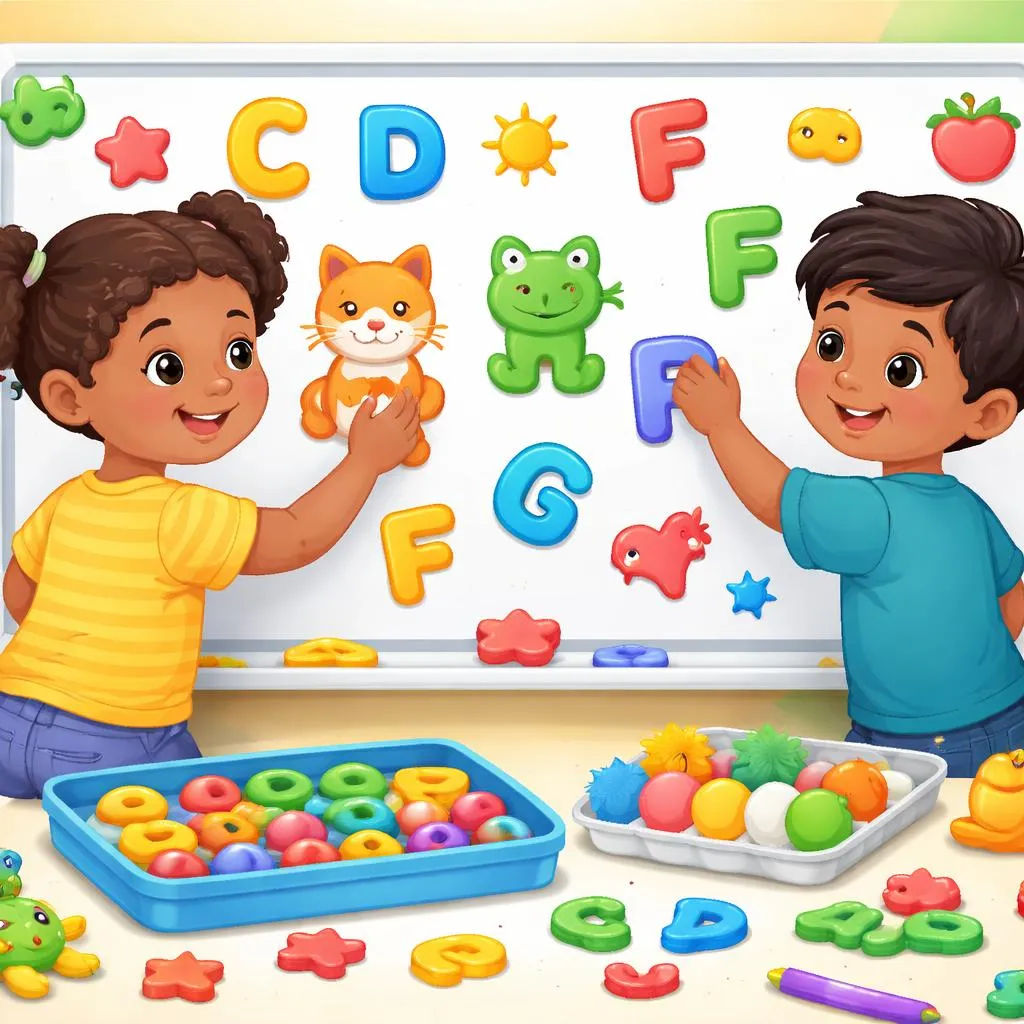

What Is This Situation? Magnetic letters are a simple, powerful tool. They stick to the fridge. They are easy to move. Children can hold them, sort them, and spell with them. They make learning active. They make phonics playful.
Magnetic letters activities for phonics give children a hands-on way to learn letters and sounds. They can find the letter B. They can match B to a picture of a ball. They can spell cat. The letters move. The learning sticks.
This situation happens at the fridge, on a cookie sheet, on any metal surface. Magnetic letters are always available. Children can play with them anytime. Learning happens naturally.
These activities are simple and playful. They build letter recognition. They build sound awareness. They build spelling skills. With magnetic letters, your child learns by doing.
Key English Phrases for This Situation Use phrases for introducing activities. "Let us play with the magnetic letters. Can you find the letter B?" "Let us spell a word. C-a-t. Cat."
Use phrases for sorting. "Let us sort the letters. Put all the red letters here. Put all the blue letters here." "Let us sort by letter. All the As together."
Use phrases for matching. "Let us match the letter to the picture. This is B. B is for ball." "Find the letter that makes the first sound in sun."
Use phrases for spelling. "Let us spell cat. Find C. Find A. Find T. Now put them together. C-a-t. Cat."
Use phrases for celebrating. "You found the letter B. Good job." "You spelled cat. You are a reader."
Simple Conversations for Kids Dialogue 1: Finding Letters Parent: "Let us play with the magnetic letters. Can you find the letter B?" Child finds B. Parent: "Good. Now find something that starts with B." Child points to a banana. Parent: "Banana starts with B. B-b-banana."
This conversation uses magnetic letters for letter recognition. The child finds the letter and a matching object. The learning is active.
Dialogue 2: Spelling Words Parent: "Let us spell a word with the magnetic letters. C-a-t. Find C." Child finds C. Parent: "Find A." Child finds A. Parent: "Find T." Child finds T. Parent: "Now put them together. C-a-t. What word is that?" Child: "Cat." Parent: "Yes. You spelled cat."
This conversation uses magnetic letters for spelling. The child finds each letter. The child reads the word. The learning is hands-on.
Dialogue 3: Sorting Letters Parent: "Let us sort the letters. Put all the round letters here. O, Q, C." Child sorts. Parent: "Now put all the tall letters here. T, L, F." Child sorts. Parent: "Good. You sorted by shape."
This conversation uses magnetic letters for sorting. The child sorts by shape. The learning is playful.
Vocabulary You Should Know Magnetic letters are letters that stick to metal. You can say "Let us play with magnetic letters." This is the main tool.
Fridge is where many people keep magnetic letters. You can say "Let us play on the fridge." This is the common surface.
Sort means to put things in groups. You can say "Let us sort the letters." This is an activity.
Match means to put together things that go together. You can say "Match the letter to the picture." This is an activity.
Spell means to put letters in order to make a word. You can say "Let us spell cat." This is the goal.
Word is a group of letters that make meaning. You can say "You made a word." This is the achievement.
How to Use These Phrases Naturally Use a playful and curious tone. Magnetic letters are toys. Your voice says "Let us see what we can make."
Let your child lead. If they want to play with the letters, let them. Their curiosity is the engine.
Keep the letters accessible. Leave them on the fridge. Your child will play with them every day.
Change activities often. Today sort by color. Tomorrow spell words. The variety keeps it interesting.
Celebrate every try. "You found the letter. Good job." Celebration makes learning feel good.
Common Mistakes to Avoid One mistake is keeping the letters out of reach. Put them where your child can reach. Play is learning.
Another mistake is correcting too much. Let your child explore. If they put the wrong letter, gently guide. "That is B. Ball starts with B. Can you find B?"
Some children want to play the same game again and again. That is good. Repetition builds mastery.
Avoid making it a lesson. Magnetic letters are for play. If your child is not in the mood, play another day.
Tips for Parents and Practice Ideas Keep magnetic letters on the fridge. Your child will play with them every day.
Use a cookie sheet. It is portable. Take the letters to the table. Play anywhere.
Sort by color. All the red letters together. All the blue letters together. Sorting builds visual discrimination.
Sort by shape. Round letters. Tall letters. Letters with tails. Sorting builds letter awareness.
Spell names. Use the letters to spell your child's name. Names are meaningful.
Fun Practice Activities Play letter hunt. Say a letter. Your child finds it on the fridge. "Find B." The hunt builds recognition.
Match letters to objects. Put a letter on the fridge. Your child puts an object that starts with that letter next to it. "B with banana." The match builds sound awareness.
Spell word families. Put "at" on the fridge. Your child adds letters to make new words. C-at, b-at, h-at. The family builds reading skills.
Make a letter train. Put letters in order. A, B, C. The train builds alphabet knowledge.
Create a word of the day. Spell a word. Your child reads it. Add a new word each day. The words build vocabulary.
Magnetic letters activities for phonics make learning hands-on and playful. The fridge becomes a classroom. Letters become toys. Sorting, matching, spelling—all with letters that move. With playful practice and patient guidance, your child will learn letters and sounds. They will find the letter B. They will spell cat. They will become a reader. That is the power of hands-on learning. One letter at a time, your child will learn. And you will be there to play along.