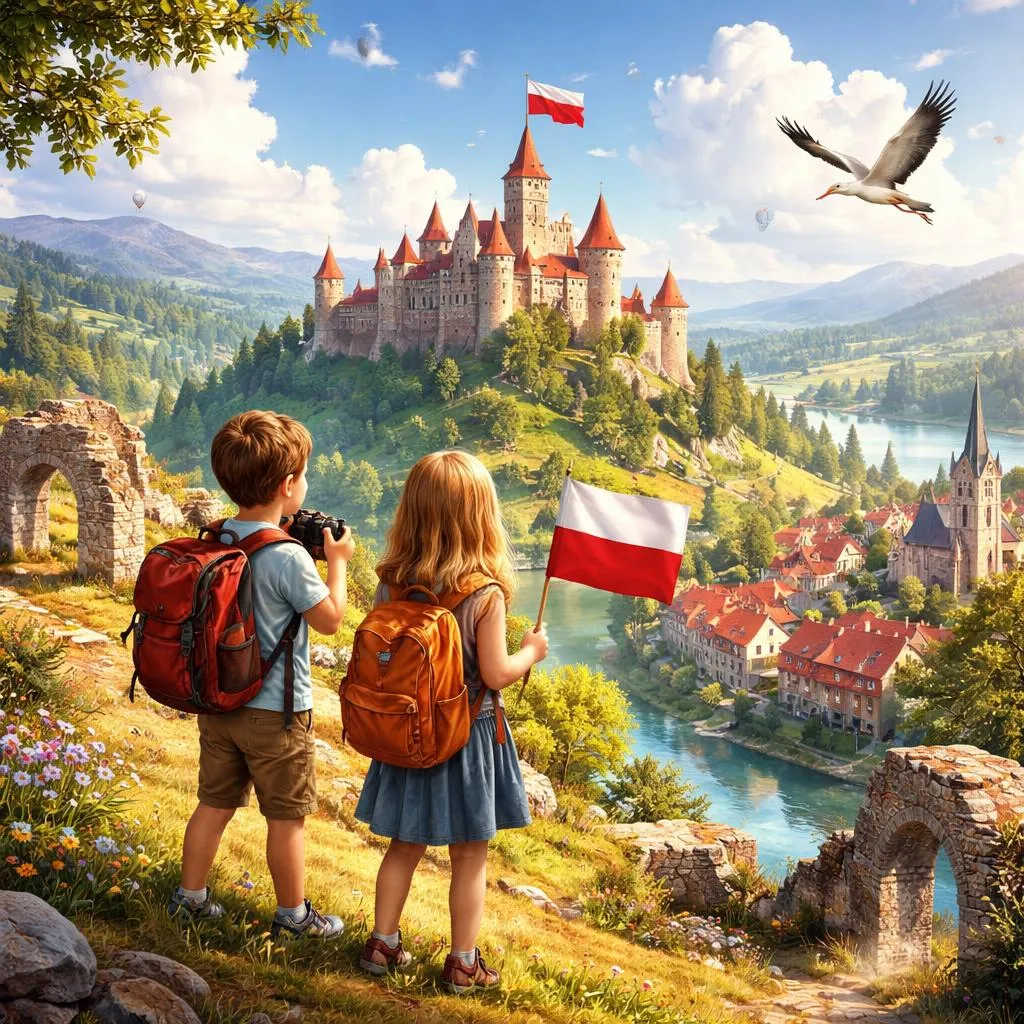

Introduction to Poland
Language learning transports us to a land of medieval castles and resilient spirit. Today we explore a country in the heart of Europe with a rich and complex history. This nation gave the world a famous astronomer who changed how we see the universe. Children will discover pierogi, delicious dumplings filled with savory or sweet ingredients. They will learn about the amber that washes up on Baltic beaches. Exploring Poland builds reading skills while revealing a country of courage, creativity, and tradition. Every fact uncovers a new layer. Every word invites young readers to imagine this European nation.
Where Is Poland?
Poland lies in Central Europe on the North European Plain. It shares borders with Germany to the west, the Czech Republic and Slovakia to the south, Ukraine and Belarus to the east, and Lithuania and Russia to the northeast. The Baltic Sea forms its northern border. The capital city is Warsaw. Warsaw sits on the Vistula River in the east-central part of the country. The country covers over one hundred twenty thousand square miles. It ranks as the ninth largest country in Europe. The landscape consists mostly of lowlands and rolling hills. The Carpathian Mountains rise along the southern border. The Baltic coast features sandy beaches and dunes. Finding Poland on a map shows a country at the crossroads of Central and Eastern Europe.
Interesting Facts About Poland
Poland offers many remarkable facts for young learners. It was home to Nicolaus Copernicus, the astronomer who proposed that the Earth orbits the Sun. His discovery revolutionized science. Another interesting fact involves amber. Poland has one of the largest amber deposits in the world. The Baltic coast yields amber that has washed up for thousands of years. People call it "Baltic gold."
Poland also has a unique medieval city. Toruń, Copernicus's birthplace, remains a well-preserved Gothic town. Its gingerbread tradition dates back centuries. Another fun fact involves the Wieliczka Salt Mine. This underground world includes chapels, chandeliers, and sculptures carved entirely from salt. Visitors descend hundreds of steps into this subterranean wonder.
The country also has a unique culinary tradition. Pierogi rank as Poland's national dish. Families gather to make these dumplings filled with potatoes, cheese, meat, or fruit. Another interesting fact involves the Białowieża Forest. This ancient woodland straddles the border with Belarus. It holds the last remaining population of European bison. The bison once roamed across Europe. Poland also has a tradition of folk art. Wycinanki, or paper cutouts, feature intricate patterns and bright colors. These facts show children a country of scientific achievement, natural wonders, and cultural richness.
Key Vocabulary About Poland
Let us build vocabulary for this Central European nation. These words help children describe what they learn.
Copernicus: a Polish astronomer who proposed the heliocentric model.
Amber: fossilized tree resin used for jewelry.
Pierogi: dumplings filled with various ingredients.
Bison: a large, shaggy mammal also known as buffalo.
Gothic: a style of architecture with pointed arches and tall windows.
Salt Mine: an underground mine where salt is extracted.
Wycinanki: traditional Polish paper cutouts. Introduce these words with pictures and stories. Show a piece of amber with a trapped insect. Show pierogi on a plate. Let children say each word aloud. These vocabulary words give children the language to explore Poland's history and traditions.
Simple Sentences for Reading Practice
Short sentences help new readers build confidence. Use these sentences about Poland for practice.
Poland is a country in Central Europe.
The capital city is Warsaw.
The Baltic Sea borders Poland to the north.
Copernicus discovered that Earth orbits the Sun.
Amber washes up on the Baltic coast.
Pierogi are delicious filled dumplings.
The Wieliczka Salt Mine has underground chapels. Read each sentence together. Let children point to the words. Encourage them to repeat after you. Use pictures to show each fact. These simple sentences prepare young readers for longer passages.
Short Reading Passage About Poland
Here is a short passage for children to read together.
“Poland stretches across the North European Plain from the Baltic Sea to the Carpathian Mountains. The capital, Warsaw, rebuilt after war, mixes modern buildings with restored Old Town streets. In the north, the Baltic Sea washes against sandy beaches. People walk along the shore searching for amber. These golden stones come from ancient trees. In the south, the Wieliczka Salt Mine descends deep underground. Miners carved chapels and chandeliers from salt. Visitors walk through chambers with salt sculptures. In the east, the Białowieża Forest shelters European bison. These massive animals roam among ancient oaks. Polish kitchens fill with the smell of pierogi. Families roll dough and fill each dumpling with cheese, potatoes, or berries. They serve them with sour cream. Poland honors Copernicus, the astronomer who looked at the stars and saw the Sun at the center. Poland holds science, nature, and tradition in its land.”
Read this passage slowly together. Pause to talk about each idea. Ask children to find vocabulary words in the text. This activity builds reading fluency and deepens understanding.
Fun Questions About Poland
Questions make reading interactive and engaging. Use these to start conversations with young learners.
What is the capital city of Poland?
What sea borders Poland to the north?
Who discovered that Earth orbits the Sun?
What golden stone washes up on the coast?
What is the national dish of Poland?
What animals live in the Białowieża Forest? Let children answer in complete sentences. Encourage them to use new vocabulary. Ask them to imagine walking through the salt mine. What would they see carved from salt? Creative questions make the topic personal and exciting.
Tips for Learning English with This Topic
Use Poland to create rich English learning experiences. Start with a map activity. Let children find Poland in Central Europe. Point out its borders and the Baltic Sea. Discuss how Poland's location made it a crossroads of history.
Next, introduce the vocabulary through a hands-on activity. Make simple pierogi using circles of dough and fillings. Let children fold and crimp the edges. Cook and taste them together. For amber, use clear resin or yellow candies to represent the golden stone. Use the words "pierogi," "amber," and "Copernicus" during the activity.
Read the passage aloud with appreciation for Poland's resilience and creativity. Let your voice reflect the wonder of the salt mine and the forest. After reading, let children draw a scene from Poland. One child might draw amber on a Baltic beach. Another might draw pierogi on a plate. Let them label their drawings with vocabulary words. Add blue for the sea and gold for the amber.
Incorporate a science and history connection. Talk about Copernicus and how his discovery changed understanding of the universe. Discuss how the salt mine shows human ingenuity. This shows children that language learning reading connects to science and history.
Use music and movement to enhance the experience. Listen to Polish folk music with fiddles and accordions. Let children move like bison in the forest. Pretend to mine salt underground. Physical activity reinforces learning in joyful ways.
Encourage children to share their knowledge. Let them tell a family member about Copernicus. They can explain what pierogi are and how they are made. Teaching others builds confidence and deepens understanding.
Connect Poland to your child's world. Ask, “What astronomers or scientists do we know?” Compare them to Copernicus. Ask about foods your family makes together. Compare to making pierogi. These connections help children see that language learning reading is about understanding different contributions and traditions. By exploring Poland together, you give children a rich experience. They learn new words, discover a land of science and dumplings, and grow their love for reading. This European nation becomes a meaningful part of their learning journey.