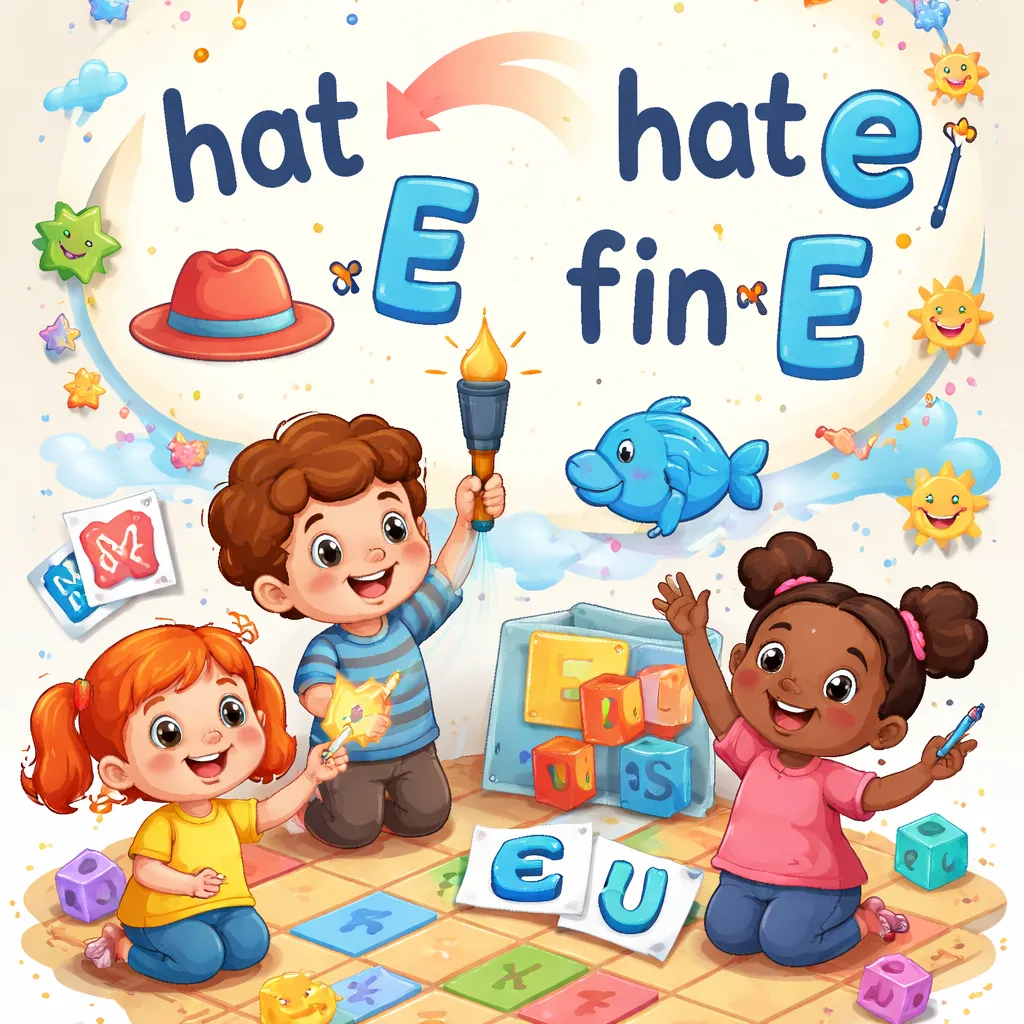

What Is This Situation? Sometimes a letter does not make a sound. That is strange for a child learning to read. Every other letter makes a sound. But the silent E sits at the end of a word and does not say anything. Instead, it tells the vowel before it to say its name.
Teaching the silent E rule to kids means showing them this magic. Without the E, "cap" has a short a. Add the E, and it becomes "cape" with a long a. The E is silent, but it changes everything. It is like a magic letter.
This situation happens when children have learned short vowel words and are ready for longer words. They see "hop" and "hope." They see "kit" and "kite." They need to understand why the vowel sound changes.
These rules are best taught through play, not worksheets. Short games and word pairs show the magic. With the silent E rule, your child learns that English has patterns. Once they know the pattern, they can read many new words.
Key English Phrases for This Situation Use phrases for introducing the magic. "This is the magic E. It is silent, but it makes the vowel say its name." introduces the rule. "Watch what happens when we add E to cap. C-a-p. Add E. Now it is cape. The a says its name."
Use phrases for comparing. "Cap has a short a. Cape has a long a. The E made the vowel long." compares the two words. "Hop has a short o. Hope has a long o. Magic E again."
Use phrases for practicing. "What happens when we add E to kit?" asks the child to apply the rule. "Kit becomes kite. The i says its name." "Can you read this word? Make. The magic E makes the a long."
Use phrases for explaining. "The E is at the end. It does not make a sound. But it tells the vowel to say its name." "That is the silent E rule."
Use phrases for celebrating. "You used the magic E! You read hope." "Good job. You know the silent E rule."
Simple Conversations for Kids Dialogue 1: Introducing the Magic E Parent: "Look at this word. C-a-p. What is it?" Child: "Cap." Parent: "Now watch. I am adding a magic E at the end. C-a-p-e. What is it now?" Child: "Cape." Parent: "Yes! The E is silent, but it made the a say its name. A says 'ay' in cape. Magic!"
This conversation shows the magic. The child reads the short vowel word. The parent adds the E. The child reads the long vowel word. The parent explains the rule.
Dialogue 2: Practicing Word Pairs Parent: "Let us try another. Hop. What is hop?" Child: "Hop." Parent: "Add magic E. H-o-p-e. What is it?" Child: "Hope." Parent: "Yes! The o says its name. Hop, hope. Can you read these? Kit. Kite." Child: "Kit. Kite." Parent: "Good. You did it."
This conversation practices the pattern. The parent gives a pair. The child reads both. The parent praises. The pattern becomes familiar.
Dialogue 3: Reading Sentences Parent: "Let us read a sentence with magic E words. 'The kite is in the sky.' Can you find the magic E word?" Child: "Kite." Parent: "Yes. Kite has magic E. The i says its name. Now read the sentence." Child: "The kite is in the sky." Parent: "Good reading. You used the magic E rule."
This conversation uses the rule in real reading. The child finds the magic E word. The child reads the sentence. The rule is applied in context.
Vocabulary You Should Know Silent E is the E at the end of a word that does not make a sound. You can say "The silent E makes the vowel long." This is the rule.
Long vowel means the vowel says its name. You can say "A says 'ay' in cape." This is what the silent E does.
Short vowel means the vowel makes a quick sound. You can say "A says 'ah' in cap." This is what the vowel does without the E.
Magic E is another name for silent E. You can say "Magic E changes the word." This name makes the rule fun.
CVC words are consonant-vowel-consonant words like cap and hop. You can say "CVC words have short vowels." These are the words that become long with silent E.
CVCe words are consonant-vowel-consonant-silent E words like cape and hope. You can say "CVCe words have long vowels." This is the pattern.
How to Use These Phrases Naturally Use an excited and magical tone. The silent E is like a magic trick. Your excitement makes it exciting. "Watch the magic!" said with wonder makes the rule memorable.
Say the phrases with word pairs. Always show the short vowel word first. Then add the E. The contrast shows the rule. Cap, cape. Hop, hope. Kit, kite.
Let your child add the E. Use magnetic letters. "Make cap. Now add the magic E. What is it now?" Letting them add the letter makes them active.
Practice with real words your child knows. They know cap and cape. They know hop and hope. Familiar words make the rule make sense.
Read books with silent E words. Point them out. "There is a magic E word. Can you find it?" Finding the rule in real reading builds skill.
Common Mistakes to Avoid One mistake is teaching the rule before the child knows short vowels. The silent E rule builds on short vowels. Make sure your child knows cap before you teach cape.
Another mistake is using too many rules at once. Teach one pattern at a time. A-E words first. Then I-E. Then O-E. Then U-E. Master one before moving on.
Some children try to sound out the silent E. They say "cap-e." Remind them "The E is silent. It does not make a sound. It tells the a to say its name."
Avoid worksheets too early. Use magnetic letters. Use word cards. Let the child see the transformation. Hands-on learning works better.
Tips for Parents and Practice Ideas Use magnetic letters. Make cap. Add E. Watch cape. The physical transformation makes the rule clear.
Make a magic E wand. Decorate a stick. Your child waves the wand over the word to add the E. The wand makes the magic real.
Create word family cards. Write cap and cape on one card. Hop and hope on another. Flip through them. The pairs show the pattern.
Read books with silent E words. Many early readers have them. Point them out. "There is a magic E word." The rule appears in real reading.
Play the silent E game. You say a short vowel word. Your child adds the E and says the long vowel word. "Cap." "Cape." The game builds speed.
Fun Practice Activities Make a magic E crown. Your child wears the crown. They are the magic E. They stand at the end of words. "What does cap become with the magic E?" They say "Cape." The crown makes them the rule.
Create word cards with a sliding E. Write cap on a card. Write E on a separate strip. Slide the E next to the word. Cap becomes cape. The slide shows the transformation.
Play silent E bingo. Make bingo cards with silent E words. Call out the short vowel word. "Cap." Your child finds cape. The game connects the pairs.
Use play dough. Roll letters. Make cap. Add a play dough E. Read cape. Hands-on learning engages the senses.
Sing a silent E song. "Silent E, silent E, you make the vowel say its name. Add an E to cap, it is cape. Add an E to hop, it is hope." Music makes the rule stick.
How to teach silent E rule to kids is about showing the magic. The rule is simple. When E is at the end, it is silent. It makes the vowel say its name. That is all. But for a child, it is magic. Cap becomes cape. Hop becomes hope. Kit becomes kite. Words transform. With playful practice and patient guidance, your child will learn this magic. They will see a silent E and know what it does. They will read new words with confidence. And they will love the magic of reading.