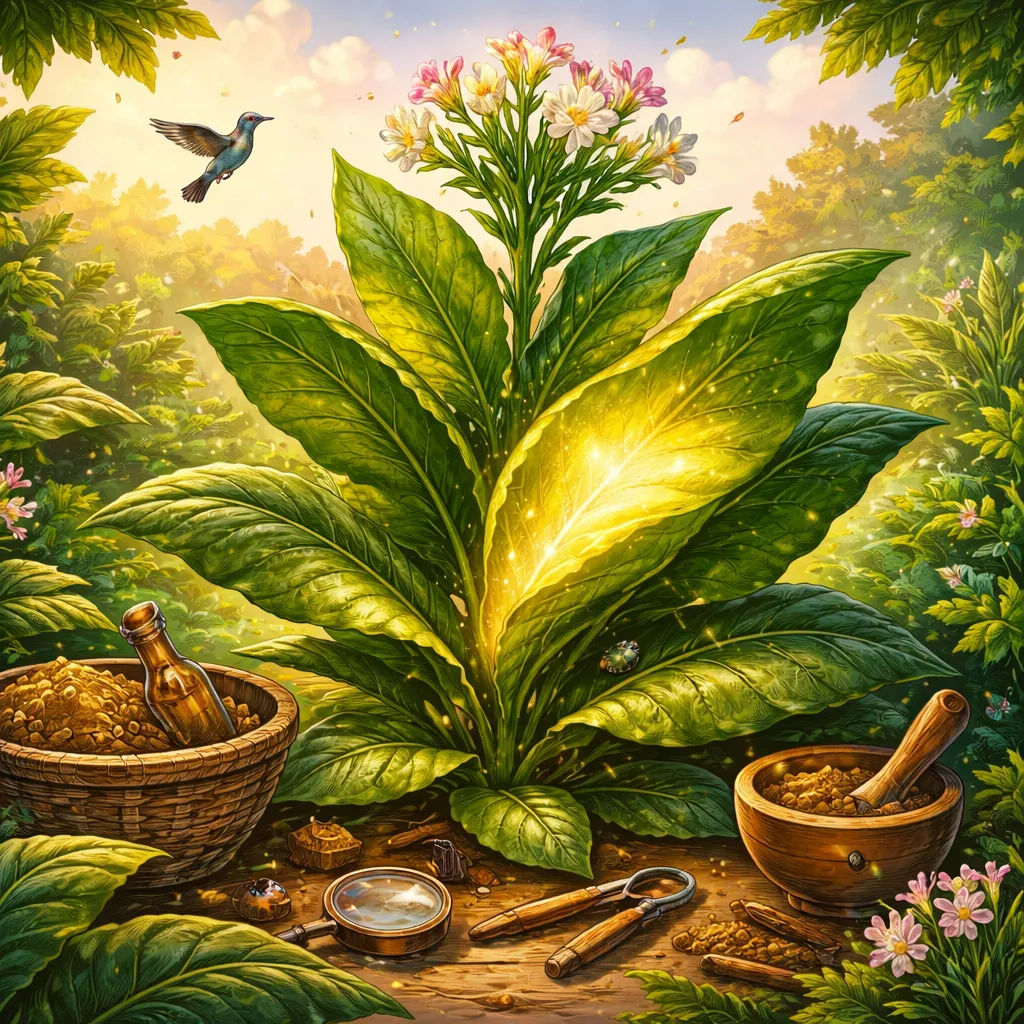

Long ago, many Native American cultures used the leaves of a certain plant in special ceremonies. They would dry the large, soft leaves and use them in a respectful way. When European explorers came to the Americas, they took this plant back to Europe. It became a very important crop around the world. But today, we know a secret about this plant. Its leaves contain a powerful chemical called nicotine. This is a story about a historically important plant that we now know is not safe for our bodies. Let’s learn the facts about the Tobacco plant.
Let’s Learn the Word! – Open the Treasure Box of Language
Formal Name and Pronunciation This plant is called Tobacco. Its scientific name is Nicotiana tabacum. You can say it like this: /təˈbæk.əʊ/ (tuh-BACK-oh). The “to” sounds like “tuh,” and “bacco” rhymes with “wacko.” To-bac-co. Say it: Tobacco. It’s a name that carries a lot of history.
The Etymology Tale The word “Tobacco” has a journey from the Americas. It likely comes from the Taíno word “tabako,” which referred to the rolled leaves they used. The scientific name Nicotiana comes from Jean Nicot, a Frenchman who sent tobacco seeds to France in the 1500s. Its name is a mix of native culture and European history.
Nicknames and Friendly Aliases Tobacco has had many names over time. It is sometimes called Nicotiana after its scientific name. People have called it The Herb or The Leaf. The dried, prepared leaves are often just called Smoking Tobacco or Chewing Tobacco. It is not a plant with friendly nicknames for children, because it is not safe.
Building Your Word Web: Core Parts Let’s learn the words for a Tobacco plant’s body. The Leaf is the main part—large, broad, and covered in tiny, sticky hairs. The Stem is tall, thick, and can grow over six feet high. The Flower is tubular and can be pink, white, or red. The Seed is incredibly tiny, like dust. The Root system is fibrous. The chemical inside is Nicotine. A Field of tobacco is a tobacco field.
Action and State Words Tobacco plants are big growers. They grow tall in warm weather. The leaves are harvested and cured (dried) in special barns. The leaves are then aged and processed. The nicotine in the plant acts as a natural insecticide, harming bugs that try to eat it. A tobacco plant is tall, sticky, potent, and annual.
Ecosystem Friends Vocabulary In nature, tobacco’s nicotine is a defense. It can poison many insects and pests that try to eat the leaves. This protects the plant. However, some caterpillars, like the Tobacco Hornworm, have evolved to eat the leaves and are not hurt by the nicotine. For them, the plant is food.
Cultural Imprint in Language Tobacco has a complicated place in history and language. It was once so valuable it was used as money in some American colonies. An old saying was, “Tobacco is a dirty weed, I like it.” This shows how people knew it was not good but used it anyway. Today, we understand its dangers much better. Learning about it is about making smart, healthy choices.
Ready for Discovery We know its powerful, historical name. Are you ready to be a science detective and learn the important facts about this plant? Let’s explore the world of the Tobacco plant with clear eyes.
Discover the Plant’s Secrets! – A Nature Detective’s Notebook
The Plant Passport Tobacco belongs to the nightshade family, Solanaceae. This is the same family as tomatoes, potatoes, and peppers. Its genus is Nicotiana. It is a large annual plant, often growing taller than a person. The leaves are large, oval, and feel slightly fuzzy. The flowers are shaped like long tubes and bloom at the top. It needs a long, warm growing season and is cultivated in many warm parts of the world.
Survival Smarts Tobacco’s main survival trick is nicotine. This is a natural chemical the plant makes. Nicotine is a powerful neurotoxin for many insects. This means it poisons the nervous systems of bugs that try to eat the leaves, protecting the plant. This is why tobacco was once used as a natural pesticide on farms. The plant is also very good at growing in different soils.
Its Role and Contribution In nature, tobacco contributes to the ecosystem as food for the few insects resistant to its poison. Its most significant role for humans has been economic and cultural. For centuries, it was a major cash crop. However, its leaves are processed into products for smoking, chewing, or sniffing. The nicotine in these products is highly addictive and very harmful to human health, causing many serious diseases. Learning about this plant helps us understand health science.
Human History and Cultural Symbol Tobacco is native to the Americas. Native peoples used it ritually and medicinally. After 1492, it became a global commodity, driving trade and farming. Its history is tied to difficult chapters like colonization and slavery. In the 20th and 21st centuries, science has clearly shown how dangerous tobacco use is for health. Today, it represents a major public health challenge and the importance of listening to science.
Fun “Wow!” Facts Get ready for a seed fact! Tobacco seeds are among the tiniest of all flowering plants. One ounce of tobacco seeds contains about 300,000 individual seeds! And here’s a science fact: Nicotine is so powerful that it is still used in some scientific labs for research, but it is handled with extreme care by trained adults in protective gear.
From Historical Crop to a Lesson in Health The story of the Tobacco plant teaches us about history, botany, and health. We do not grow it, but we learn from it. Let’s see how we can explore this topic safely and wisely.
Let’s Learn Together! – A Young Scientist’s Guide
Can We Grow It at Home? No. Tobacco is not a plant for a home or school garden. Its leaves contain nicotine, which is a dangerous poison, especially for children. Also, in many places, it is illegal to grow without a special license. We learn about it through books, videos, and science, not by planting it.
Young Scientist’s Toolkit To learn, you will need: access to books or trusted websites about plants. You might get a tomato or pepper plant (they are cousins to tobacco) to learn about the nightshade family safely. Have paper, pencils, and curiosity ready.
Step-by-Step Learning Guide
Step One: Safe Research With an adult, look up pictures of the tobacco plant. See its large leaves and pretty flowers. Learn about its family tree—the nightshades. Draw a picture of the plant and label its parts. This is safe, scientific observation.
Step Two: The Science of Health Learn about nicotine. Understand that it is a chemical that makes people feel like they need to use tobacco again and again—this is called addiction. Learn how doctors have proven that smoking hurts lungs, hearts, and the whole body. Knowledge is your superpower.
Step Three: Be a Health Hero Use what you learn. Make a poster about healthy lungs. Promise to never start using any tobacco product. You can share what you know with friends about making healthy choices. This is the most important “action” you can take.
Watch and Understand Watch a nature documentary that might show a tobacco hornworm caterpillar. See how it is adapted to eat the poisonous leaves. This is a cool example of evolution. Always observe and learn from a safe, scientific distance.
Common Questions You might ask, “Why did people use it if it’s bad?” This is a great history question! Long ago, people did not have the science we have today. They did not know how harmful it was. Today, we know better, so we can choose better.
Your Rewards and Gifts Your gift is powerful knowledge. You are learning to think critically about plants and their chemicals. You are learning about history, health science, and how to make smart decisions for your body. You become a scientist of your own well-being.
Creative Fun Start a Health Science Journal. Draw the tobacco plant and write three facts about it. Draw its nightshade family cousins (tomato, potato, pepper). Create a “Wanted” poster for Nicotine, describing its effects. Write a short play about a conversation between a wise doctor and a person from 200 years ago about tobacco. Make a list of 10 fun, healthy activities to do instead.
Growing Knowledge, Not Plants By learning about tobacco, you are not gardening. You are building a shield of knowledge. You are understanding how science helps us, how history teaches us, and how to take care of your amazing body.
Conclusion and Forever Curiosity What a serious, scientific, and important journey! You started to learn about the Tobacco plant, you discovered its secrets as a nicotine-containing member of the nightshade family, and you learned how to be a health hero. You now know the Tobacco plant is a lesson in botany, a chapter in history, and a clear lesson in health science. Remember, your brain and your body are your most precious gardens. Your curiosity helps you ask important questions and seek true answers. Keep exploring the world of plants with wonder, always remembering that knowing about something is the first step to making the wisest choices. Your adventure to learn about the Tobacco plant shows us that true power comes from knowledge and the courage to use it for good health.