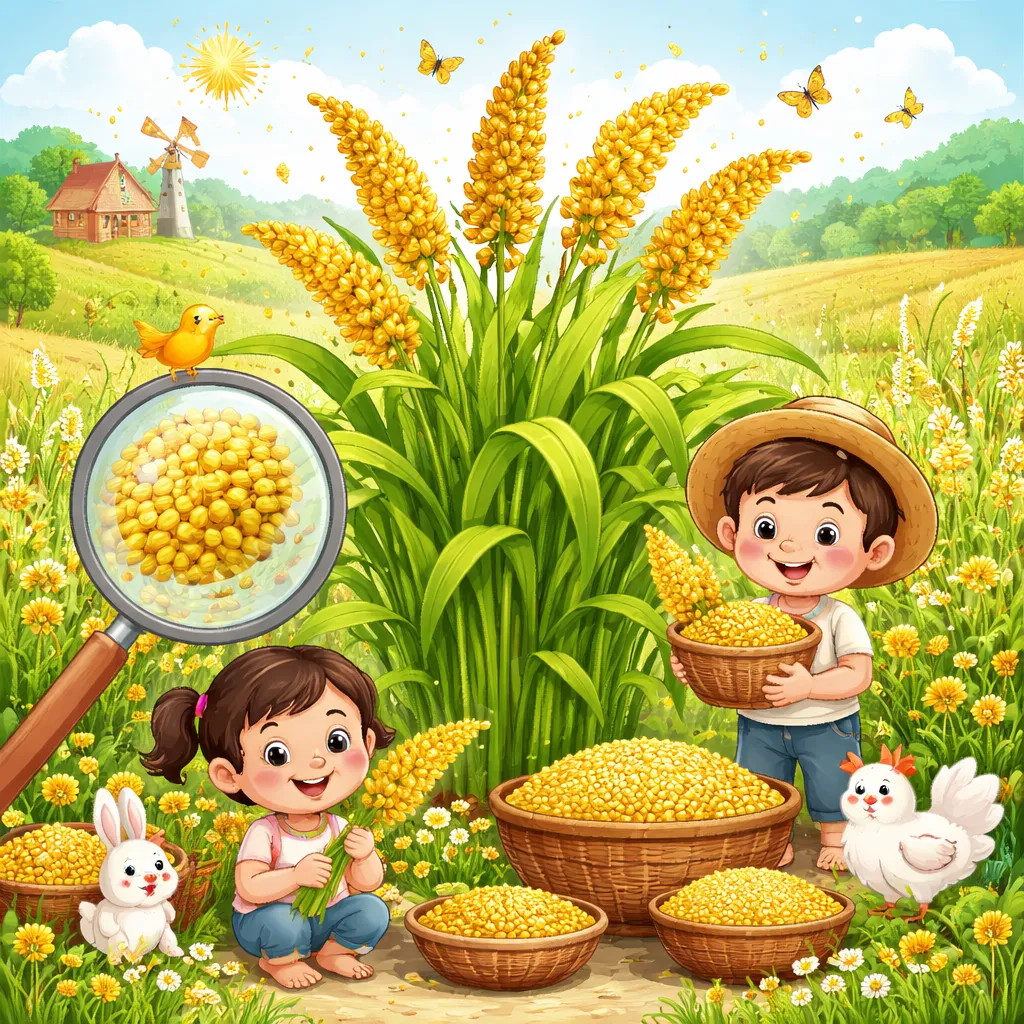

Have you ever seen a bird feeder filled with tiny, round, golden seeds? Those are often millet! Have you ever eaten a warm, creamy porridge or a fluffy flatbread in a different part of the world? That might be made from millet too! This plant is a group of many different small-seeded grasses that grow quickly, even in hot, dry places where other crops struggle. It is an ancient, humble, and super-tough superhero grain. Let’s go on a global adventure to learn about the mighty Millet plant.
Let’s Learn the Word! – Open the Treasure Box of Language
Formal Name and Pronunciation
This tiny giant is called Millet. You can say it like this: /ˈmɪl.ɪt/ (MILL-it). The “Mill” is like the building that grinds grain, and “it” is like the word. Mill-it. Say it: Millet. It’s a quick, light-sounding word.
The Etymology Tale
The word “Millet” comes from the Latin word “milium,” which simply meant millet grain. This Latin word is very old. The name has been used for thousands of years for these small, round seeds. It’s a simple, ancient name for a simple, ancient food that has fed people and animals since the beginning of farming.
Nicknames and Friendly Aliases
Millet is a big family! The most common type is Pearl Millet. Another is Foxtail Millet, because its seed head looks like a fox’s tail. There’s also Proso Millet, Finger Millet, and Barnyard Millet. Because the seeds are so small, it is sometimes called Small Millet. In bird food, it’s often just called White Millet or Red Millet.
Building Your Word Web: Core Parts
Let’s learn the words for a Millet plant’s modest body. The Culm is the slender, sometimes branched stem. The Panicle is the seed head; it can be compact like a fox’s tail or loose and open. A single Grain is the tiny, round seed. The Husk is the inedible outer shell around the grain. The Leaf is long, narrow, and grass-like. A Stand is a group of millet plants growing together. The Node is the bump on the stem where a leaf grows.
Action and State Words
Millet plants are speedy survivors. They sprout and grow very fast. They tolerate heat and drought. The seed heads nod or droop when they are heavy with grain. Farmers harvest the panicles. The grains are winnowed (tossed in the air) to separate them from the husks. Millet is nutritious, fast-maturing, drought-resistant, and gluten-free.
Ecosystem Friends Vocabulary
A millet field is a busy place. Small birds, like sparrows and finches, love to eat the seeds—that’s why it’s in birdseed! Insects visit the flowers. The plant provides quick ground cover, protecting the soil from the hot sun. In the wild, many small animals rely on wild millet seeds for food. It is a vital link in the food chain of grasslands and farms.
Cultural Imprint in Language
Millet is a symbol of sustenance, humility, and resilience in many cultures. An African proverb says, “Millet does not fear the wind,” meaning that strong, resilient people or things can withstand challenges. In ancient Chinese writings, millet is one of the Five Sacred Grains. In many folk tales, millet porridge is the food that gives strength to the hero for a long journey. It represents the power of small, simple things.
Ready for Discovery
We know its tiny, tough name. Are you ready to be a global detective and discover how these little seeds feed people and birds across the world? Let’s explore the secrets of the Millet plant.
Discover the Plant’s Secrets! – A Natural Detective’s Notebook
The Plant Passport
Millets belong to the grass family, Poaceae. They are a group of many different species, like Pennisetum glaucum (Pearl Millet) and Setaria italica (Foxtail Millet). Millet plants are annual grasses, usually 2 to 5 feet tall. They have slender stems and narrow leaves. The flower is a panicle that can be shaped like a cylinder, a spike, or a loose bunch. The seeds are tiny, round, and can be white, yellow, red, or gray. They grow in warm, often semi-arid regions of Asia, Africa, and the Americas.
Survival Smarts
Millet’s superpower is its incredible efficiency. It grows very quickly, often ready to harvest in just 60 to 90 days! This lets it complete its life cycle during a short rainy season. It has deep roots that can find water far underground. Its leaves are designed to lose very little water, making it super drought-tolerant. It can grow in poor, sandy, or acidic soils where other grains like wheat or rice would fail. It is the ultimate survivor crop.
Its Role and Gifts
In the ecosystem, millet provides quick ground cover, reducing soil erosion. Its most important gift is as a reliable source of food. The grains are highly nutritious, rich in protein, fiber, and minerals. For thousands of years, they have been a staple food for millions in dry regions, made into porridge, flatbreads, and fermented drinks. It is also a major component of birdseed and animal feed. The straw is used for fodder, fencing, and thatching.
Human History and Cultural Symbol
Millet was one of the earliest domesticated grains, with evidence of cultivation in East Asia over 10,000 years ago. It was a staple in ancient Chinese, Indian, and African civilizations. In the Middle Ages in Europe, it was a common food for the poor. Today, it is celebrated as a "smart food" — good for you, good for the farmer, and good for the planet. It symbolizes food security, tradition, and sustainable farming in the face of climate change.
Fun “Wow!” Facts
Get ready for a speed fact! Some types of millet, like Proso Millet, can go from seed to harvest in as little as 60 days! That’s one of the fastest growing times of any grain. And here’s a tiny fact: There are over 6,000 varieties of millet in the world, and the seeds are so small that it can take over 1,000 seeds to weigh just one ounce!
From Ancient Staple to Your Garden
The story of the Millet plant is one of quiet, global importance. Would you like to grow your own patch of this historic, tough grain? You can grow millet easily in a pot or garden! Let’s see how.
Let’s Grow It Together! – A Little Guardian’s Action Guide
Good for Home Growing?
Absolutely! Millet is one of the easiest and most rewarding grains to grow at home. It doesn’t need much space or care. You can grow a beautiful stand in a large pot or a small sunny garden bed. It grows quickly, so you won’t have to wait long to see the feathery seed heads. It’s a perfect project for a young gardener.
Little Gardener’s Toolkit
You will need a packet of millet seeds (from a garden store or a birdseed mix that is 100% millet). Get a wide, shallow pot or find a sunny garden spot. Use regular potting soil. Have a watering can and a sunny spot ready. That’s all you need!
Step-by-Step Growing Guide
Planting Your Mighty Mini-Grain
Millet loves heat. Plant the seeds in late spring or early summer, when the soil is warm. Scatter the seeds evenly over the soil. Cover them very lightly with about a quarter-inch of soil—just barely cover them! Gently pat the soil down. Water the soil gently so you don’t wash the tiny seeds away. Place the pot in the sunniest spot you have.
Care Calendar
Keep the soil moist until the seeds sprout, which happens in just a few days. Once the plants are a few inches tall, they are very drought-tolerant. Water them only when the soil is completely dry. They love full, hot sunshine. You don’t need to fertilize. Just watch them grow incredibly fast!
Watch and Be Friends
Watch for the first grass-like shoots. They will grow quickly into a dense clump. The most exciting part is when the seed head (panicle) forms at the top of each stem. It will start green and then turn a beautiful golden, bronze, or purple color, depending on the type. Gently touch the fuzzy or bristly seed head. Watch for birds visiting your garden, hoping for a snack! You are growing a bird cafe and a historic grain.
Problem Diagnosis
If the plants get too tall and flop over, they might be too crowded. Thin them out a bit next time. Birds might eat the seeds before you can harvest; you can cover the seed heads with a lightweight mesh bag. The most common problem is overwatering, which can cause root rot. Remember, millet likes it on the dry side.
Your Rewards and Gifts
Your gift is witnessing the speed and toughness of nature. You are growing a grain that teaches resilience, patience, and the global importance of underappreciated crops. Caring for millet connects you to farmers in dry regions of the world and to the birds in your own backyard. You become a grower of global connection and simple beauty.
Creative Fun
Start a Global Grain Journal. Draw your millet plant’s rapid growth. When the seed heads are dry, cut a few and use them in a dried flower arrangement. Try “winnowing” your tiny harvest by gently blowing on the seeds to separate the grain from the chaff. Research a simple recipe from another country that uses millet (like a porridge or flatbread) and try it with an adult. On a world map, mark the countries where millet is a staple food. Write a short story about a bird family that discovers your millet patch.
Growing a World in a Pot
By planting millet, you are not just growing grass. You are growing a lesson in biodiversity, a snack for wildlife, and a deep appreciation for the ancient, tiny grains that feed the world. You are a cultivator of resilience and global awareness.
Conclusion and Forever Curiosity
What a swift and powerful journey across continents and through time! You started by learning the word “Millet,” you discovered its secrets as the fast, drought-defying superhero of the grain world, and you learned how to grow your own stand of this generous plant. You now know the Millet plant is not just birdseed; it is a pillar of food security, a champion of drylands, a package of dense nutrition, and a quiet hero in the story of human survival. Remember, its power is in doing so much with so little—little water, little time, and tiny seeds. Your curiosity helps you see the giant potential in the smallest of packages. Keep exploring the diverse world of grains, asking about the foods of different cultures, and planting seeds of understanding. Your adventure to learn about the Millet plant shows us that sometimes, the mightiest things come in the smallest, most unassuming packages.