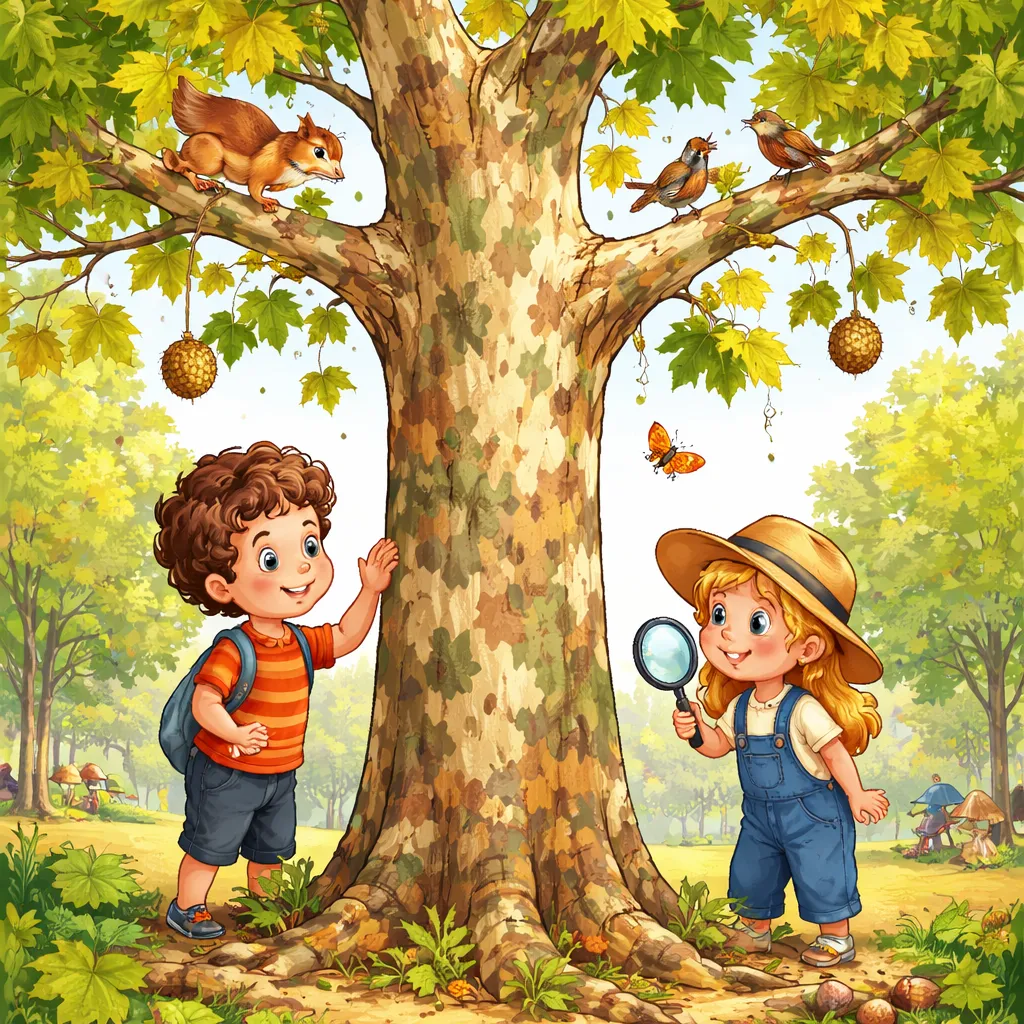

Have you ever seen a very tall city tree that looks like an artist tried to paint it? Its trunk is a crazy puzzle of colors—patches of creamy white, olive green, and grayish-brown, as if it is wearing a camouflage jacket that’s falling apart. Its big, star-shaped leaves look a bit like maple leaves, and in autumn, it drops spiky, round seed balls. This tree is a tough, silent hero of our busy streets and parks, cleaning the air and giving us cool shade. Let’s meet the incredible city survivor, the Plane Tree plant.
Let’s Learn the Word! – Open the Treasure Box of Language
Formal Name and Pronunciation This patchy-coated giant is called a Plane tree. Sometimes it’s called the London Plane. You can say it like this: /pleɪn triː/ (play-n tree). The word “Plane” rhymes with “rain” or “cane.” Plane tree. Say it: Plane. It sounds smooth and simple, just like some of its bark.
The Etymology Tale The word “Plane” for this tree has a long journey. It comes from the old Latin name for the tree, “platanus.” The ancient Greeks called it “platanos,” which meant “broad” or “wide,” because of its very broad, spreading leaves. So, its name is all about its wide, shady leaves that look like open hands. The name has traveled through thousands of years of history.
Nicknames and Friendly Aliases Plane trees have famous nicknames. In North America, it is often called the American Sycamore or Buttonwood. The most famous type in cities is the London Plane, which is a super-tough hybrid. In some places, people call it the “Ghost Tree” because of its pale, peeling bark. Because of its round seed balls, it’s also called the “Buttonball Tree.”
Building Your Word Web: Core Parts Let’s learn the words for a Plane’s unique body. The Bark is the superstar. It peels off in large, thin patches, showing the younger, lighter-colored bark underneath. This is called exfoliating bark. The Leaf is large, broad, and shaped like a star or a hand with pointed lobes. The Seed Ball is a round, prickly fruit that hangs on a long stem, like a spiky Christmas ornament. The Trunk is massive, straight, and often flared at the bottom. A Twig has a special zigzag pattern. The Bud is conical and sits inside the base of the leaf stem, hiding until spring.
Action and State Words Plane trees are constantly renewing themselves. Their bark exfoliates or peels away in patches. They tolerate horrible city pollution and compacted soil. They provide immense, cooling shade with their big leaves. They drop their seed balls and leaves in autumn. A plane tree is stately, tough, patchwork, and deciduous.
Ecosystem Friends Vocabulary The plane tree is a mini-habitat. Squirrels sometimes nibble on the young twigs. Finches and other small birds eat the tiny seeds from the balls. The leaves are food for the caterpillars of several moths, like the beautiful Plane moth. Even in the city, birds like starlings and pigeons rest in its high branches. Insects live in the crevices of its amazing bark.
Cultural Imprint in Language The plane tree is a symbol of city life and resilience. The poet William Wordsworth wrote of a plane tree’s shade in London. In ancient Greece, the philosopher Plato taught his students in a school called the “Academy,” which had a sacred grove of plane trees. The “Buttonwood Agreement” was signed under a plane tree in New York in 1792, and that agreement started the New York Stock Exchange! So, this tree is linked to the very beginning of the stock market.
Ready for Discovery We know its patchy name and its city stories. Are you ready to be a detective and peel back the layers of this tree’s secrets? Let’s explore the life of the Plane Tree plant.
Discover the Plant’s Secrets! – A Nature Detective’s Notebook
The Plant Passport Plane trees belong to the Platanaceae family. Their group name is Platanus. A plane tree is a giant, with a straight trunk that soars upwards and a huge, spreading crown that looks like a green cloud. Its most famous feature is its bark—a mosaic of tan, cream, and green that constantly peels. The leaves are large, bright green, and have 3 to 5 pointed lobes. In spring, it has small, red flower balls. The fruit is the famous, long-hanging, prickly seed ball. It is a deciduous tree, losing its leaves in winter, which makes its beautiful, patchy trunk the star of the show.
Survival Smarts The plane tree’s peeling bark is a genius trick for city life. As the old, dirty bark flakes off, it takes with it soot, pollution, and even some harmful insects and fungi! This keeps the tree healthy in dirty city air. Its leaves are also very tough and can handle pollution. Another trick is its huge, spreading root system. It can find water and nutrients even in the hard, packed soil of city streets. It is a true urban superhero.
Its Role and Gifts The plane tree is a generous giant of the city. It provides essential shade, cooling sidewalks and buildings in the summer. Its large leaves trap dust and pollution, cleaning the air. It is a vital habitat for city wildlife, offering food and resting spots. As an environmental engineer, a single large plane tree can cool the air as much as several air conditioners. Its roots help stabilize the soil, even in paved areas.
Human History and Cultural Symbol For centuries, the plane tree has been a symbol of resilience, protection, and city beauty. In ancient Persia, magnificent plane trees were planted in royal gardens. In Europe, they became the favorite tree for lining grand avenues and public squares. The London Plane became the iconic tree of London and Paris because it thrived despite soot and smoke. Its hard, fine-grained wood is prized for making butcher’s blocks, furniture, and even musical instruments.
Fun “Wow!” Facts Get ready for a shedding surprise! A large, old plane tree can shed hundreds of pounds of bark in its lifetime, constantly renewing its own skin! And here’s a cool fact: the London Plane, the most common city plane tree, is actually a hybrid between the American Sycamore and the Oriental Plane. It was “born” in a botanical garden in London over 300 years ago and became the perfect city tree.
From City Street to Your Story The Plane Tree plant’s story is written in the bark of our oldest cities. Would you like to help write its next chapter? You can help grow a future shady giant. Let’s see how.
Let’s Grow It Together! – A Little Guardian’s Action Guide
Good for Home Growing? Only if you have a LOT of space. Plane trees become forest giants. They are not for pots or small gardens. Their roots are large and can interfere with pipes and pavements. The best way to grow one is to plant it in a large park, a schoolyard, or a very big country garden where it can be a legacy tree for the next 100 years. You can grow a seedling in a large pot for a few years as a science project before finding it a forever home.
Little Gardener’s Toolkit You will need a few dried seed balls collected in winter. Get a tall, deep pot (a “tree pot”) for the long taproot. Use good-quality potting soil. Have a watering can, a pair of gloves (for the prickly balls!), and a plastic bag for stratification ready. A cold place, like a fridge, is needed.
Step-by-Step Growing Guide
Planting Your Future Giant First, break open a dry seed ball in winter and collect the tiny seeds. Place them in a damp paper towel inside a plastic bag. Put the bag in the fridge for about 60 days. This is cold stratification. In early spring, plant the seeds just under the soil surface in your deep pot. Water gently. Place the pot in a sunny spot.
Care Calendar Keep the soil moist but not waterlogged. The seedling will first grow a long taproot. Once it has a few true leaves, it will grow faster. It loves full sun. As a potted seedling, you can give it a little liquid fertilizer once a month in the growing season. The most important thing is planning for its future in the ground.
Watch and Be Friends Be patient. Watch for the first two simple leaves. Then, watch for the first true leaf that looks like a miniature plane tree leaf. Notice how the stem has a zigzag pattern. Gently feel the trunk as it grows—will it start to get rough? Measure its height every season. Imagine the patchy bark it will have one day.
Problem Diagnosis If the leaves get a white, powdery coating, it might be powdery mildew. This is common and usually not serious. Just pick off the worst leaves. Ensure good air flow. Plane trees are very tough. If grown in a pot, the biggest problem is becoming root-bound, which means it needs a bigger pot or to be planted in the ground.
Your Rewards and Gifts Your gift is planting a legacy. You are growing a future giant that could shade a city street. Caring for a plane tree teaches you about urban ecology, patience, and the importance of planting for future generations. You learn that some of the toughest things are also the most beautiful.
Creative Fun Start a City Tree Journal. Draw your seedling and write about its future. Make amazing bark rubbings of a mature plane tree (with permission) to see the patchwork pattern. Create spiky seed ball sculptures with clay or collect fallen ones for decoration. Research the famous plane trees in your city or in history and make a poster. Write a poem from the perspective of an old plane tree watching the city change.
Planting for the Future By planting a plane tree, you are not just planting a tree. You are planting a living air filter, a piece of natural history, and a gift of cool shade for the next century. You are a city hero.
Conclusion and Forever Curiosity What a journey through the city and time! You started by learning the word “Plane,” you discovered its secrets as the patchy-coated, pollution-eating hero of our streets, and you learned how to help a tiny seed begin its life as a future giant. You now know the Plane Tree is not just a city tree; it is a self-cleaning wonder, a symbol of resilience, a cooler of our world, and a living piece of history. Remember, its strength is in its ability to renew itself, layer by layer. Your curiosity helps you see the superheroes in the everyday green world around you. Keep looking for those patchy trunks, touching the peeling bark, and wondering about the quiet, tough life of city trees. Your adventure to learn about the Plane Tree plant shows us that nature finds a way to thrive, even in the busiest places, and we can help.