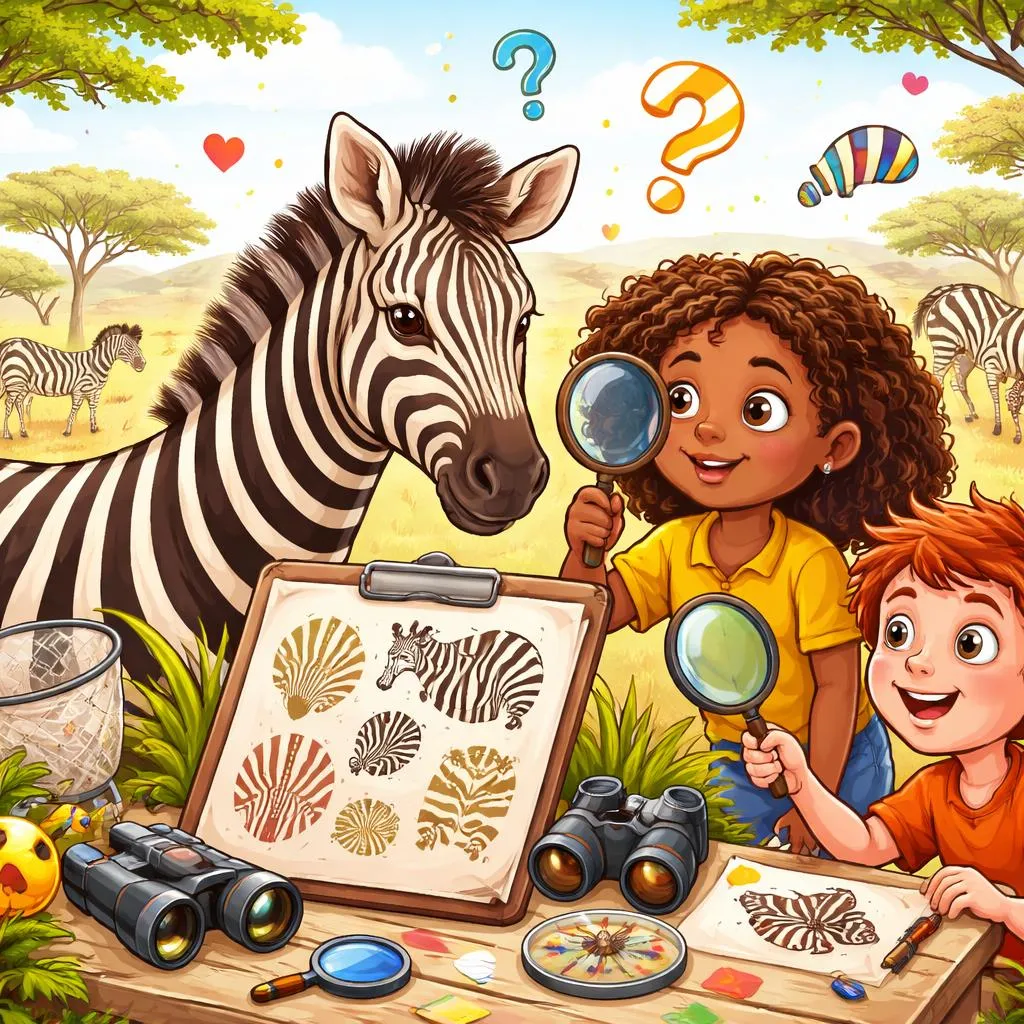

Have you ever seen a zebra’s amazing black and white stripes? Maybe at the zoo, in a movie, or in a picture book. They look like horses wearing pajamas! Zebras are wild, fast, and very social animals. Learning about zebras is a fun adventure that takes us to the wide-open plains of Africa. Let’s discover the secrets behind those famous stripes.
English Language Learning
Vocabulary and Spelling Our striped friend’s name is zebra. The word "zebra" is a noun. A noun is a word for a person, place, or thing. So, a zebra is a thing—a beautiful, living animal. Let’s spell it: Z-E-B-R-A. The letter 'Z' is a cool, zig-zag start. The 'E' and 'B' are in the middle of the word, like the zebra’s body. The 'R' and 'A' are at the end, like its strong legs and alert head. Z-E-B-R-A spells zebra.
Sound and Pronunciation Let’s say the word correctly. It sounds like this: /ˈziː.brə/. We can say it in two easy parts. First, say "zee". It sounds just like the letter 'Z'! Next, say "bruh". It rhymes with the beginning of "brother". Now, put it together fast! "Zee" "bruh". Zebra! Great job! The word "zebra" has two beats, or two syllables. Clap your hands twice: Ze-bra. It’s a zippy, fun word to say.
Related Words Learning about zebras is more exciting with new words! Here are some simple ones. Body Parts: The black and white lines on a zebra are called stripes. No two zebras have the exact same stripe pattern! It is their fingerprint. Group: A zebra family group is called a herd. They live, travel, and eat together for safety. Home: The huge, grassy land where zebras live is called the savanna.
A Famous Saying There is a fun riddle: "How do you hide a zebra? In a crossword puzzle!" This is a joke because a zebra’s stripes look like the black and white squares of a crossword puzzle! It’s a playful way to think about their amazing stripes. It reminds us that zebras’ stripes are very special and unique. Say the riddle with me: "How do you hide a zebra? In a crossword puzzle!" Can you think of other places with black and white patterns?
Now you know the word "zebra"! Are you ready to solve the mystery of the stripes? Let’s gallop from words to wonderful wild facts!
Animal Knowledge
Who Are They? – Family and Group What kind of animal is a zebra? Zebras are mammals. They have hair, are warm-blooded, and mother zebras feed their babies milk. They are part of the horse family! Their closest relatives are horses and donkeys. In fact, a zebra is like a wild, striped cousin of the horse.
What Do They Look Like? – Amazing Bodies Zebras are about the size of a small horse or a very large pony. Their most famous feature is their black and white stripes. Scientists think stripes help zebras in many ways. The stripes can confuse biting flies, who don’t like the pattern. In a big, moving herd, the stripes can also make it hard for a lion to pick out just one zebra to chase! Zebras have strong, hard hooves for running on the hard ground. They have tall, pointy ears that can turn to hear danger. Their tails have a tuft of hair at the end to swat away flies.
Where Do They Live and How? – Home and Habits Zebras live in Africa. Their home is the grassy savanna and sometimes open woodlands. They need lots of grass to eat and space to run. Zebras are herbivores. This means they only eat plants. They are grazers, so they eat mostly grass. They spend a large part of their day eating. Zebras are very social and live in family herds. A herd is usually made of one male, several females, and their young. They are most active during the day. Sometimes, huge herds of zebras migrate, or travel very long distances, to find fresh grass and water.
A Zebra’s Life Story – Growing Up A baby zebra is called a foal. Zebras are mammals, so foals are born live from their mother. The mother usually has one foal at a time. The mother zebra is the main caregiver. A foal can stand and walk just an hour after it is born! This is very important so it can run with the herd. The mother zebra keeps her foal close and protects it fiercely. The foal has brownish stripes when it is born. The stripes get darker and turn black as it grows up. It will stay with its mother for about a year, learning how to survive.
How Do They "Talk"? – Communication Zebras talk to each other with sounds and body language. They make barking sounds, whinnies, and loud snorts. They use their ears, faces, and tails to show their feelings. If a zebra’s ears are pulled back, it might be angry. They groom each other by nibbling on the neck and back, which is a friendly way to say "hello." Their best sense is their excellent eyesight. They can see very well, which helps them spot danger like a lion far away on the savanna. Their hearing is also very good.
Are They Okay? – Taking Care of Them Some zebras, like the Grevy’s zebra, are endangered. This means there are not many left. Others are safer but still face problems. The main threats are people taking their land for farms and cities. Some zebras are also hunted. When their land is divided by fences or roads, it is hard for them to migrate to find food and water. You can help zebras! You can learn all about them and be a voice for wildlife. You can support groups that protect national parks in Africa. Choosing to recycle and save paper helps protect forests and wild places for all animals.
Life Connections and Inspiration
How to Be With Them – Safety and Love Zebras are wild animals. We must love and respect them from a very safe distance. The most important rule is: Watch, don’t touch. We admire them at good zoos with large, natural spaces, or in nature documentaries. We never try to get close to, feed, or touch a wild zebra. They can kick very hard if they are scared. We show we care by wanting them to live free and safe on the African savanna. Protecting wild places is the best way to be a friend to zebras.
Super Qualities We Learn from Them Zebras teach us amazing things. One super quality is sticking together. Zebras are much safer in a herd. Their stripes blend together, confusing predators. This teaches us the power of teamwork, friendship, and community. We are stronger together! Another quality is strength for the journey. Zebras make incredibly long, tough journeys to find what they need. They don’t give up. This reminds us to be strong, persistent, and brave when we face our own big challenges or "migrations." Think about it: How does working with your friends or family make you stronger? When have you had to be strong and keep going on a tough journey, just like a zebra?
Take Action! – Your "Zebra Stripe" Project Let’s do a fun activity! Your project is to become a stripe detective and create your own zebra. Get a piece of white paper and a black crayon or marker. Draw the shape of a zebra. Now, look at pictures of real zebras. Are their stripes wide or thin? Do they go all the way down their legs? Use your black crayon to carefully draw your own unique stripe pattern. Remember, no two zebras are alike! Give your zebra a name. Then, draw a savanna background with grass and a few trees. Tell a story about your zebra’s day in the herd.
Closing Learning about zebra stripes is a wonderful adventure! We learned the word "zebra" and how to say its two-syllable name. We discovered the cool science behind their stripes and their life in big herds on the savanna. We know that zebras are social, strong travelers who need our help to protect their wild homes. You can use your new words to teach others about these striped wonders. You can use your knowledge to understand why teamwork and not giving up are so important. The animal kingdom is full of beautiful patterns and lessons. Always remember to respect wildlife and be a friend to our planet. Keep exploring, stick together with your friends, and be strong on your journey. Your curiosity and care make you a hero for animals everywhere.