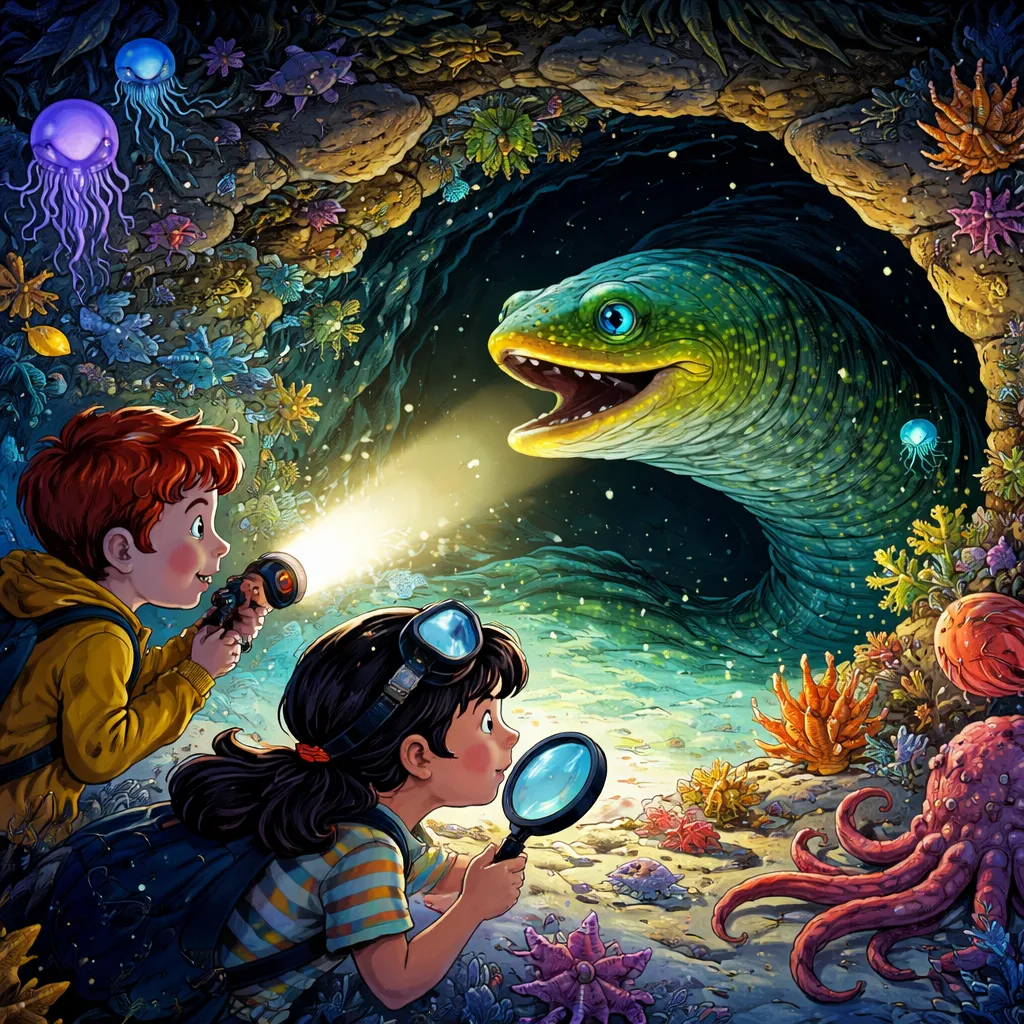

Have you ever seen a creature that looks like a snake but lives in water? That is the eel. It moves with a gentle, wavy motion. It hides in reefs, rivers, and even deep ocean caves. For children, learning about Eel opens a window to a mysterious world. This animal does not seek attention. Yet it carries fascinating secrets. Parents and children can explore these secrets together. No complicated tools are needed. Just a sense of wonder and a few quiet moments of discovery.
The eel is not a reptile. It is a fish. A long, slender fish. It does not have scales like most fish. Its skin is smooth and covered with a layer of mucus. This helps it glide through tight spaces. Let us begin our journey into the world of the eel.
What Is This Animal? An eel is a long, snake-like fish. It has a continuous fin running along its back, around its tail, and under its belly. This fin helps it swim backward and forward with ease. Most eels have no pelvic fins. Their bodies are built for slipping into narrow cracks and burrows.
Eels live in many places. Some live in freshwater rivers. Others live in the ocean. A few species travel between both. They can be small, like a pencil. Some grow longer than a tall adult. Their eyes are small. Their mouths are wide with sharp teeth. But eels are not aggressive toward humans unless threatened.
Children often mistake eels for snakes. Pointing out the difference is a fun learning moment. Eels have gills for breathing underwater. Snakes have lungs and live on land. This simple comparison builds observation skills.
English Learning About This Animal Let us start with the word “eel.” It is pronounced /iːl/. The sound is long and smooth, like the animal itself. Say it with your child: eee-l. It rhymes with “feel” and “seal.” The word is short and easy to remember.
When learning about Eel in English, we meet interesting words. Here are a few to explore together.
Slender – thin and graceful in shape.
Burrow – a hole or tunnel where an animal hides.
Current – the steady flow of water in a river or ocean.
Nocturnal – active during the night.
You can use these words in simple sentences. For example, “The eel hides in a burrow.” Or “Eels are nocturnal animals.” These sentences help children connect words to real ideas.
Here is a proverb that fits the eel’s nature. “Still waters run deep.” This means quiet places or people often hold great depth. Eels live in quiet waters. They move slowly. Yet they have strong bodies and long journeys ahead. The proverb teaches children not to judge by appearances.
Another meaningful saying comes from naturalist Henry David Thoreau. He wrote, “Many men go fishing all of their lives without knowing that it is not fish they are after.” This reminds us that learning about an animal like the eel is about more than facts. It is about curiosity, patience, and connection to nature.
Animal Facts and Science Knowledge Eels are fish. They belong to the order Anguilliformes. There are over 800 species. Some live in freshwater. Some live in saltwater. The most famous is the European eel and the American eel. These species begin life in the ocean, travel to rivers, and later return to the sea to reproduce.
Eels are carnivores. They eat small fish, insects, worms, and crustaceans. They hunt at night. During the day, they hide in mud, sand, or rock crevices. Their sense of smell is very strong. They can detect food from far away.
One of the most amazing facts about eels is their life cycle. Freshwater eels travel thousands of miles to breed in the ocean. Scientists still do not fully understand how they find their way. Young eels, called glass eels, are nearly transparent. They drift with ocean currents until they reach rivers. This long journey shows incredible endurance.
Eels have a unique way of swimming. They move their whole body in waves. This is called anguilliform locomotion. It allows them to swim forward and backward easily. They can also move on damp land for short distances. This helps them travel between bodies of water.
Some eels, like the moray eel, have a second set of jaws in their throat. These pharyngeal jaws grab prey and pull it in. This adaptation makes them efficient hunters. Learning about Eel reveals how animals evolve to survive in unique ways.
How to Interact With This Animal Safely Eels are wild animals. Most eels are not aggressive. But they will defend themselves if disturbed. In the ocean, divers sometimes see moray eels peeking from reefs. The best approach is to watch quietly. Do not reach into holes or crevices. Do not attempt to touch or feed an eel. A frightened eel may bite.
In freshwater areas, children may see eels near streams or ponds. Teach them to observe from a safe distance. Do not try to catch an eel. Their skin is sensitive. Handling them can harm their protective mucus layer.
If your family visits an aquarium, you might see eels in tanks. Follow the rules. Do not tap the glass. Sudden movements or loud noises can stress the animals. Respecting their space teaches children empathy for all creatures.
Some people keep eels as pets. This requires a large tank with secure lids. Eels are escape artists. They need hiding spaces and clean water. Keeping an eel is a big responsibility. It is best for experienced aquarists. For most families, watching eels in nature or at public aquariums is a better choice.
Safety also means protecting eel habitats. Do not litter near rivers or oceans. Chemicals and trash harm eels and their food sources. Caring for the environment is part of caring for wildlife.
What Can We Learn From This Animal Eels teach us the value of patience. They spend much of their time resting in hidden places. They do not rush. They wait for the right moment to move. Children can learn that waiting calmly is a strength. Not everything needs an instant reaction.
Eels also show us resilience. They travel vast distances. They face strong currents and changing environments. Yet they continue their journey. This teaches children to keep going even when things feel difficult. Small steps lead to great achievements.
Another lesson is adaptability. Eels live in fresh water and salt water. They adjust to different conditions. This reminds us that we can adapt too. New schools, new friends, or new challenges—we can learn to navigate them.
Eels are also masters of camouflage. They blend into rocks and sand. This teaches children that being quiet and observant has value. You do not always need to be the loudest in the room. Watching and listening can reveal hidden wonders.
Fun Learning Activities Turn learning about Eel into playful exploration. Here are a few simple activities.
Make a Wavy Eel Craft Cut a long strip of paper. Let your child decorate it with spots or stripes. Fold the strip back and forth like a fan. Attach a string and hang it. Watch how it moves like an eel in water.
Create an Eel Story Ask your child to imagine an eel’s journey from the ocean to a river. What does it see? What dangers does it face? Write or draw the adventure together. Use new words like slender, current, and nocturnal.
Pretend to Swim Like an Eel Lie on the floor and move your whole body in gentle waves. Start from your head and flow to your toes. Ask your child to describe how it feels. This builds body awareness and imagination.
Play a Hide-and-Seek Game Talk about how eels hide in burrows and crevices. Take turns hiding a small toy eel in a room. Give clues using words like under, inside, or behind. This reinforces spatial vocabulary in a playful way.
Watch and Wonder Find a short video of an eel swimming or hunting. Watch together without talking. Then ask open questions. “What did you notice?” “Why do you think it moves that way?” Let your child share their thoughts. This builds observation and language skills naturally.
Learning about Eel invites children into a quieter side of nature. It shows that not all wonders are loud or colorful. Some are hidden, patient, and full of quiet strength. As parents and children explore together, they build language, knowledge, and a shared sense of discovery. The eel slips through the water, unhurried. And in that slow glide, young learners find something lasting—a deeper appreciation for the mysterious world beneath the surface.