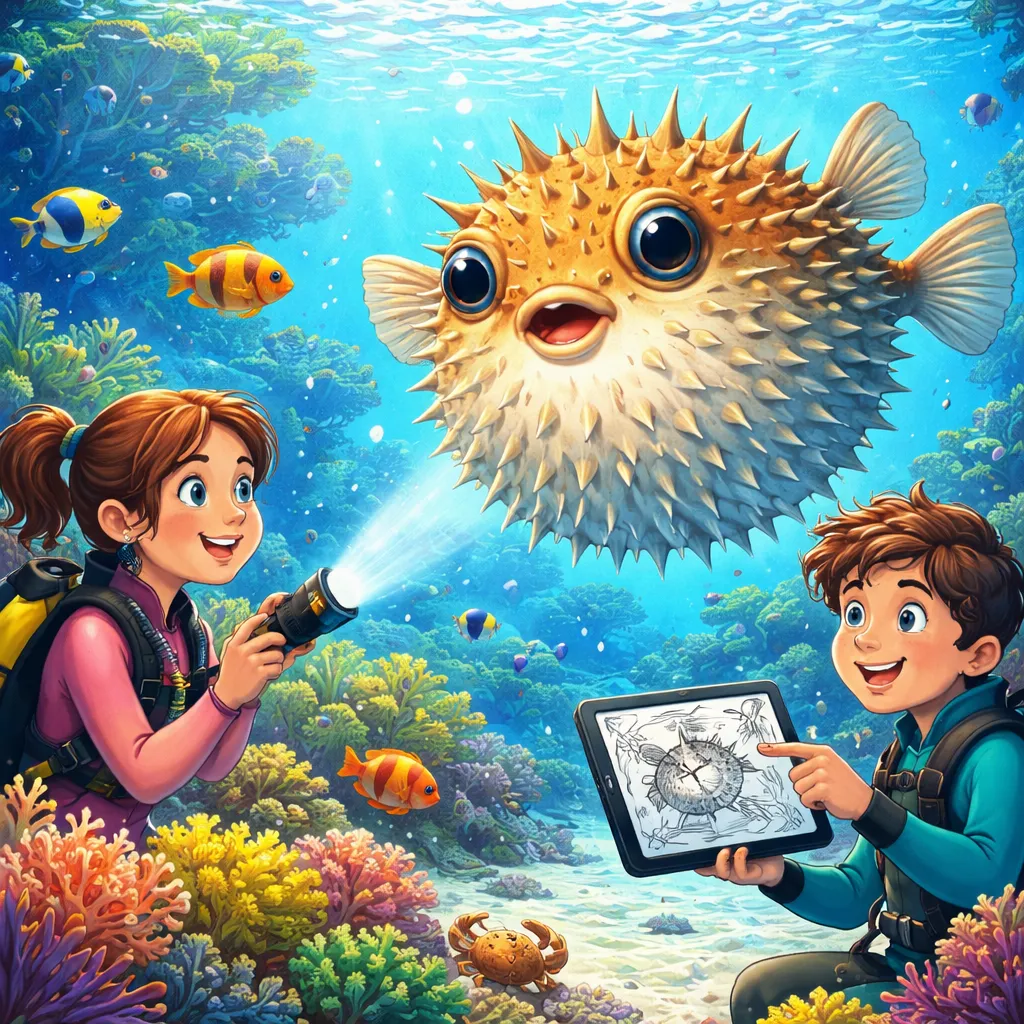

Some fish rely on speed. Others depend on hiding. The porcupine fish takes a bolder approach. It transforms into a spiky, unswallowable ball. For children, learning about Porcupine Fish opens a window to one of the ocean’s most dramatic defense mechanisms. Parents and children can explore this remarkable creature together. No deep-sea dive is required. Just a sense of wonder about an animal that turns itself into a living shield.
The porcupine fish looks harmless at first. But when danger appears, it shows its true nature. Let us begin our journey into its spiky world.
What Is This Animal?
A porcupine fish is a round fish covered in sharp spines. Its body is oval and sturdy. Its eyes are large and forward-facing. When relaxed, the spines lie flat against its skin. The fish looks smooth and ordinary. When threatened, it swallows water rapidly. Its body swells to twice its normal size. The spines stand straight out. It becomes a spiky ball that most predators cannot eat.
Porcupine fish live in warm tropical oceans. They inhabit coral reefs, seagrass beds, and shallow lagoons. They swim slowly. Their unusual shape makes them easy to spot. Their defense makes them hard to attack.
Children often find porcupine fish delightful and strange. The name alone sparks curiosity. Learning about Porcupine Fish becomes an exploration of how animals use unique features to survive.
English Learning About This Animal
Let us begin with the name “porcupine fish.” It is pronounced /ˈpɔːrkjəpaɪn fɪʃ/. Porcupine has three syllables: por-cu-pine. Say it slowly: por-cu-pine fish. The name comes from the land animal called the porcupine. Both share the same spiky defense.
When learning about Porcupine Fish in English, we meet words about protection and transformation. Here are a few to share.
Spine – a sharp, pointed structure on an animal’s body.
Inflate – to fill with water or air and become larger.
Predator – an animal that hunts other animals for food.
Toxin – a poisonous substance.
Use these words in simple sentences. “The porcupine fish inflates when scared.” “Its spines protect it from predators.” These sentences help children connect words to the fish’s behavior.
Here is a proverb that fits the porcupine fish. “The best defense is a good offense.” Porcupine fish do not attack. But they make themselves so unappealing that predators leave them alone. This teaches children that protecting yourself can be about making clear boundaries.
Another meaningful thought comes from author A.A. Milne. He wrote, “You are braver than you believe, stronger than you seem, and smarter than you think.” The porcupine fish looks small and slow. But it carries powerful tools for survival. This reminds children that they too have hidden strengths.
Animal Facts and Science Knowledge
Porcupine fish belong to the family Diodontidae. They are closely related to pufferfish. The name Diodontidae means “two teeth.” Their teeth are fused into a strong beak. This beak helps them crush hard-shelled prey. There are about 20 species of porcupine fish.
Porcupine fish have spines that lie flat against their bodies. These spines are modified scales. When the fish inflates, the spines lock into an upright position. A predator that tries to bite gets a mouthful of sharp points. Even if swallowed, the spines make the fish impossible to digest.
Like pufferfish, porcupine fish contain tetrodotoxin. This powerful toxin is found in their skin, organs, and spines. The poison does not harm the fish. But it can kill predators. Most ocean animals learn to avoid porcupine fish after one encounter.
Porcupine fish are carnivores. They eat crabs, snails, sea urchins, and shellfish. Their strong beaks crack open hard shells. They also eat coral and algae. They use their large eyes to spot prey on the reef.
These fish are mostly solitary. They move slowly and deliberately. At night, they often hide in crevices or burrow into sand. During the day, they swim openly. Their defense gives them confidence.
Porcupine fish have excellent eyesight. Their large eyes can move independently. This helps them watch for danger from all directions. They also have good hearing and can sense vibrations in the water.
How to Interact With This Animal Safely
Porcupine fish are wild animals. They are not aggressive. But they are dangerous if mishandled. Never touch a porcupine fish in the wild. Their spines can pierce skin. Their toxin can cause serious harm. Even dead porcupine fish carry toxin on their spines and skin.
If you see a porcupine fish while snorkeling or diving, keep a respectful distance. Do not chase it. Do not try to make it inflate. Forcing inflation causes extreme stress. It uses energy the fish needs for survival. Watch quietly. Let the fish remain calm.
In some aquariums, you may see porcupine fish in tanks. Follow all posted rules. Do not tap the glass. Do not put hands in the water. Observe from a safe distance. Aquarium staff provide proper care.
Never attempt to keep a porcupine fish as a pet without extensive research. They require large saltwater tanks, specialized diets, and expert care. Their spines and toxin make them unsuitable for home aquariums. Most families should enjoy them through observation, not ownership.
Teach children that some animals are best admired from afar. Respecting wild creatures keeps both humans and animals safe.
What Can We Learn From This Animal
Porcupine fish teach us about setting boundaries. When something threatens them, they do not run. They make themselves unapproachable. Children can learn that it is okay to say no. It is okay to make your boundaries clear. Protecting yourself is not selfish. It is wise.
Porcupine fish also show us that we have hidden strengths. They look ordinary until they need to defend themselves. Then they reveal their spines. Children can learn that they too carry inner strengths. Courage, kindness, and knowledge are tools they can use when needed.
Another lesson is preparation. Porcupine fish carry their defense with them at all times. They are always ready. This teaches children that being prepared matters. Learning skills, thinking ahead, and staying aware help in difficult moments.
Porcupine fish also teach us not to underestimate. A slow, round fish can be one of the most protected creatures in the sea. People and animals often have more depth than first impressions show.
Fun Learning Activities
Turn learning about Porcupine Fish into creative play. Here are a few simple ideas.
Make a Spiky Fish Craft
Draw a fish shape on paper. Glue short pieces of uncooked spaghetti or toothpicks onto the body for spines. Let your child decorate it with eyes and a mouth. Talk about why spines help the fish survive.
Create a Transformation Story
Ask your child to imagine being a porcupine fish swimming near a coral reef. A shark appears. What happens next? Write or draw the story together. Use new words like inflate, spine, and predator.
Play the Inflation Game
Take turns pretending to be a porcupine fish. Walk or swim slowly. When someone says “danger,” puff out your cheeks and spread your arms wide. Stay still. The “predator” pretends to swim away. This movement game builds understanding through play.
Design a Warning Poster
Ask your child to draw a poster about porcupine fish safety. What would you tell people who see one while swimming? What colors would get attention? This activity combines art with safety awareness.
Watch and Wonder
Find a short video of a porcupine fish swimming or inflating. Watch together. Pause and ask open questions. “What do you notice about its eyes?” “How does its shape change?” Let your child share observations freely.
Learning about Porcupine Fish takes us into a world where being different is a strength. This creature does not hide. It does not flee. It transforms. It makes itself impossible to ignore. As parents and children explore together, they build language, knowledge, and a shared appreciation for nature’s boldest defenders. The porcupine fish drifts slowly through warm waters, spines flat, eyes watching. But in that calm exterior, young learners discover something powerful—that true protection comes from knowing your own strength and using it when the moment arrives.