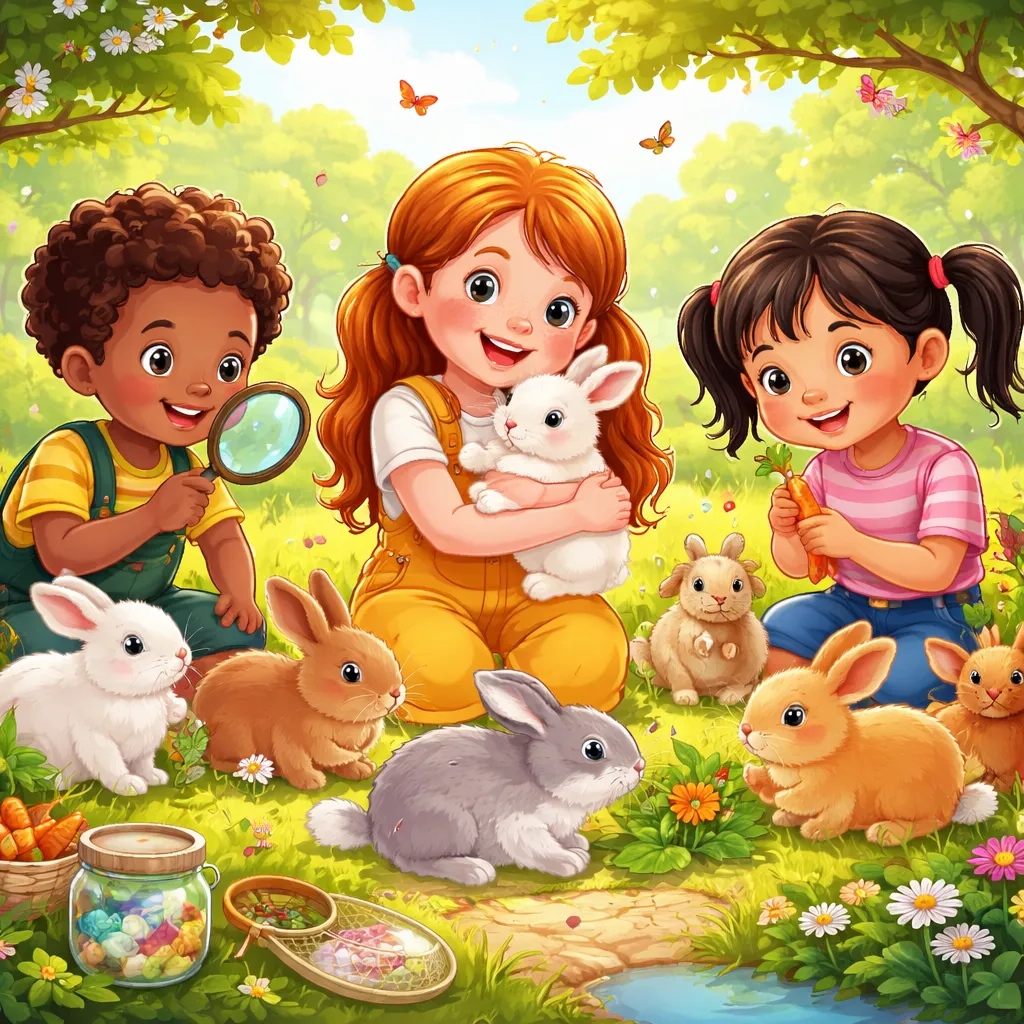

Have you ever seen a rabbit in a garden, a park, or maybe as a soft, cuddly pet? With their long ears, twitchy noses, and quick hops, rabbits are adorable and fascinating animals. Learning about rabbits is a wonderful adventure that takes us to grassy fields and cozy hutches. Let’s start our journey of learning about rabbit life and love!
English Language Learning
Vocabulary and Spelling The word for this gentle animal is rabbit. The word "rabbit" is a noun. A noun is a word for a person, place, or thing. So, a rabbit is a thing—a soft, living animal. Let’s spell it: R-A-B-B-I-T. The 'R' hops to the start. The 'A' and the two 'B's bounce in the middle. The 'I' and 'T' are at the end, like two perky ears. R-A-B-B-I-T spells rabbit.
Sound and Pronunciation Let’s say the word just right. It sounds like this: /ˈræb.ɪt/. We can say it in two quick parts. First, say "rab". It rhymes with "cab" or "tab". Next, say "it". It sounds just like the word "it". Now, put it together! "Rab" "it". Rabbit! Great job! The word "rabbit" has two beats, or two syllables. Clap your hands twice: Rab-bit. It’s a bouncy, happy word.
Related Words Learning about rabbits is more fun with new words! Here are some simple ones. Body Parts: A rabbit’s long, sensitive hairs on its face are whiskers. They help it feel its way in the dark. Its big, strong back legs are perfect for hopping. Home: A wild rabbit’s underground home is called a burrow. A pet rabbit’s special house is often called a hutch. Baby: A baby rabbit is called a kit.
A Famous Saying There is a fun and speedy saying: "Quick as a rabbit." This means someone or something is very fast. Rabbits are known for their quick hops and speedy getaways. It’s a playful way to say, "You’re fast!" or "That was quick!" Say the saying with me: "Quick as a rabbit." Can you hop as quick as a rabbit?
Now you know the word "rabbit"! Are you ready to hop into some amazing facts? Let’s bounce from words to wonderful knowledge!
Animal Knowledge
Who Are They? – Family and Group What kind of animal is a rabbit? Rabbits are mammals. They have fur, are warm-blooded, and mother rabbits feed their babies milk. They are part of a group called lagomorphs. This group also includes hares and pikas. Rabbits are different from hares; rabbit babies are born without fur and with eyes closed, while hare babies are born ready to go!
What Do They Look Like? – Amazing Bodies Rabbits can be very small, like a softball, or as big as a small cat. They have soft fur that can be white, brown, black, gray, or spotted. Their most famous features are their long ears. Rabbit ears can turn to catch sounds from all directions, helping them hear danger. Their powerful back legs are made for jumping high and running fast in a zigzag. Rabbits have special body tools. They have eyes on the sides of their head, so they can see almost all the way around to watch for predators. Their teeth never stop growing! They chew on hay and wood to wear them down.
Where Do They Live and How? – Home and Habits Wild rabbits live in many places like meadows, forests, grasslands, and sometimes deserts. Pet rabbits live safely in homes with loving families. Rabbits are herbivores. This means they only eat plants. They love to eat grass, hay, leafy greens, and some vegetables. Carrots are a treat, not their main food! Wild rabbits are very social and live in groups. A group of rabbits is called a fluffle. They are most active at dawn and dusk. They spend their time eating, grooming, and playing. Pet rabbits also love to play and explore.
A Rabbit’s Life Story – Growing Up A baby rabbit is called a kit. Rabbits are mammals, so kits are born live from their mother. A mother rabbit can have several kits at one time, in a group called a litter. The mother rabbit makes a soft nest for her kits. She feeds them rich milk but only visits the nest a few times a day so she doesn’t attract predators. The kits grow incredibly fast! Newborn kits are blind, deaf, and have no fur. In about two weeks, their eyes open, and they grow a soft coat of fur. They start to leave the nest and eat solid food after three weeks. They become adults in just a few months.
How Do They "Talk"? – Communication Rabbits are mostly quiet, but they talk with their bodies. A happy rabbit might make a soft purring sound by gently grinding its teeth. They thump their powerful back legs on the ground to warn other rabbits of danger. They also nudge with their noses to say hello or ask for attention. A rabbit jumping and twisting in the air, called a "binky," means it is very happy! Their best senses are their excellent hearing and smell. Their big ears catch the smallest sound, and their twitchy nose is always sniffing the air for information.
Are They Okay? – Taking Care of Them Many wild rabbits are common, but some types are endangered because they lose their homes. Pet rabbits can live long, happy lives with good care. Problems for wild rabbits are losing their meadows to buildings, and predators. Pet rabbits can have problems if they don’t get the right food, enough space, or veterinary care. You can help rabbits! If you have a pet rabbit, promise to care for it for its whole life (up to 10 years!). For wild rabbits, you can let part of a garden grow wild for them to hide in. Always be gentle and quiet if you see a wild rabbit.
Life Connections and Inspiration
How to Be With Them – Safety and Love Rabbits can be pets or wild animals. Let’s learn how to be good friends to both. Having a pet rabbit is a big, long responsibility. They need a safe, large home (like an exercise pen), unlimited hay, fresh greens, water, toys, and a vet who knows about rabbits. Always be calm and gentle. Let a pet rabbit come to you. Pet it softly on its head and back. Never pick up a rabbit by its ears! Support its whole body. Wild rabbits should only be watched from far away. Never chase or try to touch a wild rabbit. A happy rabbit, wild or pet, is a safe rabbit who can hop, play, and eat in peace. Your gentle care makes all the difference.
Super Qualities We Learn from Them Rabbits teach us beautiful lessons. One super quality is gentleness and awareness. Rabbits are gentle creatures who are always aware of their surroundings. They teach us to be kind, gentle with others, and to pay attention to the world around us. Another quality is quick thinking and agility. When a rabbit senses danger, it thinks and moves quickly to stay safe. This reminds us to be alert, think on our feet, and be ready to move toward safety or solutions when needed. Think about it: How can you be more gentle and aware in your actions? How can you use quick, smart thinking to solve a problem, just like a rabbit?
Take Action! – Your "Rabbit Habitat" Project Let’s do a fun and gentle activity! Your project is to build a cozy rabbit burrow diorama. Find a shoebox, some brown paper, green paper, cotton balls, and drawing supplies. Turn the box on its side. Crumple brown paper to make tunnels and rooms for the burrow. Use cotton for a soft nest. Cut out green paper grass and leaves to place at the entrance. Now, draw or color a picture of a rabbit family. Cut them out and place them in your burrow diorama. Are the kits in the nest? Is an adult eating grass outside? Tell a story about a day in your safe rabbit home.
Closing Learning about rabbit wonders is a joyful adventure! We learned the word "rabbit" and how to say its bouncy, two-part name. We discovered amazing facts about their long ears, their powerful hops, and their life in fluffles. We know that rabbits are gentle, alert animals who need our kindness and care. You can use your new words to share stories about these furry friends. You can use your knowledge to be a responsible pet owner or a respectful wildlife watcher. The animal world is full of gentle teachers. Always remember to be kind, gentle, and aware of all living creatures. Keep exploring with a soft heart, think quickly and kindly, and hop towards new discoveries. Your gentle curiosity and responsible actions help make the world a safer, happier place for all animals, big and small.