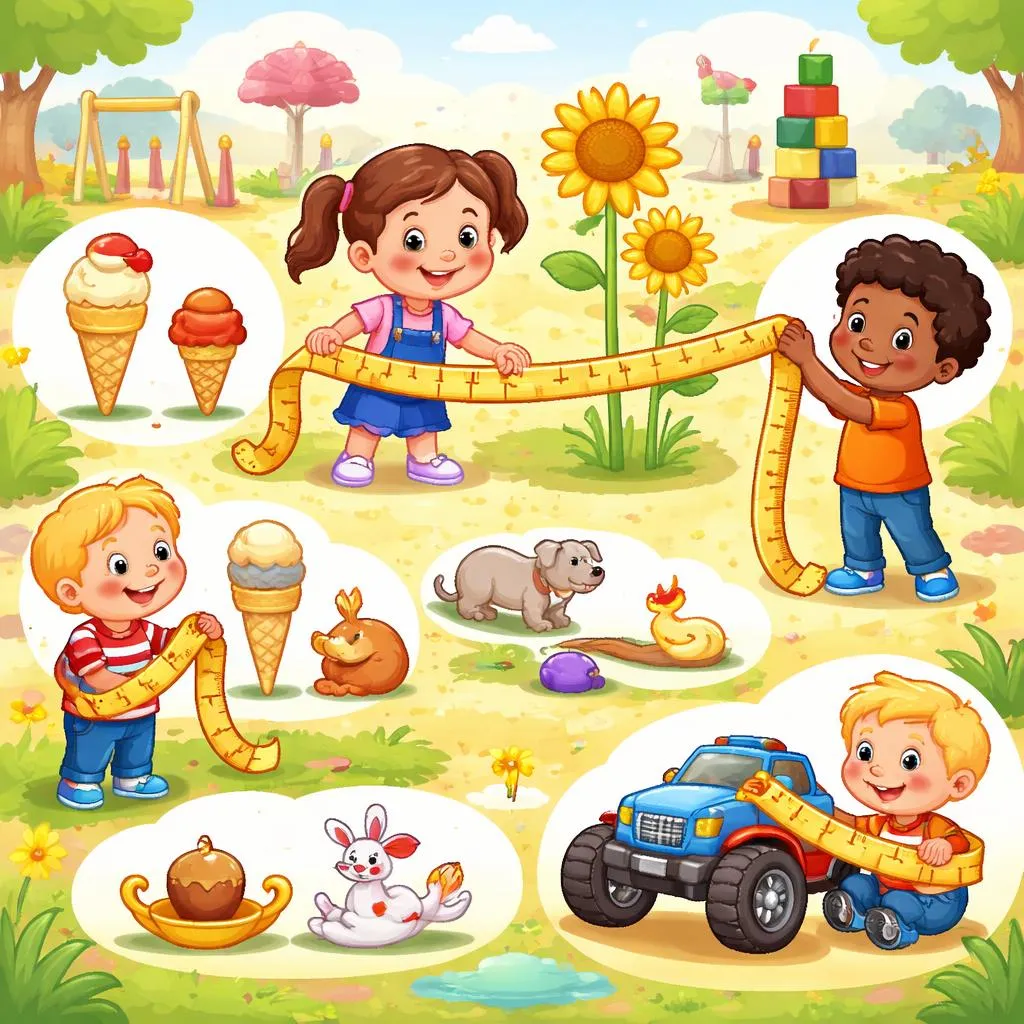

Hello, little word measurer! Do you know about a measuring tape? You can measure how tall you are. You can see who is taller. You can find the tallest person in the room. Your words can measure too! These measuring words are called comparatives and superlatives. They help us compare things. Today, we will measure sixty wonderful things. Our guide is Max the Measuring Monkey. Max loves to measure with words! He will show us comparatives and superlatives at home, the playground, school, and in the jungle. Let's start measuring!
What Are Comparatives and Superlatives? Comparatives and superlatives are your word measuring tape. We use them to compare two or more things. A comparative compares two things. It often ends with "-er" or uses the word "more". It tells us which one has more of a quality. A superlative compares three or more things. It often ends with "-est" or uses the word "most". It tells us which one has the most of a quality. At home, you say "My dad is taller than me." The word "taller" is a comparative. It compares two people. You say "My dad is the tallest in our family." The word "tallest" is a superlative. It compares everyone. At the playground, you say "This slide is faster than that one." At school, you say "This is the easiest game." In nature, Max says "The giraffe has a longer neck. The elephant is the biggest." "Max is the most curious monkey." Learning these must-know comparisons helps you describe the world around you.
Why Do We Need a Word Measuring Tape? Comparatives and superlatives are your comparison tools! They help your ears listen. You can understand how things are different. They help your mouth speak. You can explain your choices clearly. "I want the bigger cookie." They help your eyes read. You will see them in stories that describe characters and settings. They help your hand write. You can write sentences that make clear comparisons. Using your word measuring tape makes you a great observer and describer.
How Can You Spot a Comparison? Spotting comparatives and superlatives is a fun game. Use these simple clues.
For comparatives, look for the word "than" or the ending "-er". Also, look for the word "more" before a longer adjective. "This ball is bigger than that one."
For superlatives, look for the word "the" before the adjective and the ending "-est". Also, look for the word "most" before a longer adjective. "This is the biggest ball of all."
Also, listen for words that compare. Is someone talking about two things or many things?
Look at Max's measurements. "The green leaf is brighter than the brown leaf." Clue: "-er" and "than". It's a comparative! "The blue flower is the brightest in the garden." Clue: "the" and "-est". It's a superlative!
How Do We Use Our Measuring Tape? Using comparatives and superlatives is about following simple rules. For short adjectives (one or two syllables), add "-er" for the comparative and "-est" for the superlative. "tall, taller, tallest". For longer adjectives (two or more syllables that don't sound right with -er/-est), use "more" and "most". "beautiful, more beautiful, most beautiful". Some words are irregular! "good, better, best" and "bad, worse, worst". Max shows us. "I am small. You are smaller. The mouse is the smallest." Start by comparing two things you see. "This book is thicker than that book."
Let's Fix Some Measuring Mistakes. Sometimes our measurements get a little mixed up. Let's fix that. A common mistake is using both "-er" and "more". A child might say "more bigger". Use one or the other: "bigger" or "more big" (but "bigger" is correct). Another mistake is using a superlative for two things. "This is the tallest of the two trees" is not right. Use a comparative: "This is the taller of the two trees." Also, don't forget "the" with superlatives. "She is tallest girl" is wrong. "She is the tallest girl" is right.
Can You Be a Measuring Expert? You are a great expert! Let's play the "Which One?" game. I will say two sentences. You tell me if it is a comparative or superlative. "My dog is fast. Your dog is faster." You say: "Comparative!" "My dog is the fastest in the park." You say: "Superlative!" Great! Here is a harder challenge. Look at three of your toys. Can you say which one is the biggest and which one is bigger than another?
Your Measurement Chart of 60 Must-Know Examples. Ready to see the chart? Here are sixty wonderful comparative and superlative examples. Max the Monkey measured them all. They are grouped by the scene. We have adjectives, their comparative form, and their superlative form in simple sentences.
Home Chart (15). Adjective: big. My house is big. Your house is bigger. Their house is the biggest. Adjective: soft. My blanket is soft. Your blanket is softer. Her blanket is the softest. Adjective: loud. The baby is loud. The dog is louder. The vacuum is the loudest. Adjective: warm. The soup is warm. The bread is warmer. The fire is the warmest. Adjective: happy. I am happy. My sister is happier. My mom is the happiest.
Playground Chart (15). Adjective: high. The swing is high. The slide is higher. The tree is the highest. Adjective: fast. I am fast. You are faster. She is the fastest runner. Adjective: fun. Tag is fun. Hide-and-seek is more fun. The playground is the most fun. Adjective: bouncy. The ball is bouncy. The new ball is bouncier. The superball is the bounciest. Adjective: scary. The big slide is scary. The roller coaster is scarier. The haunted house is the scariest.
School Chart (15). Adjective: smart. I am smart. You are smarter. My teacher is the smartest. Adjective: easy. This puzzle is easy. That one is easier. The game is the easiest. Adjective: neat. My paper is neat. Your paper is neater. Her paper is the neatest. Adjective: important. Reading is important. Writing is more important. Learning is the most important. Adjective: colorful. My drawing is colorful. Your drawing is more colorful. Her drawing is the most colorful.
Nature and Animal Chart (15). Adjective: tall. The bush is tall. The tree is taller. The redwood is the tallest. Adjective: strong. I am strong. The lion is stronger. The elephant is the strongest. Adjective: beautiful. The flower is beautiful. The butterfly is more beautiful. The rainbow is the most beautiful. Adjective: small. The ant is small. The ladybug is smaller. The grain of sand is the smallest. Adjective: fierce. The cat is fierce. The tiger is fiercer. The lion is the fiercest.
More Irregular Examples. Let's look at a few irregular measuring words. They don't follow the "-er" or "-est" rule. Good, better, best: My day is good. Yesterday was better. Today is the best! Bad, worse, worst: My cold is bad. Your cold is worse. His cold is the worst. Far, farther, farthest: I can throw far. You can throw farther. She can throw the farthest. Many, more, most: I have many toys. You have more toys. She has the most toys.
These sixty examples are your must-know comparatives and superlatives. They are your word measuring tape. Practice with them every day.
Measuring Your World with Words. You did it! You are now a comparison expert. You know comparatives compare two things. You know superlatives compare three or more things. You can form them by adding "-er" and "-est" or using "more" and "most". Max the Measuring Monkey is proud of your skills. Now you can measure and describe differences in your world. Your sentences will be more precise and interesting.
Here is what you can learn from our measuring adventure. You will know what comparatives and superlatives are. You will understand when to use each one. You can form simple comparatives and superlatives with common adjectives. You can use them correctly in sentences. You have a measurement chart of sixty key comparative and superlative examples.
Now, let's do some life practice! Your mission is today. Be a word measurer. Compare two things in your room. Then, find the "most" something in your house. Tell your grown-up: "This teddy is bigger than that one. This is the softest pillow in the house." You just used a comparative and a superlative! Keep measuring with your word tape every day. Have fun, little measurer!