
Some songs take children on imaginary journeys through strange houses. The English song: Goosey Goosey Gander does exactly that. This old nursery rhyme follows a wanderer through rooms and up stairs, with a surprising encounter along the way. For families learning English together, this song offers a wonderful way to explore house vocabulary, direction words, and the fun of unexpected twists. Let us discover what makes this traditional rhyme so intriguing for young learners.
What Is the Story Behind This Famous Song?
The English song: Goosey Goosey Gander is a very old nursery rhyme that first appeared in print around 1784. Like many traditional rhymes, it may have hidden meanings that historians still discuss. Some believe it refers to religious conflicts in England's history.
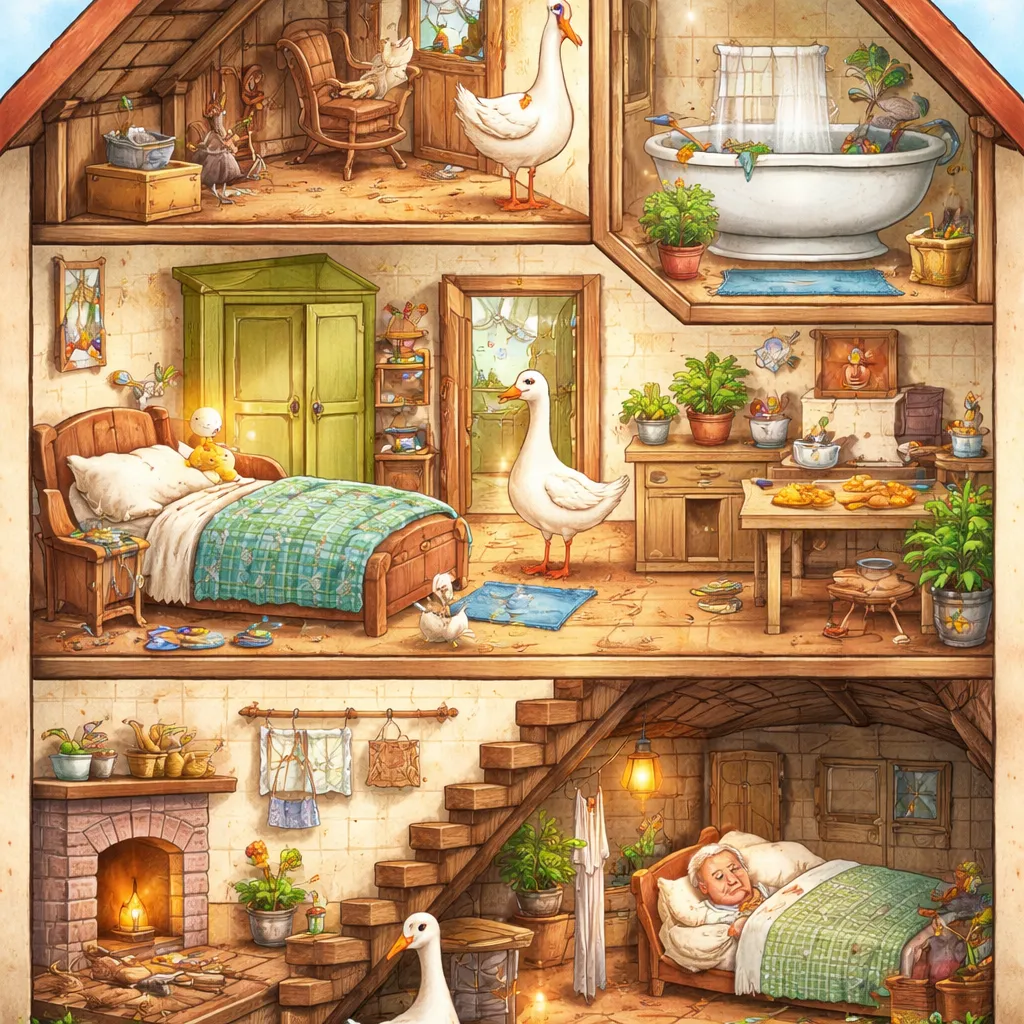
The rhyme follows a person who wanders through a house. They go upstairs and downstairs. They enter a room where they find an old man who refuses to say his prayers. The wanderer takes the man by the left leg and throws him down the stairs.
This ending seems strange and violent to modern readers. Some scholars think the old man represents Catholic priests who hid in secret rooms during times of religious persecution. The wanderer might represent government officials searching for them. Throwing down the stairs could mean arrest or punishment.
For children today, the rhyme works as a simple adventure story. A goose wanders through a house, finds someone, and something happens. The playful language and strong rhythm make it fun to say. The strange ending sparks curiosity and questions.
Understanding this背景 helps families appreciate the rhyme's place in history while using it gently with children.
The Complete Lyrics of the Song
Reading the words helps us understand this curious rhyme. Here are the lyrics to the English song: Goosey Goosey Gander. Let us look at them.
Goosey goosey gander, whither shall I wander? Upstairs and downstairs and in my lady's chamber There I met an old man who wouldn't say his prayers I took him by the left leg and threw him down the stairs
Learning New Words from the Song
The English song: Goosey Goosey Gander introduces many useful words. Let us explore them together.
First, "Goosey goosey gander" uses playful language. A gander is a male goose. The repetition makes it fun to say. Children love the silly sound.
"Whither" is an old word meaning where. Modern English uses "where" instead. But children hear "whither" in songs and stories and learn its meaning from context.
"Shall I wander" means should I travel without a fixed path. Wander means to walk slowly with no special destination. This word paints a picture of aimless exploring.
"Upstairs and downstairs" teach important house words. Upstairs means the upper floor. Downstairs means the lower floor. These words help children navigate and describe houses.
"In my lady's chamber" means in a woman's private room. Chamber is an old word for bedroom. "My lady" shows respect for a woman of high status. This phrase teaches about old-fashioned language and social roles.
"There I met an old man" introduces a character. Met is the past of meet, meaning encountered. This simple sentence structure appears constantly in stories.
"Who wouldn't say his prayers" describes the man's refusal. Prayers are words spoken to God. In old times, everyone was expected to pray. Refusing was shocking.
"I took him by the left leg" specifies which leg. Left and right are important direction words. Children learn them through such phrases.
"Threw him down the stairs" means pushed so he fell. Threw is the past of throw. Stairs are the steps between floors. This action, while violent, teaches useful vocabulary.
Exploring Pronunciation and Rhythm
The English song: Goosey Goosey Gander offers wonderful practice with English rhythm. The bouncy lines make it easy to feel the beat.
Listen to the opening "Goosey goosey gander, whither shall I wander?" The rhythm goes GOOS-ey GOOS-ey GAN-der, WHITH-er shall I WAN-der? The strongest beats fall on "goos", "gan", "whith", and "wan". Clapping along helps children feel this pattern.
The second line "Upstairs and downstairs and in my lady's chamber" has a rolling rhythm. UP-stairs and DOWN-stairs and IN my LA-dy's CHAM-ber. The contrasting words "up" and "down" get strong stress.
The third line "There I met an old man who wouldn't say his prayers" flows naturally. THERE I met an OLD MAN who WOULD-n't say his PRAYERS. The story words get emphasis.
The final line "I took him by the left leg and threw him down the stairs" has strong action words. I TOOK him by the LEFT LEG and THREW him DOWN the STAIRS. Children love the dramatic ending.
Finding Grammar Patterns in the Lyrics
The English song: Goosey Goosey Gander offers useful grammar examples. One pattern appears in the question "whither shall I wander?" This uses "shall" which is similar to "should" or "will". In modern English, we usually say "where should I wander?" But children hear "shall" in songs.
The song uses prepositions of place throughout. "Upstairs", "downstairs", "in", and "by" all show location or direction. These small words are essential for describing where things are.
Another pattern appears with the past tense. "Met", "took", and "threw" tell us this happened before. Stories typically use past tense.
The phrase "who wouldn't say his prayers" uses "wouldn't" which is a contraction of "would not". This teaches modals for refusal. For example, "He wouldn't eat his vegetables" or "She wouldn't go to bed".
The word "by" in "took him by the left leg" shows the specific part used for grabbing. This use of "by" appears often. "Take me by the hand" or "Hold it by the handle".
Fun Learning Activities for the Whole Family
Listening to the English song: Goosey Goosey Gander can inspire many family activities. Here are some ideas to try together.
First, go on a house tour. Walk through your home and name each room in English. "This is the kitchen" or "This is my bedroom". Practice "upstairs" and "downstairs" by moving between floors. If you live in a one-story home, use "upstairs" and "downstairs" imaginatively or when visiting other buildings.
Second, create a house map. Draw a simple floor plan of your home. Label each room. Add stairs between floors. Use the map to practice directions. "Go upstairs to the bathroom" or "Go downstairs to the living room". This builds spatial vocabulary.
Third, act out the rhyme. One person is the goose and wanders through the house. Another is the old man in a "chamber". The goose finds the man and pretends to throw him down the stairs safely with pillows. This dramatic play makes the rhyme memorable.
Creating Printable Materials at Home
Families can make simple learning tools based on the English song: Goosey Goosey Gander. These activities help reinforce new ideas.
Create room flashcards with pictures of different rooms. Kitchen, bedroom, bathroom, living room, dining room. On each card, write the room name and a simple sentence. "We cook in the kitchen" or "We sleep in the bedroom". Review these cards together.
Make a direction word chart. Draw simple pictures showing "up", "down", "left", and "right". Write the words under each. Practice giving directions using these words. "Go up the stairs" or "Turn left at the door". This builds essential direction vocabulary.
Create a fill-in-the-blank page using song lyrics. Remove key words like "gander", "wander", "upstairs", "downstairs", "chamber", "met", "prayers", "left", and "stairs". Leave blanks where those words belong. Listen to the song together and fill in the missing words. This builds listening and spelling skills.
Connecting the Song to Daily Life
The English song: Goosey Goosey Gander connects to daily life through houses and rooms. Every child knows what it feels like to wander through a home, going upstairs and downstairs.
Talk with your children about wandering in your house. Where do they like to go? What do they find in different rooms? Use English to share. "I like to wander to the kitchen for snacks" or "My favorite room is my bedroom". This builds personal connection to vocabulary.
The song also teaches about prayers and routines. The old man wouldn't say his prayers. In many families, bedtime includes prayers or grateful thoughts. Use English to talk about your routines. "We say thank you before dinner" or "We talk about our day before sleep".
Parents can use the song to discuss kindness. Throwing someone down the stairs is not kind, even in a song. Talk about better ways to handle disagreements. "If someone won't do something, we can talk, not push" or "We use words to solve problems".
Educational Games to Play Together
Games make learning with the English song: Goosey Goosey Gander exciting. Here are some simple games to try.
Play the direction game. Give each other directions using words from the song. "Go upstairs and find something blue" or "Go downstairs and touch the door". Follow the directions and describe what you did. "I went upstairs and found a blue pillow". This builds listening and following directions.
Try the room guessing game. One person describes a room without naming it. "In this room, we cook food and wash dishes." Others guess "Kitchen!" Take turns describing rooms. This builds descriptive vocabulary.
Play the left and right game. Call out commands using left and right. "Lift your left hand" or "Step to the right". Do actions together. This builds direction vocabulary through movement.
Why This Song Helps English Learning
The English song: Goosey Goosey Gander helps learners in special ways. The house vocabulary matches what children need every day. Words like upstairs, downstairs, room, and stairs help them navigate and describe their world.
The direction words left and right are essential for giving and understanding instructions. Learning them through song makes them stick.
The playful language like "goosey goosey gander" builds phonological awareness. Children practice sounds in a fun, stress-free way.
The story structure helps comprehension. Children follow the wanderer's journey and remember words through the narrative.
Making Music Part of Your Routine
Families can make songs a regular part of English time. Choose one song each week to explore together. Listen during quiet moments or while moving through the house.
The English song: Goosey Goosey Gander works perfectly for moving between rooms. Sing it while going upstairs or downstairs. Let the song accompany your family's wandering.
Remember that language learning thrives in everyday moments. When children associate English with wandering through their own homes, they learn naturally. They understand that words connect to real places they know.
Keep singing, keep wandering, and keep exploring the rooms of English together. In the great house of language learning, every new word is another room waiting to be discovered.