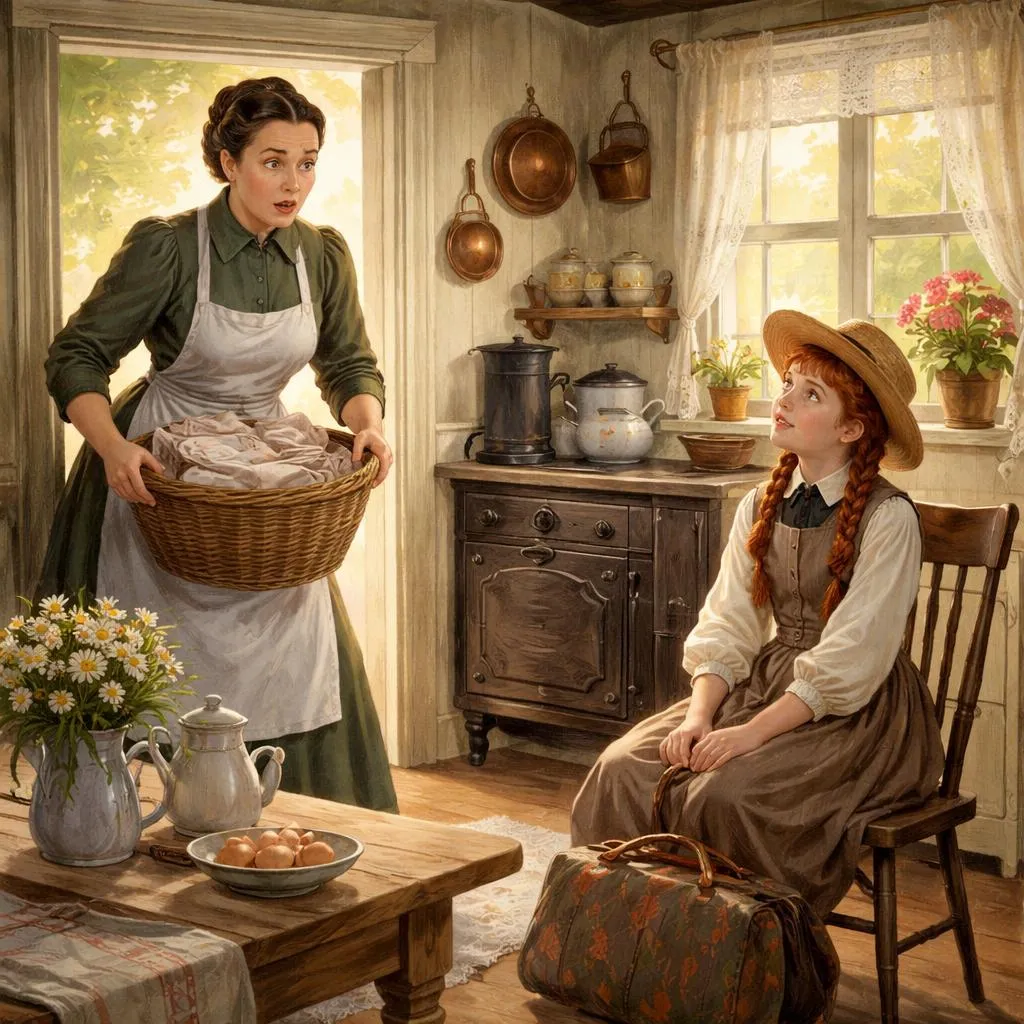

Marilla stepped forward quickly as Matthew opened the door. But when her eyes landed on the odd little figure in the stiff, plain dress, with long red braids and bright, eager eyes, she stopped in surprise.
“Matthew Cuthbert, who is that?” she exclaimed. “Where is the boy?”
“There wasn’t any boy,” Matthew said sadly. “There was only HER.”
He nodded toward the child, realizing he had never even asked her name.
“No boy! But there MUST have been a boy,” insisted Marilla. “We sent word to Mrs. Spencer to bring a boy.”
“Well, she didn’t. She brought HER. I asked the station-master. And I had to bring her home. She couldn’t be left there, no matter what the mistake was.”
“Well, this is quite a problem!” said Marilla.
Throughout this conversation, the child remained silent, her eyes shifting between the two adults, her lively expression fading. Suddenly, she seemed to understand what had been said. Dropping her precious carpet-bag, she stepped forward and clasped her hands.
“You don’t want me!” she cried. “You don’t want me because I’m not a boy! I might have expected it. Nobody ever wanted me. I should have known it was all too good to last. I should have known nobody really wanted me. Oh, what will I do? I’m going to cry!”
And cry she did. Sitting down on a chair by the table, throwing her arms out on it and burying her face, she sobbed loudly. Marilla and Matthew looked at each other helplessly. Neither knew what to say or do. Finally, Marilla spoke up.
“Well, well, there’s no need to cry so much.”
“Yes, there IS need!” The child lifted her tear-streaked face, lips trembling. “YOU would cry too if you were an orphan and had come to a place you thought was home and found they didn’t want you because you weren’t a boy. Oh, this is the most TRAGIC thing that ever happened to me!”
Marilla’s stern face softened slightly, as if a rusty smile was trying to appear.
“Well, don’t cry anymore. We’re not going to send you away tonight. You’ll have to stay here until we figure this out. What’s your name?”
The child hesitated.
“Will you please call me Cordelia?” she said eagerly.
“Call you Cordelia? Is that your name?”
“No, it’s not exactly my name, but I would love to be called Cordelia. It’s such a perfectly elegant name.”
“I don’t understand. If Cordelia isn’t your name, what is?”
“Anne Shirley,” the girl said reluctantly, “but please call me Cordelia. It can’t matter much to you what you call me if I’m only here a little while, can it? And Anne is such an unromantic name.”
“Unromantic fiddlesticks!” said Marilla. “Anne is a good, plain, sensible name. You have no need to be ashamed of it.”
“Oh, I’m not ashamed,” Anne explained, “only I like Cordelia better. I always imagined my name was Cordelia—at least lately. When I was younger, I thought it was Geraldine, but I like Cordelia better now. But if you call me Anne, please spell it with an E.”
“What difference does spelling make?” asked Marilla, smiling faintly as she picked up the teapot.
“Oh, it makes SUCH a difference. It LOOKS nicer. When you hear a name, can’t you see it in your mind, just as if it was printed? I can; and A-n-n looks dreadful, but A-n-n-e looks much more distinguished. If you call me Anne with an E, I’ll try to accept not being called Cordelia.”
“Very well, then, Anne with an E, can you tell us how this mistake happened? We sent word to Mrs. Spencer to bring a boy. Were there no boys at the asylum?”
“Oh yes, there were plenty. But Mrs. Spencer said you wanted a girl about eleven years old. And the matron thought I would do. You don’t know how happy I was. I couldn’t sleep all night for joy. Oh,” she added, turning to Matthew, “why didn’t you tell me at the station you didn’t want me and leave me there? If I hadn’t seen the White Way of Delight and the Lake of Shining Waters, it wouldn’t be so hard.”
“What does she mean?” asked Marilla, looking at Matthew.
“She’s just referring to some conversation we had on the road,” Matthew said quickly. “I’m going to put the mare away, Marilla. Have tea ready when I come back.”
“Did Mrs. Spencer bring anyone else?” Marilla asked after Matthew left.
“She brought Lily Jones for herself. Lily is only five and very pretty with nut-brown hair. If I were very pretty and had nut-brown hair, would you keep me?”
“No. We want a boy to help Matthew on the farm. A girl wouldn’t be any use. Take off your hat. I’ll put it and your bag on the hall table.”
Anne meekly took off her hat. Matthew returned, and they sat down to supper. But Anne could not eat. She nibbled at bread and butter and pecked at crab-apple preserve but made no real progress.
“You’re not eating,” Marilla said sharply.
Anne sighed. “I can’t. I’m in the depths of despair. Can you eat when you’re in the depths of despair?”
“I’ve never been in the depths of despair,” Marilla said.
“Weren’t you? Well, did you ever try to imagine you were?”
“No.”
“Then you can’t understand. It’s very uncomfortable. When you try to eat, a lump rises in your throat and you can’t swallow anything, not even chocolate caramel. I had one two years ago and it was delicious. I often dream about having many, but I always wake up just as I’m about to eat them. I hope you won’t be offended that I can’t eat. Everything is very nice, but I just can’t.”
“I guess she’s tired,” Matthew said. “Best put her to bed, Marilla.”
Marilla wondered where to put Anne. She had prepared a couch for the boy in the kitchen chamber, but it did not seem right for a girl. The spare room was out of the question. So only the east gable room remained. Marilla lit a candle and told Anne to follow, which she did, taking her hat and carpet-bag. The hall was very clean; the little gable chamber was even cleaner.
Marilla set the candle on a small table and turned down the bedclothes.
“Do you have a nightgown?” she asked.
Anne nodded. “Yes, two. The matron made them for me. They’re very skimpy. There’s never enough in an asylum, so things are always skimpy—at least in a poor one like ours. I hate skimpy nightgowns. But you can dream just as well in them as in lovely trailing ones with frills around the neck—that’s one consolation.”
“Well, undress quickly and go to bed. I’ll come back for the candle. I don’t trust you to put it out yourself—you might set the place on fire.”
When Marilla left, Anne looked around wistfully. The whitewashed walls were painfully bare, almost aching in their emptiness. The floor was bare except for a round braided mat she had never seen before. In one corner was a high, old-fashioned bed with four dark posts. In another corner was the small table with a red velvet pin-cushion and a tiny mirror above. Between table and bed was a window with an icy white muslin frill; opposite was the washstand. The room’s rigid simplicity sent a shiver down Anne’s spine. With a sob, she quickly took off her clothes, put on the skimpy nightgown, and dove into bed, burying her face in the pillow and pulling the covers over her head. When Marilla returned for the candle, the scattered clothes and the messy bed were the only signs of Anne’s presence.
Marilla picked up the clothes, placed them neatly on a yellow chair, and took the candle to the bed.
“Good night,” she said awkwardly but kindly.
Anne’s pale face and big eyes appeared over the covers suddenly.
“How can you call it a GOOD night when you know it must be the worst night I’ve ever had?” she said reproachfully.
Then she disappeared under the covers.
Marilla went downstairs to wash the dishes. Matthew was smoking—a rare sign of worry. Marilla usually disapproved of smoking, but sometimes she allowed it, understanding men needed outlets for their feelings.
“Well, this is a fine mess,” she said angrily. “This is what happens when you send word instead of coming yourself. The Spencers must have misunderstood. One of us will have to go see Mrs. Spencer tomorrow. This girl will have to be sent back.”
“Yes, I suppose so,” Matthew said reluctantly.
“You SUPPOSE so? Don’t you know?”
“Well, she’s a nice little thing, Marilla. It’s a pity to send her back when she’s so eager to stay.”
“Matthew Cuthbert, you don’t mean to say you want to keep her!”
Marilla’s surprise was as great as if Matthew had said he wanted to stand on his head.
“Well, no, not exactly,” Matthew stammered. “I suppose we can hardly be expected to keep her.”
“I should say not. What good would she be to us?”
“We might be some good to her,” Matthew said suddenly.
“Matthew Cuthbert, I believe that child has bewitched you! I can see plainly you want to keep her.”
“Well, she’s an interesting little thing,” Matthew insisted. “You should have heard her talk coming from the station.”
“Oh, she can talk fast enough. I saw that at once. It’s nothing in her favor. I don’t like children who have so much to say. I don’t want an orphan girl, and if I did, she isn’t the kind I’d choose. There’s something I don’t understand about her. No, she has to be sent back.”
“I could hire a French boy to help me,” Matthew said, “and she’d be company for you.”
“I’m not suffering for company,” Marilla said sharply. “And I’m not keeping her.”
“Well, it’s as you say, Marilla,” Matthew said, putting away his pipe. “I’m going to bed.”
Matthew went to bed, and after putting away dishes, Marilla went to bed frowning. Upstairs, in the east gable, a lonely, heart-hungry child cried herself to sleep.
Background and Author Introduction
This excerpt is from Anne of Green Gables, a classic novel written by Canadian author Lucy Maud Montgomery in 1908. The story follows Anne Shirley, an imaginative and talkative orphan girl mistakenly sent to live with Marilla and Matthew Cuthbert, siblings who had intended to adopt a boy to help with their farm. Set in the fictional village of Avonlea on Prince Edward Island, the novel explores Anne’s adventures, struggles, and growth as she finds a place to belong.
Lucy Maud Montgomery was born in 1874 and grew up on Prince Edward Island, drawing inspiration from her surroundings and childhood experiences. Anne of Green Gables became an international success and remains beloved worldwide for its warmth, humor, and vivid characters.
Detailed Interpretation and Significance
This opening scene introduces the central conflict: Anne is an unexpected arrival, a girl instead of the boy the Cuthberts requested. It reveals themes of misunderstanding, belonging, and identity. Anne’s imaginative nature and sensitivity shine through her fanciful names and emotional response to rejection.
Marilla and Matthew represent the practical, reserved world Anne must navigate. Their initial reluctance contrasts with Anne’s lively spirit, setting the stage for growth and mutual transformation.
The scene also highlights the loneliness and vulnerability of orphans, a recurring theme in children’s literature, inviting readers to empathize with Anne’s plight.
Lessons and Insights for Students
-
Acceptance and Adaptability: Anne’s arrival disrupts plans, but the characters must learn to accept unexpected changes. This teaches students the importance of flexibility and open-mindedness in life.
-
Empathy and Kindness: Anne’s feelings of rejection remind us to be sensitive to others’ emotions. Students can learn to be compassionate, especially toward those who feel out of place.
-
Imagination and Identity: Anne’s desire to rename herself “Cordelia” shows the power of imagination in shaping identity. Students can explore how creativity helps express individuality and cope with difficulties.
-
Communication Skills: Anne’s talkative nature is both a charm and a challenge. Students can reflect on balancing self-expression with listening and understanding others.
Applying These Lessons in Daily Life
-
In School: Embrace new situations or classmates who seem different. Be open to change and new friendships.
-
In Social Settings: Show kindness to those who might feel lonely or rejected. Listen and offer support.
-
In Personal Growth: Use creativity and imagination to solve problems and express yourself authentically.
-
In Family Life: Understand that misunderstandings happen, but patience and communication can build stronger bonds.
Cultivating Positive Traits from the Story
-
Resilience: Anne’s ability to endure rejection and remain hopeful encourages students to develop emotional strength.
-
Curiosity: Her eagerness to learn and explore new environments inspires lifelong learning.
-
Optimism: Despite hardships, Anne’s hopeful outlook teaches the value of seeing the good in difficult situations.
-
Respect for Others: Marilla’s eventual softening shows how understanding can grow with time, encouraging respect and forgiveness.
Anne of Green Gables remains a timeless story that not only entertains but also offers valuable life lessons. By reading and reflecting on Anne’s journey, students can gain insights into empathy, resilience, and the beauty of embracing one’s true self.
