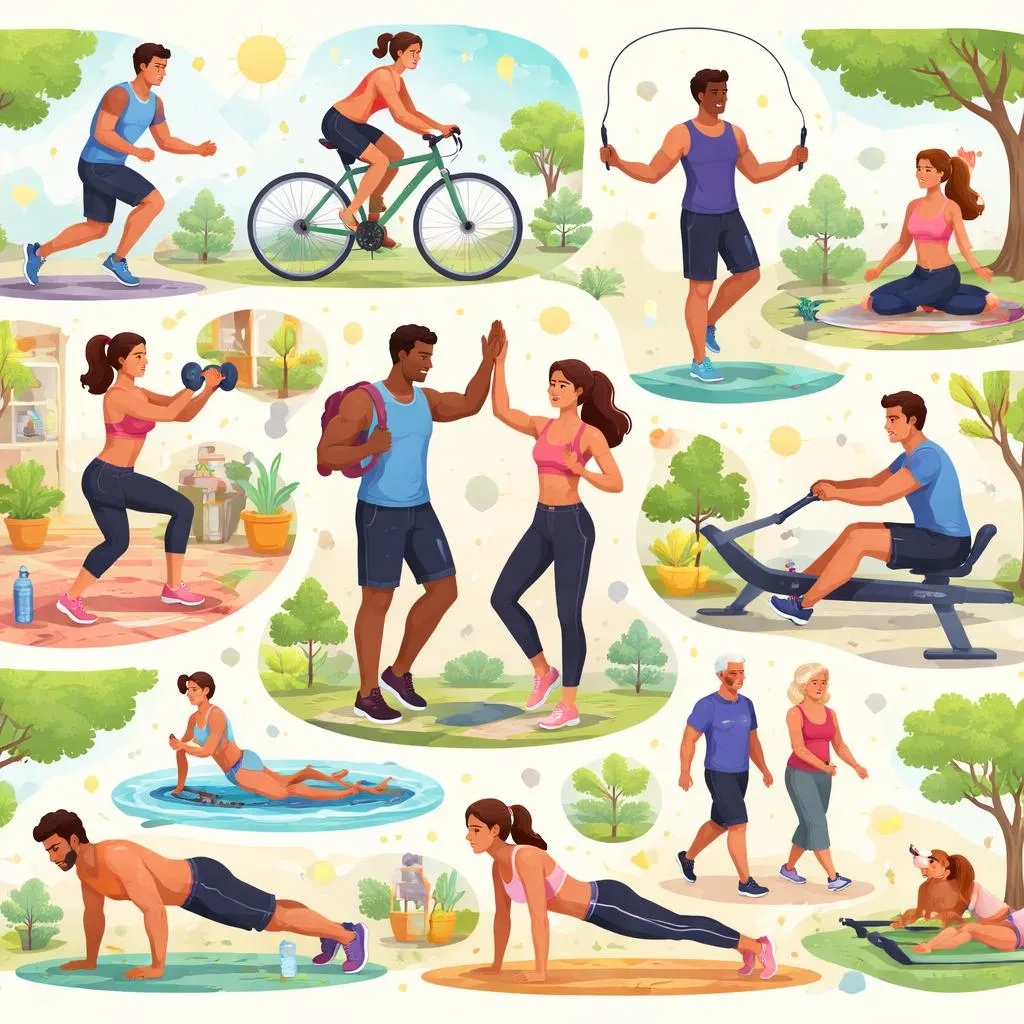

You run, jump, stretch, and play. Your heart beats faster. You feel strong.
That is exercise. Today we learn four words.
“Exercise,” “exerciser,” “exercising,” and “exercised.”
Each word shares the idea of moving to stay healthy. Each does a different job.
Parents and children can learn these words together. They help with fitness.
What Does “Same Word, Different Forms” Mean?
One action takes different shapes. The action here is physical activity.
“Exercise” is a verb. “Please exercise every day.” Action.
“Exercise” is also a noun. “Running is good exercise.” Activity.
“Exerciser” is a noun. “A regular exerciser is healthy.” Person.
“Exercising” is a noun or verb part. “Exercising keeps you fit.” Activity. “I am exercising now.” Verb part.
“Exercised” is a past tense verb or adjective. “She exercised yesterday.” Past action. “The exercised muscle.” Describes.
Same root. Different endings. Different jobs. The movement stays.
Personal Pronouns Change Their Form
Pronouns change for grammar. “I” becomes “me.” “We” becomes “us.”
Our words change for role and time. “I exercise in the morning.” Present.
“The exerciser runs.” Person. “Exercising is fun.” Activity.
“We exercised last night.” Past.
Pronouns help us speak faster. Word families help us talk about fitness.
When children know these four words, they describe healthy habits.
From Verb to Noun to Adjective to Adverb – One Family, Many Words
“Exercise” works as a verb. “Exercise your brain with puzzles.” Action.
“Exercise” also works as a noun. “Jumping jacks are a good exercise.” Activity.
“Exerciser” is a noun. “The exerciser wore blue leggings.” Person.
“Exercising” is a noun. “Exercising daily builds strength.” Activity.
“Exercised” is a past verb. “He exercised his legs at the gym.” Past action.
“Exercised” is also an adjective. “The exercised muscles felt sore.” Worked.
We have an adverb “exercisingly” (rare). Skip.
Six meanings. Very useful for health class.
One Root, Many Roles – How Words Grow from Actions to Qualities
The root “exercise” comes from Latin “exercere,” meaning to keep busy or train. “Ex-” out + “arcere” to restrain.
From that root, we add “-er” to name the person who exercises.
We add “-ing” to name the activity.
We add “-ed” for past tense or to make an adjective meaning “trained.”
Help your child see this pattern. Exercise is the action or activity. Exerciser is the person. Exercising is the process. Exercised means already worked.
Same Meaning, Different Jobs – Is It a Verb or a Noun?
Look at “exercise” in a sentence. Ask: Is it an action? Or is it an activity?
“You should exercise every day.” Action. Verb.
“Swimming is a great exercise.” Activity. Noun.
Same word. Two jobs. Context tells you.
Now look at “exerciser.” Always a noun. “A regular exerciser feels good.”
“Exercising” is a noun or verb part. “Exercising is healthy.” Noun. “I am exercising.” Verb part.
“Exercised” can be a past verb or adjective. “She exercised her dog.” Past verb. “The exercised limb.” Adjective.
Teach children to look at the endings. “-er” noun (person). “-ing” noun or verb part. “-ed” past verb or adjective.
“Exercise” alone can be verb or noun.
Adjectives and Adverbs – When Do We Add -ly?
We do not add “-ly” to these words. No “exercisely.” No “exerciserly.” No “exercisingly.”
If you want to describe how someone exercises, use a separate adverb. “She exercises regularly.” “He exercised vigorously.”
This family stays simple. Focus on the verb and nouns.
Watch Out for Tricky Spelling Changes (Double Letters, y to i, and More)
Spelling here is very regular. No double letters. No y to i changes.
“Exercise” adds “-er” to make “exerciser.” Keep the “e”? “Exercise” ends with “e.” Drop the “e” for “-er”? Yes. Exercis + er = exerciser.
“Exercise” adds “-ing” to make “exercising.” Drop the “e.” Exercis + ing = exercising.
“Exercise” adds “-ed” to make “exercised.” Drop the “e.” Exercis + ed = exercised.
So the rule: Drop the final “e” for all endings.
Practice with your child. Write “exercise.” Drop the “e.” Add “er.” You get “exerciser.” Add “ing.” You get “exercising.” Add “ed.” You get “exercised.”
No double letters.
Let’s Practice – Can You Choose the Right Form?
Try these sentences. Fill in the blank with exercise, exerciser, exercising, or exercised.
Please _____ for at least twenty minutes a day. (action verb)
A regular _____ is less likely to get sick. (person)
_____ is important for a healthy heart. (activity)
He _____ his arms with push-ups yesterday. (past tense verb)
Yoga is a relaxing _____. (noun, activity)
The _____ muscles needed a rest day. (adjective)
She is _____ her legs on the treadmill. (verb part with is)
Every _____ should warm up before working out. (person)
Answers: 1 exercise, 2 exerciser, 3 Exercising, 4 exercised, 5 exercise, 6 exercised, 7 exercising, 8 exerciser.
Number 3 starts with a capital letter because it begins the sentence.
Number 5 uses “exercise” as a noun meaning a type of activity.
Tips for Parents – Help Your Child Learn Word Families in a Fun Way
Exercise together. “Let us exercise with a silly dance.”
Call your child an exerciser. “You are a strong exerciser!”
Talk about exercising as fun. “Exercising is playing with energy.”
Use past tense. “Yesterday, you exercised by climbing the stairs.”
Play a game. You name a movement. Your child does it. “Jumping jacks!”
Draw a person stretching. Label “exerciser” and “exercising.”
Read a book about movement. “From Head to Toe” by Eric Carle.
Do not correct every mistake. If your child says “exercise” for “exerciser,” gently say “You are the exerciser. Exercise is what you do.”
Celebrate when your child uses “exercised” as an adjective. “My exercised legs are tired.”
Explain that “exercise” can be for the brain too. “Reading exercises your mind.”
Tomorrow you will exercise your legs by walking. You will be an exerciser. You will enjoy exercising with music. You will have exercised your whole body.
Your child might say “I exercised all my energy today!” You will nod.
Keep exercising. Keep being an exerciser. Keep loving exercising. Keep celebrating exercised effort.
Your child will grow in language and in health. Movement is medicine. Words help us move.