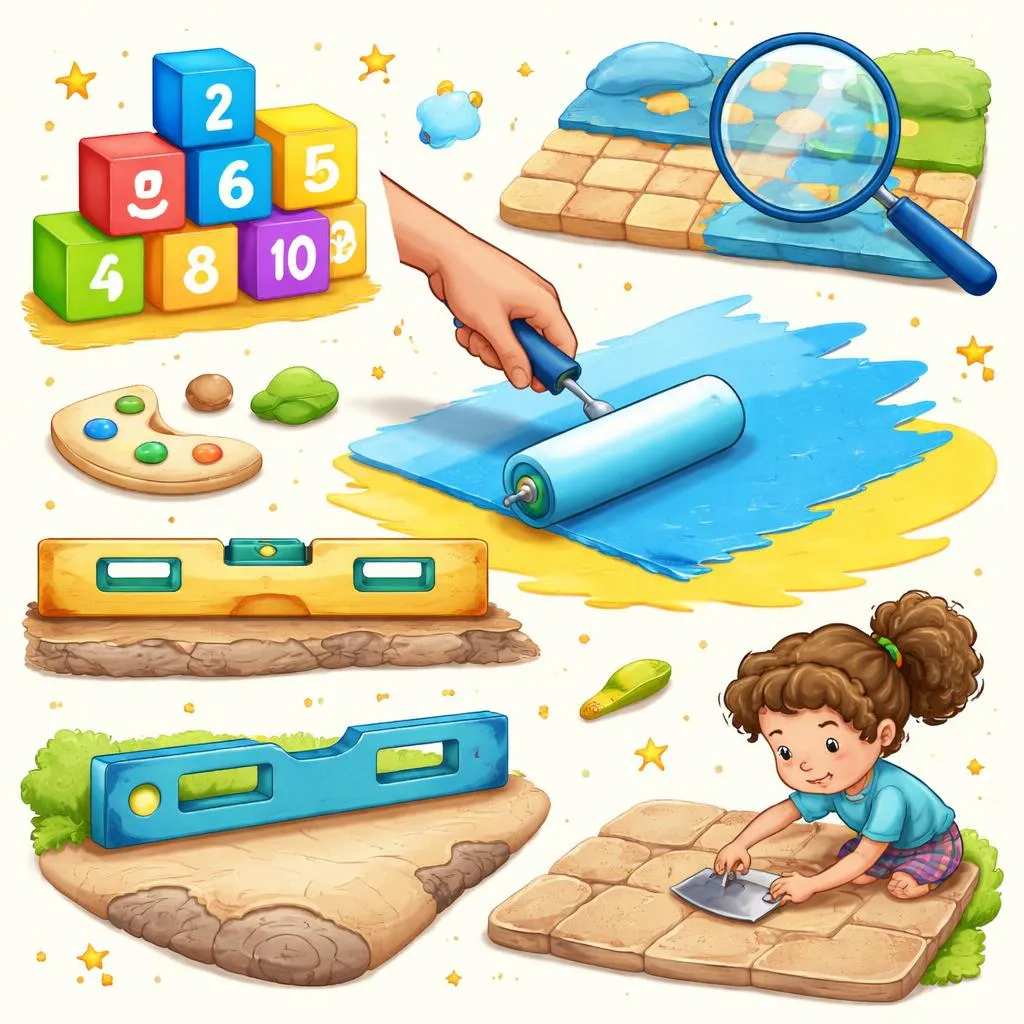

A number split into two equal parts. A surface that is flat. A race that is fair.
These are even. Today we learn four words.
“Even,” “evenly,” “evenness,” and “uneven.”
Each word shares the idea of level or equal. Each does a different job.
Parents and children can learn these words together. They help with counting.
What Does “Same Word, Different Forms” Mean?
One idea takes different shapes. The idea here is flatness or equality.
“Even” is an adjective. “The floor is even.” Flat.
“Even” also means an even number. “Two, four, and six are even.” Divisible by two.
“Evenly” is an adverb. “Spread the frosting evenly.” Describes a verb.
“Evenness” is a noun. “The evenness of the tabletop helped the cups not spill.” Quality.
“Uneven” is an adjective. “The road is uneven.” Not flat.
Same root. Different endings. Different jobs. The flatness stays.
Personal Pronouns Change Their Form
Pronouns change for grammar. “I” becomes “me.” “We” becomes “us.”
Our words change for role and description. “The floor is even.” Describes.
“Spread it evenly.” How. “The evenness matters.” Quality.
“The sidewalk is uneven.” Opposite.
Pronouns help us speak faster. Word families help us talk about math and surfaces.
When children know these four words, they describe balance.
From Verb to Noun to Adjective to Adverb – One Family, Many Words
“Even” works as an adjective. “The scores were even.” Tied.
“Even” also works as an adverb. “He ran even faster.” (Not a keyword.)
“Evenly” is an adverb. “Cut the cake evenly.” Describes.
“Evenness” is a noun. “The evenness of the dough made rolling easy.” Quality.
“Uneven” is an adjective. “Uneven bars are an Olympic event.” Not level.
We have no other forms.
Four members. Essential for math and cooking.
One Root, Many Roles – How Words Grow from Actions to Qualities
The root “even” comes from Old English “efen,” meaning level or equal.
From that root, we add “-ly” to make an adverb. “Evenly” means in an even manner.
We add “-ness” to make a noun. “Evenness” means the state of being even.
We add “un-” as a prefix to make the opposite adjective. “Uneven” means not even.
Help your child see this pattern. Even is the quality. Evenly tells how. Evenness is the state. Uneven is the opposite.
Same Meaning, Different Jobs – Is It a Verb or a Noun?
Look at “even.” Always an adjective here. “The floor is even.”
“Evenly” is always an adverb. “Spread the butter evenly.”
“Evenness” is always a noun. “The evenness of the path was good for biking.”
“Uneven” is always an adjective. “The ground is uneven.”
No word plays two jobs. Each has one clear role.
Teach children that “even” can also be a verb (“even out the surface”) but that is less common.
Adjectives and Adverbs – When Do We Add -ly?
We add “-ly” to “even” to make “evenly.” This is the rule.
Adjective + ly = adverb. “Even” + “ly” = “evenly.”
Example: “The line is even.” Adjective. “She drew it evenly.” Adverb.
We do not add “-ly” to “evenness” or “uneven.”
For children, “evenly” is very useful for sharing.
Watch Out for Tricky Spelling Changes (Double Letters, y to i, and More)
Spelling here is very regular. No double letters. No y to i changes.
“Even” adds “-ly” to make “evenly.” Just add.
“Even” adds “-ness” to make “evenness.” Just add.
“Un-” adds to “even” to make “uneven.” Un + even = uneven.
No dropping. No vowel changes. Very clean.
Practice with your child. Write “even.” Add “ly.” You get “evenly.” Add “ness.” You get “evenness.” Put “un” in front of “even.” You get “uneven.”
No tricks.
Let’s Practice – Can You Choose the Right Form?
Try these sentences. Fill in the blank with even, evenly, evenness, or uneven.
Two, four, and six are _____ numbers. (adjective)
Please space the chairs _____. (adverb)
The _____ of the floor was important for the dance. (noun)
The sidewalk was _____, with many cracks. (adjective, not flat)
The scores were _____ at the end of the game. (adjective, tied)
Spread the glue _____ across the paper. (adverb)
The _____ of the batter helped the cake bake evenly. (noun)
The path was _____. Watch your step. (adjective)
Answers: 1 even, 2 evenly, 3 evenness, 4 uneven, 5 even, 6 evenly, 7 evenness, 8 uneven.
Number 4 and 8 use “uneven” as an adjective meaning “not level.”
Number 2 and 6 use “evenly” as an adverb.
Tips for Parents – Help Your Child Learn Word Families in a Fun Way
Point to an even number. “Four is even because you can split it into two twos.”
Spread jam evenly on toast. “Let us spread this evenly.”
Notice evenness. “The evenness of this table means the blocks won’t roll off.”
Find uneven ground. “This path is uneven. Walk carefully.”
Play a game. You name a number. Your child says “even” or “odd.”
“7.” “Odd.” “8.” “Even.”
Draw a wavy line (uneven) and a flat line (even).
Read a book about fairness. “A Fair Bear Share” teaches even sharing.
Do not correct every mistake. If your child says “evenly” for “even,” gently say “The number is even. You share it evenly.”
Celebrate when your child uses “evenness.” That word is precise.
Explain that “even” can mean “fair.” “An even trade is fair.”
Tomorrow you will see even numbers on a clock. You will spread butter evenly. You will check the evenness of a shelf. You will avoid an uneven sidewalk.
Your child might say “My two cookies are even.” You will smile.
Keep counting even numbers. Keep spreading evenly. Keep appreciating evenness. Keep fixing uneven surfaces.
Your child will grow in language and in spatial awareness. Even is balanced. Words help us find it.