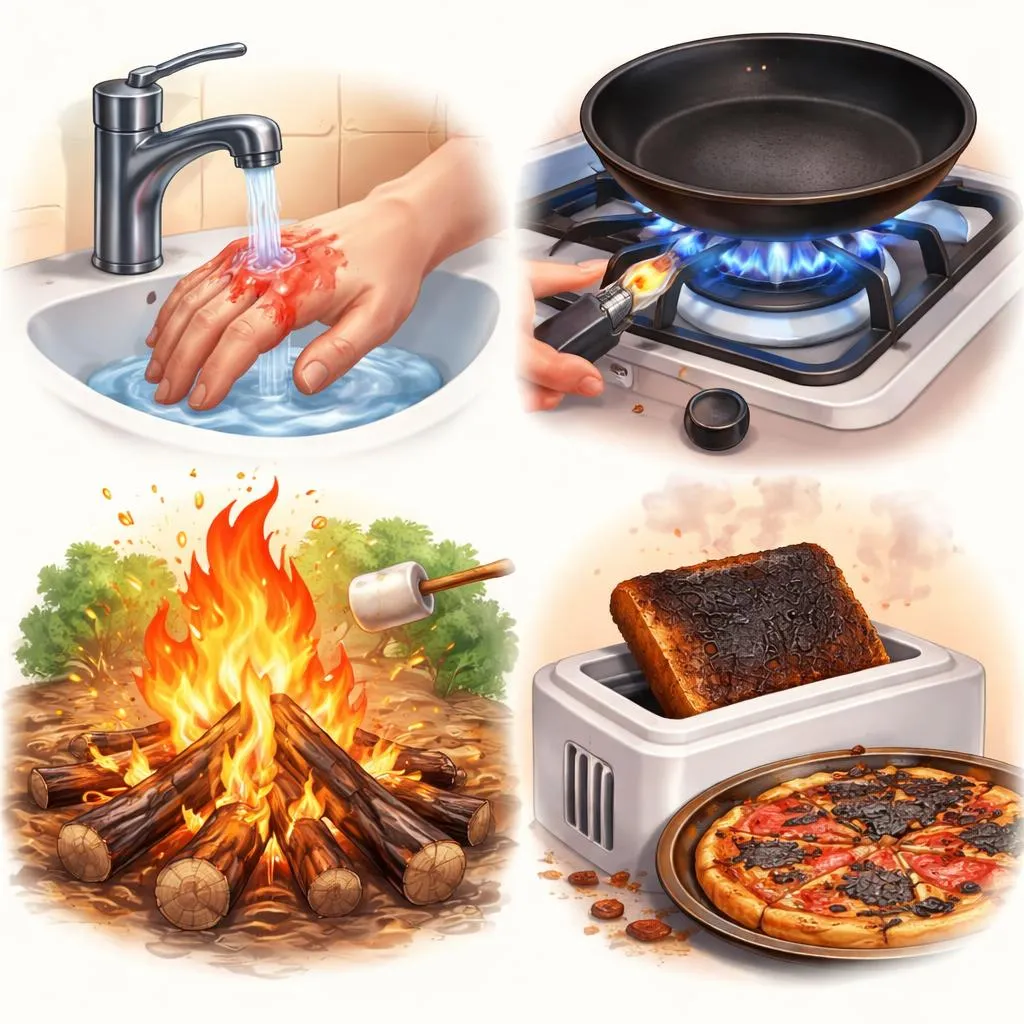

Fire gives heat. Fire gives light. Fire also hurts.
We need words to talk about fire and heat. Today we learn four words.
“Burn,” “burner,” “burning,” and “burnt.”
Each word shares the idea of fire or heat damage. Each does a different job.
Parents and children can learn these words together. They help with safety talks.
What Does “Same Word, Different Forms” Mean?
One action leaves different traces. The action here is being on fire or getting heat damage.
“Burn” is a verb. “Paper will burn in the fire.” Action.
“Burn” is also a noun. “The candle left a burn on the table.” Thing.
“Burner” is a noun. “The stove burner glows red.” Thing that produces heat.
“Burning” is an adjective or noun. “A burning candle is hot.” Describes. “The burning of wood creates smoke.” Activity.
“Burnt” is an adjective or past verb. “Burnt toast tastes bad.” Describes. “She burnt her finger.” Past action.
Same root. Different endings. Different jobs. The heat stays the same.
Personal Pronouns Change Their Form
Pronouns change for grammar. “I” becomes “me.” “They” becomes “them.”
Our words change for time and role. “I burn the paper.” Present action.
“The burner is hot.” Thing. “Burning wood smells good.” Activity.
“She burnt the cookies.” Past action. “The burnt pan is ruined.” Describes.
Pronouns help us speak faster. Word families help us talk about heat and danger clearly.
When children know these words, they can describe what happened.
From Verb to Noun to Adjective to Adverb – One Family, Many Words
“Burn” works as a verb. “Logs burn in the fireplace.” Action.
“Burn” also works as a noun. “He has a burn on his hand.” Injury.
“Burner” is a noun. “The back burner of the stove is broken.” Appliance part.
“Burning” is an adjective or noun. “Burning leaves smell smoky.” Adjective. “The burning of fossil fuels causes pollution.” Noun.
“Burnt” is an adjective or past verb. “Burnt food has black edges.” Adjective. “I burnt my tongue on hot soup.” Past verb.
We have no common adverb. “Burningly” is very rare. Skip it.
Five useful members. Each one helps with safety and cooking talk.
One Root, Many Roles – How Words Grow from Actions to Qualities
The root “burn” comes from Old English “beornan” and “b?rnan.” One was intransitive. The other was transitive.
Long ago, people burned wood for warmth. They burned fields for farming. They accidentally burned themselves.
From that root, we add “-er” to name the thing that burns. A burner produces heat.
We add “-ing” to name the activity or describe something active.
“Burnt” is the past form. English sometimes uses “burned” too. “Burnt” is more common as an adjective. “Burned” is more common as a past verb. But both work.
Help your child see this. Fire burns. A burner makes fire. Burning is the action. Burnt is the result.
Same Meaning, Different Jobs – Is It a Verb or a Noun?
Look at “burn” in a sentence. Ask: Is it an action? Or is it a mark?
“Fire will burn the wood.” Action. Verb.
“The burn on the table is small.” Mark. Noun.
Same word. Two jobs. Context tells you.
Now look at “burner.” Always a noun. “Turn off the burner after cooking.”
“Burning” can be adjective or noun. “A burning house is dangerous.” Adjective. “The burning of paper is fast.” Noun.
“Burnt” is adjective or past verb. “Burnt rice sticks to the pot.” Adjective. “He burnt the toast.” Past verb.
Teach children to look at the word’s job in the sentence.
Adjectives and Adverbs – When Do We Add -ly?
We can add “-ly” to “burning.” It becomes “burningly.” Very rare. “The sun was burningly hot.” Poetic but not common.
We do not add “-ly” to “burn,” “burner,” or “burnt.”
For children, skip adverbs. Focus on the verb, noun, and adjective forms.
“Burn” for action. “Burner” for the thing. “Burning” for active description. “Burnt” for finished result.
That is plenty for daily use.
Watch Out for Tricky Spelling Changes (Double Letters, y to i, and More)
Spelling has one small choice. British and American English differ.
“Burn” adds “-er” to make “burner.” Just add.
“Burn” adds “-ing” to make “burning.” Just add. No double letters.
For the past tense, you have two choices. “Burned” or “burnt.” Both are correct.
“Burned” is more common in American English. “Burnt” is more common in British English. Also “burnt” is the usual adjective.
“The toast is burnt.” Adjective. “He burned the toast.” Past verb.
No double letters. No y to i. Just this small choice.
Teach your child both forms. Explain that both are fine. Pick one and stay consistent.
Let’s Practice – Can You Choose the Right Form?
Try these sentences. Fill in the blank with burn, burner, burning, or burnt.
Please do not _____ your fingers on the hot pan. (action verb)
The left _____ on the stove does not work. (appliance part)
A _____ candle can start a fire. (adjective describing the candle)
The _____ toast went into the trash. (adjective, finished result)
She _____ her hand on the iron yesterday. (past tense verb)
The _____ of leaves creates a lot of smoke. (activity noun)
Turn off the _____ when you finish cooking. (appliance part)
The campfire began to _____ brightly. (action verb)
Answers: 1 burn, 2 burner, 3 burning, 4 burnt, 5 burnt (or burned), 6 burning, 7 burner, 8 burn.
For number 5, “burnt” and “burned” are both correct. Choose one.
Tips for Parents – Help Your Child Learn Word Families in a Fun Way
Always teach safety first. “Fire is dangerous. Only adults touch burners.”
Cook together safely. Point to the burner. “This is the burner. It gets very hot.”
Make toast together. Burn a piece on purpose (adult does this). “Look, burnt toast.”
Watch a candle burn. “The flame is burning. See the burning wax.”
Talk about past burns. “I burnt my finger once. It hurt.”
Use a nightlight. “The bulb is warm but not burning.”
Play a word game. You say a sentence. Your child acts it out. “I burn the paper.” (Pretend.)
Draw a stove with burners. Label each part.
Read a book about fire safety. Point out “burn” and “burning.”
Do not scare your child. Fire is useful and dangerous. Respect is the right feeling.
Celebrate when your child uses “burnt” correctly. “You said burnt toast. Perfect.”
Remind them that “burned” and “burnt” are both fine. No wrong choice.
Tomorrow you will see a burner on a stove. You will see a burning candle. You might smell burnt food.
Your child might say “The burner is hot. Do not burn yourself.” You will feel proud.
Keep cooking. Keep talking. Keep respecting fire. Your child will grow in language and in safety.